Good day.
GOOGLE tells me that there is something interesting coming up. :-)
The Mars Reconnaissance Orbiter is in the process of orbiting Mars and will take some time to get that circularized.
Not to fear, images to start soonest, and then go to sleep for 6 months.
Will be nice to get a taste of what the HiRise instrument will be able to do.
Larry Kellogg
Web Site: http://lkellogg.vttoth.com/LarryRussellKellogg/
BlogSpot: http://kelloggserialreports.blogspot.com/
RSS link: http://kelloggserialreports.blogspot.com/atom.xml
Newsltr.: https://news.altair.com/mailman/listinfo/lunar-update
=============================================================
http://www.spaceref.com/news/viewpr.html?pid=19314
NASA Mars Reconnaissance Orbiter HiRISE Team to Get First Mars Images Thursday Night
PRESS RELEASE
Date Released: Tuesday, March 21, 2006
Source: University of Arizona
The University of Arizona's High Resolution Imaging Experiment (HiRISE) camera on NASA's Mars Reconnaissance Orbiter is scheduled to take its first images of Mars at 9:41 p.m. Mountain Time Thursday night, March 23.
According to the latest schedule, the HiRISE camera will take four images of Mars between 9:41 p.m. and 9:50 p.m. Thursday. The camera will also take a second set of images during another orbit, between 9:15 a.m. and 9:22 a.m.
Mountain Time on Saturday, March 25.
"We could have our data in hand as early as an hour-and-a-half, or two hours after the observations," said Eric Eliason of UA's Lunar and Planetary Laboratory, or as soon as 11:15 p.m. Thursday and 10:45 a.m. Saturday.
Eliason manages the HiRISE Operations Center (HiROC) in the C. P. Sonett Space Sciences Building, 1541 E. University Blvd, on the UA campus.
*** EDITORS - Media are welcome at HiROC as the team views the camera's first images. For more information, contact HiRISE team member Loretta McKibben, 520-626-7432, loretta @ lpl.arizona.edu, or Lori Stiles, University Communications, 520-626-4402, lstiles@u.arizona.edu. ***
HiRISE images taken during two orbits will be the camera's only photos for the next six months because the camera will be turned off while the spacecraft "aerobrakes." This involves dipping repeatedly into the upper atmosphere to scrub off speed and drop into successively more circular orbits.
The NASA spacecraft, Mars Reconnaissance Orbiter (MRO), will provide more science data than all previous Mars missions combined. HiRISE is the most powerful telescope camera ever sent to another planet.
The first images will be highly experimental because the team is trying a number of algorithms and systems for the first time, so things could go wrong, said UA planetary sciences Professor Alfred McEwen, who leads HiRISE.
"However, we are sure to learn important lessons about how to operate the spacecraft and HiRISE."
Also, the geometries of the early orbits may be less than ideal for the HiRise camera's test-image swath. And there's a chance that atmospheric dust or ice hazes could obscure the surface because it's early fall in the southern hemisphere.
The camera's first images will be taken at middle latitudes of the southern hemisphere when the MRO is flying between 1,500 miles and 800 miles (2,500 km and 1,300 km) above the planet. After aerobraking, the camera will fly just outside the planet's atmosphere at only 190 miles (about 300 km) above the surface.
Some of the camera's first targets next fall will be of potential landing sites for UA's Phoenix Mission lander, which is slated to reach the Martian surface in May 2008. This Scout-class lander mission is led by LPL scientist Peter Smith. The Phoenix Mission will communicate with Earth using MRO's high-data-rate relay.
The MRO mission is managed by JPL, a division of the California Institute of Technology, Pasadena, for the NASA Science Mission Directorate, Washington.
Lockheed Martin Space Systems, Denver, is the prime contractor for the project and built the spacecraft.
PIO Contact: Lori Stiles
lstiles@u.arizona.edu
520-621-1877
Contact Information
Alfred S. McEwen 520-621-4573 mcewen@lpl.arizona.edu Eric Eliason 520-626-0764 eeliason@lpl.arizona.edu Loretta McKibben 520-626-7432 loretta@lpl.arizona.edu
=============================================================
http://marsoweb.nas.nasa.gov/HiRISE/
The High Resolution Imaging Science Experiment (HiRISE) will fly on the Mars Reconnaissance Orbiter (MRO) mission, planned for launch in August of 2005.
HiRISE will investigate deposits and landforms resulting from geologic and climatic processes and assist in the evaluation of candidate landing sites.
By combining very high resolution and signal-to-noise ratio with a large swath width, it is possible to image on a variety of scales down to 1 meter, a scale currently afforded only in glimpses by landers. HiRISE will offer such views over any selected region of Mars, providing a bridge between orbital remote sensing and landed missions. Stereo image pairs will be acquired over the highest-priority locations with a vertical precision of better than 25 cm per pixel.
User-friendly web tools will be available to both the science community and the public to view/analyze HiRISE images and to submit observation requests.
Processed images will be released soon after acquisition to allow everyone to share in the scientific discovery process.
http://hirise.lpl.arizona.edu/
=============================================================
http://spaceflightnow.com/mars/mro/050809instruments.html
Science instruments
FROM NASA PRESS KIT
Posted: August 9, 2005
Mars Reconnaissance Orbiter will carry six science instruments. Two additional investigations will use the spacecraft itself as an instrument.
The High Resolution Imaging Science Experiment will photograph selected places on Mars with the most powerful telescopic camera ever built for use at a foreign planet. It will reveal features as small as a kitchen table in images covering swaths of Mars' surface 6 kilometers (3.7 miles) wide.
Combining images taken through filters admitting three different portions of the spectrum will produce color images in the central portion of the field of view. Paired images of top-priority target areas taken from slightly different angles during different orbits will yield three-dimensional views revealing differences in height as small as 25 centimeters (10 inches).
Snip
[More about the other instruments here as well. - LRK -] =============================================================
WHAT THE MIND CAN CONCEIVE, AND BELIEVE, IT WILL ACHIEVE - LRK
=============================================================
Tuesday, March 21, 2006


Monday, March 13, 2006
Good day,
Some of you on the other side of the World from me may be able to see a total eclipse of the Sun on March 29.
Some links about same below.
I remember as a kid watching a Solar eclipse with smoked glass. Don't suggest you do that.
A pin hole method works well and looking at a projection won't burn holes in your retina.
------------------------------------------------------------
http://www.mreclipse.com/Totality/TotalityCh11.html
WARNING!
Permanent eye damage can result from looking at the disk of the Sun directly, or through a camera viewfinder, or with binoculars or a telescope even when only a thin crescent of the Sun or Baily's Beads remain. The 1 percent of the Sun's surface still visible is about 10,000 times brighter than the full moon. Staring at the Sun under such circumstances is like using a magnifying glass to focus sunlight onto tinder. The retina is delicate and irreplaceable. There is little or nothing a retinal surgeon will be able to do to help you. Never look at the Sun outside of the total phase of an eclipse unless you have adequate protection.
Once the Sun is entirely eclipsed, however, its bright surface is hidden from view and it is completely safe to look directly at the totally eclipsed Sun without any filters. In fact, it is one of the greatest sights in nature.
There are five basic ways to observe the partial phases of a solar eclipse without damage to your eyes. We will describe each of them below. We'll also explain how to safely watch an eclipse with binoculars or a telescope.
Snip
The Pinhole Projection Method
One safe way of enjoying the Sun during a partial eclipse--or anytime--is a "pinhole camera," which allows you to view a projected image of the Sun.
There are fancy pinhole cameras you can make out of cardboard boxes, but a perfectly adequate (and portable) version can be made out of two thin but stiff pieces of white cardboard. Punch a small clean pinhole in one piece of cardboard and let the sunlight fall through that hole onto the second piece of cardboard, which serves as a screen, held below it. An inverted image of the Sun is formed. To make the image larger, move the screen farther from the pinhole. To make the image brighter, move the screen closer to the pinhole. Do not make the pinhole wide or you will only have a shaft of sunlight rather than an image of the crescent Sun. Remember, this instrument is used with your back to the Sun. The sunlight passes over your shoulder, through the pinhole, and forms an image on the cardboard screen beneath it.
Do not look through the pinhole at the Sun.
Snip
------------------------------------------------------------
Thanks for looking up with me. (or instead of me, since I don't get to see this time.)
Larry Kellogg
Web Site: http://lkellogg.vttoth.com/LarryRussellKellogg/
BlogSpot: http://kelloggserialreports.blogspot.com/
RSS link: http://kelloggserialreports.blogspot.com/atom.xml
Newsltr.: https://news.altair.com/mailman/listinfo/lunar-update
=============================================================
http://sunearth.gsfc.nasa.gov/eclipse/SEmono/TSE2006/TSE2006.html
On Wednesday, 2006 March 29, a total eclipse of the Sun will be visible from within a narrow corridor which traverses half the Earth. The path of the Moon's umbral shadow begins in Brazil and extends across the Atlantic, northern Africa, and central Asia where it ends at sunset in western Mongolia. A partial eclipse will be seen within the much broader path of the Moon's penumbral shadow, which includes the northern two thirds of Africa, Europe, and central Asia.
Snip
This web site has been established for the purpose of providing detailed predictions, maps, figures and information about this important event. The material here is adapted from the NASA Technical Publication "Total Solar Eclipse of 2006 March 29" (NASA/TP-2004-212762). The document was published in 2004 November and is now available for distribution in hard copy and as either a low resolution (5 MB) or high resolution (27 MB) PDF file . It is part of NASA's official eclipse bulletin publication series. Instructions and a form for ordering a hard copy of this publication can be found at:
Order Form for NASA Eclipse Bulletins.
NASA Goddard's Solar Data Analysis Center has made the complete 2006 total eclipse bulletin available online as a series of separate web pages, figures and tables. The link to the main page is: Total Solar Eclipse of 2006 March29 .
Additional and supplemental material for the 2006 eclipse will be published here in the coming months.
Snip
=============================================================
http://www.bautforum.com/showthread.php?t=38354
Hi to all,
I made a website about TOTAL SOLAR ECLIPSE 29 th March 2006. You can see it
here: http://astrosurf.com/ceu/eclipsetotal2006.html
(it´s huge but I think you will enjoy...) In special the ones that read Portuguese language, Brazilian and the Spaniard. And for all the curious ones, of course! I hope you enjoy! Thanks a lot.
I made with help of calsky.com a file *kmz which has the path of total solar eclipse. You can see it here:
http://astrosurf.com/ceu/eclipsesolartotal2006.kmz
For Brazilian I made an overlay that you can access here:
http://astrosurf.com/ceu/eclipse2006nordestebrasil.kmz
And I made other maps (for other countries) with Google Earth. See what I do (thanks to hermit eclipse) here:
http://www.flickr.com/photos/83233401@N00/83353766
(please use the browse to see more images)
Thank you for your attention.
Jorge Almeida
ps please feel free to contact me for any questions.
--
PER ARDUA AD ASTRA
Um abraço,
Jorge Almeida
-------------------------------------------------------------
Last edited by jorgemotalmeida : 20-February-2006 at 04:38 PM.
-------------------------------------------------------------
http://astrosurf.com/ceu/eclipsetotal2006.html
Snip
Mapa 1: Mapa que mostra o plano geral do trajecto da sombra lunar sobre a superfície terrestre. Este eclipse solar total de 29 de Março de 2006 faz parte do ciclo Saros 139 † . Cortesia de Fred Espenak.
Snip
=============================================================
http://www.turkeyhotelguides.com/2_1_2.asp?id=83&q=2
SOLAR ECLIPSE March 29, 2006
Solar ECLIPSE in Cappadocia
Cultural Tour in the Land of Beautiful Horses
Tour Itinerary
March 25: Arrive Istanbul. Transfer and Overnight in Hotel.
Snip
=============================================================
http://www.eclips2006.com/infocentrum.php?osCsid=f5987cf6032555575aa85bfa2fdf7d20
Welcome at the Eclips2006.com information center!
A total solar eclipse is a unique and very rare natural event that one can see maybe only once in a lifetime! When you are near, do not miss it! But please note: do not attempt to observe the partial or annular phases of any eclipse with the naked eye. Failure to use appropriate filtration may result in permanent eye damage or blindness!
Snip
=============================================================
http://www.alanya-holidays.com/FullEclipseOfSunTurkeyMarch2006.htm
Full Eclipse Of Sun Turkey In March 2006 Turkish Villa Rental Holiday The Best Luxury Villa Rental in Turkey
Witness one of nature's most dramatic sights: a total eclipse of the sun.
Experience the drama of the sun rapidly disappearing behind the disc of the moon with the amazing progression of events. You will experience the drop in temperature as the sun disappears, and possibly see Bailey's beads, sunlight passing through the valleys of the moon. Watch for the solar corona and solar prominences which become visible only during totality. We may even see a few planets and stars before the first bright burst of sun known as the diamond ring signals the end of totality and a rapid return to daylight. All of this is in Turkey.
Snip
Partial Eclipse: This is the most common eclipse where only a portion of the sun's disk is covered by the moon. This is also how the eclipse appears outside of the area of complete shadow (the umbra) during a total eclipse.
Annular Eclipse: When the moon is farther from the earth, the relative size of the moon appears to be smaller than the sun, allowing a small rim of sun to shine all the way around the disk of the moon. This is the rarest kind of eclipse.
Total Solar Eclipse: Because the moon is 400 times smaller than the sun, and the sun is 400 times farther from the earth, the relative size appears to be the same. When this happens the moon is able to completely cover the sun, giving us the magic of a total solar eclipse. Only during totality is the sun's fainter corona visible to the naked eye. This is the only kind of eclipse that is safe to view without special filters.
Next Total Solar Eclipse in Turkey will occur on 29th of March 2006.
According to Kandilli Observatory of Bogazici University in Istanbul, duration of the centerline will be 3:48, and local times at cities are:
Snip
=============================================================
WHAT THE MIND CAN CONCEIVE, AND BELIEVE, IT WILL ACHIEVE - LRK
=============================================================
Sunday, March 12, 2006
Larry Klaes posted the below. Do you remember Comet Halley?
- LRK -
-------------------------------------------------------------
Giotto’s brief encounter
http://www.esa.int/esaCP/SEMSZ0NVGJE_index_0.html
Twenty years ago, in the night between 13 and 14 March 1986, ESA’s Giotto spacecraft encountered Comet Halley.
-------------------------------------------------------------
It came by in 1910 when my mom was born and she wanted to live to see it again. (95 now)
It comes by every 76 years or so and this time it wasn't the best view as it went by the Sun on the far side from us in 1986.
http://www.seds.org/nineplanets/nineplanets/halley.html
Where will you be in 2062 when it comes by again? :-)
O.K., what were you doing when it came by in 1986?
I was supporting the Pioneer missions at NASA Ames and we had Pioneer-Venus (Pioneer 12) going around Venus and it had just gone by the Sun on the far side from Earth. The project turned Pioneer-Venus so that it could view Comet Halley and gather information on its glow in the ultraviolet.
- LRK -
-------------------------------------------------------------
Small image
http://t2www.nasa.r3h.net/centers/ames/images/content/118550main_AC86-0107-5-m.jpg
Large image
http://t2www.nasa.r3h.net/centers/ames/images/content/118532main_AC86-0107-5.jpg
-------------------------------------------------------------
Well that was just one of many comets.
http://www.windows.ucar.edu/cgi-bin/tour_def/comets/comets.html
And now we have brought some of one back.
http://stardust.jpl.nasa.gov/home/index.html
Where do we go next? Ummm, if we don't cancel all the projects.
Thanks for looking up with me.
Larry Kellogg
Web Site: http://lkellogg.vttoth.com/LarryRussellKellogg/
BlogSpot: http://kelloggserialreports.blogspot.com/
RSS link: http://kelloggserialreports.blogspot.com/atom.xml
Newsltr.: https://news.altair.com/mailman/listinfo/lunar-update
=============================================================
http://www.esa.int/esaCP/SEMSZ0NVGJE_index_0.html
Giotto’s brief encounter
10 March 2006
Twenty years ago, in the night between 13 and 14 March 1986, ESA’s Giotto spacecraft encountered Comet Halley. It was ESA’s first deep space mission, and part of an ambitious international effort to solve the riddles surrounding this mysterious object.
The adventure began when Giotto was launched by an Ariane 1 rocket (flight V14) on 2 July 1985. After three revolutions around the Earth, the on-board motor was fired to inject it into an interplanetary orbit.
After a cruise of eight months and almost 150 million kilometres, the spacecraft’s instruments first detected hydrogen ions from Halley at a distance of 7.8 million kilometres from the comet on 12 March 1986.
Giotto encountered Comet Halley about one day later, when it crossed the bow shock of the solar wind (the region where a shock wave is created as the supersonic solar particles slow to subsonic speed). When Giotto entered the densest part of the dusty coma, the camera began tracking the brightest object (the nucleus) in its field of view.
Snip
=============================================================
http://www.seds.org/nineplanets/nineplanets/halley.html
Snip
The average period of Halley's orbit is 76 years but you cannot calculate the dates of its reappearances by simply subtracting multiples of 76 years from 1986. The gravitational pull of the major planets alters the orbital period from revolution to revolution. Nongravitational effects (such as the reaction from gasses boiled off during its passage near the Sun) also play an important, but smaller, role in altering the orbit. Between the years 239 BC and 1986 AD the orbital period has varied from 76.0 years (in 1986) to 79.3 years (in 451 and 1066). The closest perihelion passage to the time of Jesus are 11 BC and 66 AD; neither event took place in Jesus' lifetime. Its most famous appearance was in 1066 when it was seen at the Battle of Hastings, an event commemorated in the Bayeux Tapestry.
Comet Halley was visible in 1910 and again in 1986. Its next perihelion passage will be in early 2062.
Snip
=============================================================
http://www.nasa.gov/centers/ames/multimedia/images/2005/comets1.html
Snip
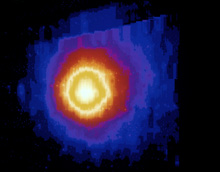
Halley's Comet studied by Pioneer-Venus spacecraft: The next two images show Comet Halley in Lyman Alpha light from hydrogen ions. These images were created from data collected by the Ultra-Violet Spectrometer on the Pioneer Venus Orbiter spacecraft during the days of February 2-6, 1986. During the six days, the spacecraft was maintained in a fixed attitude while the comet moved past, and the instrument scanned across the coma.
During the six days, telemetry data was collected from Deep Space Network (DSN) stations in Spain, Australia and California. The data was processed to assemble the scans into false color images where the lightest colors indicate the strongest signal.
These images show the cloud of hydrogen ions, which surrounded the comet during February 2-6. These images are actually a composite because different parts of the cloud were scanned each day, and also because individual ions moved from the nucleus to the edge in about four days. At the time that these images were acquired, the hydrogen coma was the largest object in the Solar System with a radius of about 0.1 Astronomical Unit. In ultra-violet light, the comet was the second brightest object in the Solar System (exceeded only by the Sun).
These images show asymmetry caused by radiation pressure from the Sun. Hydrogen ions initially leave the nucleus in all directions but eventually are deflected by radiation pressure and move away from the Sun. The size of the Hydrogen coma indicates that water was being evaporated from the nucleus at a rate of about 40 tons per second.
Snip
=============================================================
http://en.wikipedia.org/wiki/Comet_Halley
Comet Halley
From Wikipedia, the free encyclopedia
Comet Halley, officially designated 1P/Halley, more generally known as Halley's Comet after Edmond Halley, is a comet that can be seen every 75-76 years. It is the most famous of all periodic comets, even though in every century many comets appear brighter and more spectacular. Halley's comet last appeared in the inner Solar System in 1986, and will next appear in the summer of 2061.
The most standard pronunciation of "Halley" - and the pronunciation that the astronomer himself probably used - is [hæli] (IPA), to rhyme with "valley". The once-standard alternate pronunciation [heIli] (to rhyme with "Bailey") led to rock and roll singer Bill Haley naming his band Bill Haley and the Comets.
Snip
=============================================================
WHAT THE MIND CAN CONCEIVE, AND BELIEVE, IT WILL ACHIEVE - LRK
=============================================================
- LRK -
-------------------------------------------------------------
Giotto’s brief encounter
http://www.esa.int/esaCP/SEMSZ0NVGJE_index_0.html
Twenty years ago, in the night between 13 and 14 March 1986, ESA’s Giotto spacecraft encountered Comet Halley.
-------------------------------------------------------------
It came by in 1910 when my mom was born and she wanted to live to see it again. (95 now)
It comes by every 76 years or so and this time it wasn't the best view as it went by the Sun on the far side from us in 1986.
http://www.seds.org/nineplanets/nineplanets/halley.html
Where will you be in 2062 when it comes by again? :-)
O.K., what were you doing when it came by in 1986?
I was supporting the Pioneer missions at NASA Ames and we had Pioneer-Venus (Pioneer 12) going around Venus and it had just gone by the Sun on the far side from Earth. The project turned Pioneer-Venus so that it could view Comet Halley and gather information on its glow in the ultraviolet.
- LRK -
-------------------------------------------------------------
Small image
http://t2www.nasa.r3h.net/centers/ames/images/content/118550main_AC86-0107-5-m.jpg
Large image
http://t2www.nasa.r3h.net/centers/ames/images/content/118532main_AC86-0107-5.jpg
-------------------------------------------------------------
Well that was just one of many comets.
http://www.windows.ucar.edu/cgi-bin/tour_def/comets/comets.html
And now we have brought some of one back.
http://stardust.jpl.nasa.gov/home/index.html
Where do we go next? Ummm, if we don't cancel all the projects.
Thanks for looking up with me.
Larry Kellogg
Web Site: http://lkellogg.vttoth.com/LarryRussellKellogg/
BlogSpot: http://kelloggserialreports.blogspot.com/
RSS link: http://kelloggserialreports.blogspot.com/atom.xml
Newsltr.: https://news.altair.com/mailman/listinfo/lunar-update
=============================================================
http://www.esa.int/esaCP/SEMSZ0NVGJE_index_0.html
Giotto’s brief encounter
10 March 2006
Twenty years ago, in the night between 13 and 14 March 1986, ESA’s Giotto spacecraft encountered Comet Halley. It was ESA’s first deep space mission, and part of an ambitious international effort to solve the riddles surrounding this mysterious object.
The adventure began when Giotto was launched by an Ariane 1 rocket (flight V14) on 2 July 1985. After three revolutions around the Earth, the on-board motor was fired to inject it into an interplanetary orbit.
After a cruise of eight months and almost 150 million kilometres, the spacecraft’s instruments first detected hydrogen ions from Halley at a distance of 7.8 million kilometres from the comet on 12 March 1986.
Giotto encountered Comet Halley about one day later, when it crossed the bow shock of the solar wind (the region where a shock wave is created as the supersonic solar particles slow to subsonic speed). When Giotto entered the densest part of the dusty coma, the camera began tracking the brightest object (the nucleus) in its field of view.
Snip
=============================================================
http://www.seds.org/nineplanets/nineplanets/halley.html
Snip
The average period of Halley's orbit is 76 years but you cannot calculate the dates of its reappearances by simply subtracting multiples of 76 years from 1986. The gravitational pull of the major planets alters the orbital period from revolution to revolution. Nongravitational effects (such as the reaction from gasses boiled off during its passage near the Sun) also play an important, but smaller, role in altering the orbit. Between the years 239 BC and 1986 AD the orbital period has varied from 76.0 years (in 1986) to 79.3 years (in 451 and 1066). The closest perihelion passage to the time of Jesus are 11 BC and 66 AD; neither event took place in Jesus' lifetime. Its most famous appearance was in 1066 when it was seen at the Battle of Hastings, an event commemorated in the Bayeux Tapestry.
Comet Halley was visible in 1910 and again in 1986. Its next perihelion passage will be in early 2062.
Snip
=============================================================
http://www.nasa.gov/centers/ames/multimedia/images/2005/comets1.html
Snip
Halley's Comet studied by Pioneer-Venus spacecraft: The next two images show Comet Halley in Lyman Alpha light from hydrogen ions. These images were created from data collected by the Ultra-Violet Spectrometer on the Pioneer Venus Orbiter spacecraft during the days of February 2-6, 1986. During the six days, the spacecraft was maintained in a fixed attitude while the comet moved past, and the instrument scanned across the coma.
During the six days, telemetry data was collected from Deep Space Network (DSN) stations in Spain, Australia and California. The data was processed to assemble the scans into false color images where the lightest colors indicate the strongest signal.
These images show the cloud of hydrogen ions, which surrounded the comet during February 2-6. These images are actually a composite because different parts of the cloud were scanned each day, and also because individual ions moved from the nucleus to the edge in about four days. At the time that these images were acquired, the hydrogen coma was the largest object in the Solar System with a radius of about 0.1 Astronomical Unit. In ultra-violet light, the comet was the second brightest object in the Solar System (exceeded only by the Sun).
These images show asymmetry caused by radiation pressure from the Sun. Hydrogen ions initially leave the nucleus in all directions but eventually are deflected by radiation pressure and move away from the Sun. The size of the Hydrogen coma indicates that water was being evaporated from the nucleus at a rate of about 40 tons per second.
Snip
=============================================================
http://en.wikipedia.org/wiki/Comet_Halley
Comet Halley
From Wikipedia, the free encyclopedia
Comet Halley, officially designated 1P/Halley, more generally known as Halley's Comet after Edmond Halley, is a comet that can be seen every 75-76 years. It is the most famous of all periodic comets, even though in every century many comets appear brighter and more spectacular. Halley's comet last appeared in the inner Solar System in 1986, and will next appear in the summer of 2061.
The most standard pronunciation of "Halley" - and the pronunciation that the astronomer himself probably used - is [hæli] (IPA), to rhyme with "valley". The once-standard alternate pronunciation [heIli] (to rhyme with "Bailey") led to rock and roll singer Bill Haley naming his band Bill Haley and the Comets.
Snip
=============================================================
WHAT THE MIND CAN CONCEIVE, AND BELIEVE, IT WILL ACHIEVE - LRK
=============================================================
Subscribe to:
Posts (Atom)