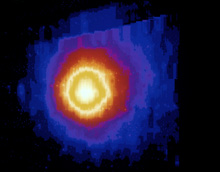
Good day - Radio "amateurs" detect Voyager 1 signal
Thanks for the heads up from Larry Klaes.
Speak about being able for Amateur Radio Hams to bounce signals off the Moon and thinking how nice it would be for them to be able to listen to activities there, and today see that they have tracked Voyager 1 on March 31.
I suppose if you are going to command and listen to a satellite to go to Mars, AMSAT P5-A, the Moon would be a snap.
Have some links below about the AMSAT-DL / IUZ team.
Maybe when we go back to the Moon and there is more interest in the daily happenings, we will have an Amateur Radio team listening in and putting the daily news on the Internet for us all to view.
- LRK -
Thanks for looking up.
Larry Kellogg
Web Site: http://lkellogg.vttoth.com/LarryRussellKellogg/
BlogSpot: http://kelloggserialreports.blogspot.com/
RSS link: http://kelloggserialreports.blogspot.com/atom.xml
Newsltr.: https://news.altair.com/mailman/listinfo/lunar-update
=============================================================
http://www.southgatearc.org/news/april2006/voyager1.htm
[Reported by the Southgate Amateur Radio Club. - LRK -]
VOYAGER 1 received by AMSAT-DL group
Space probe VOYAGER 1 successfully received
On March 31st, 2006 an AMSAT-DL / IUZ team received the American space probe VOYAGER 1 with the 20m antenna in Bochum.
The distance was 14.7 billion km.
This is a new record for AMSAT-DL and IUZ Bochum.
The received signal was clearly identified through means of doppler shift and position in the sky. The receive frequency was exactly measured and compared with the information provided by NASA.
This distance equals approximately 98 times the distance between Earth and Sun. VOYAGER 1 is the most distant object ever built by mankind. This again proves the superior performance of the Bochum antenna. Most probably this is the first time Voyager 1 has been received by radio amateurs.
VOYAGER 1 was launched on 5. September 1977 by NASA. It transmitted the first close-up pictures of Jupiter and Saturn. In 2004 VOYAGER 1 passed the Termination Shock Region, where the solar wind mixes with interstellar gas.
VOYAGER 1 today is still active, measuring the interstellar magnetic field.
The following radio amateurs were involved:
Freddy de Guchteneire, ON6UG
James Miller, G3RUH
Hartmut Paesler, DL1YDD
Achim Vollhardt, DH2VA/HB9DUN
Special thanks to Thilo Elsner, DJ5YM of the IUZ Bochum, Roger Ludwig of Jet Propulsion Laboratory (JPL), Pasadena USA and the Deep Space Network Tracking Station in Madrid, Spain for their cooperation.
For more information please visit
http://voyager.jpl.nasa.gov
http://www.amsat-dl.org/cms , under "News"
=============================================================
http://www.amsat-dl.org/cms/
http://www.amsat-dl.org/cms/index.php?option=com_content&task=blogcategory&id=35&Itemid=97
http://www.amsat-dl.org/cms/index.php?option=com_content&task=view&id=62&Itemid=97
Raumsonde VOYAGER 1 von Funkamateuren empfangen
Geschrieben von Hartmut Päsler
Freitag, 31 März 2006
Am 31. März 2006 ist es dem AMSAT-DL/IUZ-Team erstmalig gelungen, die amerikanische Raumsonde VOYAGER 1 mit der Anlage in Bochum zu empfangen. Die überbrückte Entfernung betrug hierbei 14.7 Milliarden km und stellt einen neuen Rekord fuer AMSAT-DL und das IUZ Bochum auf. Das empfangene Signal wurde eindeutig durch die Dopplerverschiebung und durch die Position am Himmel identifiziert. Weiterhin wurde die Empfangsfrequenz mittels eines Rubidium-Frequenznormals vermessen und mit den Angaben der NASA verglichen.
-------------------
Google translation - LRK - http://translate.google.com/translate_t
Space probe VOYAGER 1 received from radio amateurs written of Hartmut Paesler Friday, 31 March 2006 on 31 March 2006 succeeded it to the AMSAT DL/IUZ team for the first time to receive the American space probe VOYAGER 1 with the plant in Bochum. The bridged distance amounted to here 14,7 billion km and sets up a new record for Amsat DL and the IUZ Bochum. The received signal was identified clearly by the Doppler shift and by the position in the sky. Further the empfangsfrequenz was measured by means of Rubidium-Frequenznormals and compared with the data of NASA.
=============================================================
http://www.amsat-dl.org/go-mars/html/bochum1.html
P5A-Leitstation in Bochum
bestand Feuertaufe
An der Sternwarte Bochum (IUZ) steht der unter einem Radom geschützte 20-m-Parabolspiegel der für die P5A-Mission als zentrale Bodenstation dienen soll. AMSAT-DL hat die restaurierte Anlage mit der für Deep-Space-Missionen nötigen Steuerungs- und Hochfrequenztechnik ausgestattet. Die Bochumer Antenne war bei der Ankunft von Mars-Express und BEAGLE2-Lander zu Weihnachten 2003 live dabei. Sie konnte bereits über 1 Milliarde km entfernte Signale der Cassini-Saturnsonde empfangen.
Snip
-------------------
Google translation - LRK -
P5A control station in Bochum existed fire baptism at the observatory Bochum
(IUZ) stands the 20-m-Parabolspiegel protected under a radome for the P5A mission as central ground station to serve is. Amsat DL equipped the restored plant with the control and high-frequency engineering necessary for Deep space missions. The Bochumer antenna participated 2003 live with the arrival from Mars express and BEAGLE2-Lander to Christmas. It could already receive over 1 billion km distant signals of the Cassini Saturnsonde.
Snip
=============================================================
The P5A mission.
Your German is probably better than mine or Google's. - LRK -
-------------------------------------------------------------
http://www.amsat-dl.org/go-mars/html/p5a-marsmission.html
Snip
Nach diesen Vorarbeiten hat der Vorstand der AMSAT-Deutschland das formelle GO im Jahr 2002 für die Mission zum Mars gegeben und erste Mittel für das Projekt freigegeben. Da diese das erste interplanetare AMSAT-Projekt ist, erhielt es in der so genannten Phase 5 die vorläufige Projektbezeichnung AMSAT-Phase 5A oder kurz P5A. In einem der Startfenster 2007 oder 2009 soll P5A seine mehrmonatige Reise antreten.
Snip
-----------------------
Snip
After this pre-working the executive committee gave to that AMSAT Germany the formal GO in the year 2002 for the mission to Mars and released first means for the project. Since this is the first interplanetary AMSAT project, it kept the provisional project designation AMSAT phase 5A or P5A short in the phase in such a way specified 5. In one of the starting windows 2007 or 2009 P5A is to begin its mehrmonatige journey.
Snip
=============================================================
WHAT THE MIND CAN CONCEIVE, AND BELIEVE, IT WILL ACHIEVE - LRK
=============================================================
Monday, April 03, 2006


Sunday, April 02, 2006
Good day, Lunar Resource Utilization, practice here, now.
Back in 1957, I suggested in my chemistry class that Porta-Potties should pay you by the pound for their use. I was booed, the idea of finding a profitable use for human excrement didn't seem like something they thought would be useful. Somehow plastics from poop wasn't their thing. I probably would have been sued for patent infringement also.
It is now 2006 and we still haven't mastered the technique of recycling what we use on the International Space Station. We also blame farm animals for contributing to global warming by contributing to the generation of methane gas. Land fills leak gases that smell and burn. Some are collecting this gas and burning it to create steam for electric power generation but not enough.
Let us hope that there are studies going on in our colleges and don't forget to do your patent search as others have already obtained patents and will probably want their royalties should you decide to make something useful on the Moon or Mars.
- LRK -
Shall we look more at what will be required to live on the Moon?
Maybe we will find some things useful for here on Earth as well.
Thanks for looking up.
Larry Kellogg
Web Site: http://lkellogg.vttoth.com/LarryRussellKellogg/
BlogSpot: http://kelloggserialreports.blogspot.com/
RSS link: http://kelloggserialreports.blogspot.com/atom.xml
Newsltr.: https://news.altair.com/mailman/listinfo/lunar-update
=============================================================
http://aerospacescholars.jsc.nasa.gov/HAS/cirr/em/6/6.cfm
"Engineering is the professional art of applying science to the optimum conversion of natural resources to the benefit of man."
-Ralph J. Smith (1962)
Resource utilization will play an important role in the establishment and support of a permanently manned lunar base. The identification of new and innovative technologies will insure the success, sustainability and growth of a future lunar base. These new technologies will certainly utilize lunar resources. Lunar resources can be used to supply replenishables such as oxygen, fuel, water and construction materials. These materials would otherwise have to be brought from Earth at considerable expense.
Lunar resources include oxygen from the lunar soil, water from the poles and a supply of volatile gases. One of the most significant steps towards self-sufficiency and independence from the Earth will be the use of lunar materials for construction.
At least seven major potential lunar construction materials have been identified. These include:
* concrete
* sulfur concrete
* cast basalt
* sintered basalt
* fiberglass
* cast glass
* metals
All of these materials may be used to construct a future lunar base. The basalt materials can be formed out of lunar regolith (soil) by a simple process of heating and cooling, and are the most likely to be used to build the first bases.
Snip
=============================================================
http://www.nas.nasa.gov/About/Education/SpaceSettlement/
http://www.belmont.k12.ca.us/ralston/programs/itech/SpaceSettlement/index.html
http://www.nas.nasa.gov/About/Education/SpaceSettlement/spaceres/index.html
http://www.nas.nasa.gov/About/Education/SpaceSettlement/spaceres/toc.html
Table of Contents
* Preface
* List of Participants
I RESEARCH NEEDS FOR REGENERATIVE LIFE-SUPPORT SYSTEMS
http://www.nas.nasa.gov/About/Education/SpaceSettlement/spaceres/I-1.html
* I-1 Systems Engineering Overview for Regenerative Life-Support Systems
Applicable to Space Habitats. Jack Spurlock and Mike Modell
* References
* I-2 Research Planning Criteria for Regenerative Life-Support Systems
Applicable to Space Habitats. Jack Spurlong, William Cooper,Paul Deal,
Annita Harlan, Marcus Karel, Michael Modell, Paul Moe, John Phillips, David
Putnam, Philip Quattrone, C. David Raper, Jr., Elliot Swan, Frieda Taub,
Judith Thomas, Christine Wilson, and Ben Zeitman
* References
Snip
=============================================================
http://www.belmont.k12.ca.us/ralston/programs/itech/SpaceSettlement/spaceresvol3/toc.html
NASA SP-509, vol. 3
SPACE
RESOURCES
Materials
http://www.belmont.k12.ca.us/ralston/programs/itech/SpaceSettlement/spaceres
vol4/toc.html
NASA SP-509, vol. 4
SPACE
RESOURCES
Social Concerns
=============================================================
http://stl.ame.arizona.edu/~jeffb/projects/solidoxide.html
Introduction
One of the main projects at the Space Technologies Laboratory is oxygen
production. Oxygen production is done through an electrochemical cell made
from Zirconia. At elevated temperatures (T>1000 C) Zirconia is an excellent
oxygen ion conductor. In the prescence of an applied potential the
electrolyte will pump oxygen from the cathode to anode.
Snip
[Back in 1996 - What is going on now? - LRK -]
http://stl.ame.arizona.edu/~jeffb/projects/lunarlander.html
Background
This is a quarter-scale model of a lunar-lander, designed and initially
constructed by the spacecraft design class. It features robotic motion
controlled by an on-board processor.
The purpose of this model is to show how an ISRU (In Situ Resource
Utilization) payload can function atop a lunar lander platform. The payload
designed here was designed for the Artemis common lunar lander.
The mission of the payload is to be a proof-of-concept for oxygen production
on the moon. The objective of this payload is to produce oxygen from lunar
soil, using techniques developed here at the University of Arizona .
The process is as follows:
1. The arm acquires a soil sample from around the lander.
2. The arm raises. As it does, the lunar regolith transverses down
through the hollow arm, into the hopper.
3. The soil sample is deposited into a crucible. Ten soil samples are
taken in all.
4. Earth-carried carbon is mixed in with each soil sample.
5. The sample (in crucible) is raised into a solar furnace. The solar
furnace consists of a primary concentrating mirror, iris, and cpc.
6. As the sample is heated, it releases carbon monoxide. This carbon
monoxide is disproportionated into carbon dioxide. From the carbon dioxide,
a solid-oxide electrolysis process is used to convert the carbon dioxide
into oxygen.
7. The oxygen is detected by an oxygen detector.
This model depicts only a proof-of-concept device. A cheap proof-of-concept
mission needs to occur to demonstrate the ability of the technolgy to
provide for the needs of the mission. After a successful proof-of-concept,
the funds for a full oxygen-prod uction facility could be secured and a
complete mission planned. A complete mission may be an oxygen production
faciliry for a lunar base or Martian outpost.
=============================================================
http://sbir.nasa.gov/SBIR/abstracts/05/sbir/phase1/SBIR-05-1-X9.01-8819.html?solicitationId=SBIR_05_P1
NASA SBIR 2005 Solicitation
FORM B - PROPOSAL SUMMARY
PROPOSAL NUMBER: 05 X9.01-8819
SUBTOPIC TITLE: In-Situ Resource Utilization & Space Manufacturing
PROPOSAL TITLE: In Situ Oxygen Production from Lunar and Martian Regolith
SMALL BUSINESS CONCERN (Firm Name, Mail Address, City/State/Zip, Phone)
Lynntech, Inc.
7607 Eastmark Drive, Suite 102
College Station ,TX 77840 - 4027
(979) 693 - 0017
PRINCIPAL INVESTIGATOR/PROJECT MANAGER (Name, E-mail, Mail Address,
City/State/Zip, Phone)
Brian Hennings
brian.hennings@lynntech.com
7607 Eastmark Drive, Suite 102
College Station, TX 77840 -4027
(979) 693 - 0017
TECHNICAL ABSTRACT (LIMIT 200 WORDS)
In situ oxygen production is of immense importance to NASA in the support of
the NASA initiative to sustain man's permanent presence in space. The oxygen
produced can be used as breathable oxygen, as a source of fuel for Moon or
Mars based vehicles (for either return to Earth or as a basis for further
space exploration), or as a source of oxygen for fuel cell or other power
generating devices. Lynntech proposes to use plasma technology to liberate
the oxygen bound in the oxides of regolith to produce oxygen in situ on
either the moon or Mars. Lynntech's innovative solid feedstock plasma
reformer is simple, robust and unaffected by variations in the composition
or particle size of the regolith. Lynntech has previously demonstrated the
principle of plasma reformation on a variety of projects and has preliminary
results demonstrating the technology proposed here. Lynntech is currently
developing plasma reformers for the US Air Force capable of producing
several SCFM of hydrogen from JP-8 as well as multi-fuel (gas/liquid)
capable reformers. A small (< 10W) plasma reformer has also been
demonstrated for the production of hydrogen on Titan for NASA.
POTENTIAL NASA COMMERCIAL APPLICATIONS (LIMIT 150 WORDS)
With little or no modification, Lynntech's plasma-based oxygen generation
system could be used to produce oxygen from the Martian atmosphere. The
atmosphere on Mars consists largely of CO2 (~95%) and is saturated with
dust. Preliminary experiments with a Lynntech reformer indicate that CO2 can
be reformed to solid carbon and gaseous O2. The dust in the atmosphere does
not harm our system; rather it contributes to the oxygen content of the
product stream, as it is broken down into constituents, similar to the CO2.
Another NASA application for a space-bound plasma system is in the
production of hydrogen from hydrocarbon rich atmospheres (such as the
methane saturated Saturn moon, Titan), either for buoyancy, power or
propulsion. Lynntech has already successfully demonstrated a 10-Watt methane
reformer that produces hydrogen from 100K to 300K and weighs less than 500g
for the production of make-up hydrogen for a balloon operating on Titan.
POTENTIAL NON-NASA COMMERCIAL APPLICATIONS (LIMIT 150 WORDS)
The plasma-based system can also be used in several ground-based, non-NASA
commercial applications as well. One of these is solid waste processing.
With only small modifications, the plasma system proposed could be used to
reform solid waste into high value components (i.e. hydrogen and carbon for
most hydrocarbon chains, such as plastics and organics). The high value
constituents are contingent upon the feedstock, and thus are as diverse.
Alternatively, the plasma system could be used to process liquid or gaseous
waste streams also. One particularly attractive area is the reformation of
used and dirty hydrocarbon wastes from automobiles. These wastes include
motor oil, greases, transmission and brake fluids, which can be reformed
into products such as hydrogen and nano-structured carbon materials. The
process is immune to changes in the feedstock, and mixtures of hydrocarbons
can be fed directly to produce a 90+% hydrogen stream prior to clean-up.
NASA's technology taxonomy has been developed by the SBIR-STTR program to
disseminate awareness of proposed and awarded R/R&D in the agency. It is a
listing of over 100 technologies, sorted into broad categories, of interest
to NASA.
TECHNOLOGY TAXONOMY MAPPING
In-situ Resource Utilization
Form Printed on 09-19-05 13:12
=============================================================
http://www.tsgc.utexas.edu/tadp/1995/spects/o2.html
Lunar Oxygen Production Plant: Specification Sheet
Olivier Dubois-Matra
polard@mail.utexas.edu
August 1995
Foreword
The purpose of the Oxygen Production Demonstration Plant (O2 plant) is to
test in-situ one or two process(es) of oxygen production from lunar minerals
in order to prove the possibility of large-scale production for a manned
base (fuel and life support). Several processes are under study, and some of
them are currently adapted for lunar environment [Gibson & all]. However,
there exists no plan yet for a small, automated demonstration plant which
could be the payload of a small lander. Therefore, considerable work remains
to be done to design this device. The following figures are only a first
rough estimation based on laboratory experiments. Accurate figures would
required a complete design.
The processes considered here are based on the reduction of ilmenite at high
temperature. Ilmenite (FeTiO3) is a common mineral in the lunar soil, and is
the most likely source of lunar oxygen [Allen & all]. Other potential
feedstocks are volcanic glass and basalt. The ilmenite can be reduced either
by hydrogen [Gibson & all] or by carbon [Ramohalli & all]. The respective
reactions are :
FeTiO3 + H2 ---> Fe + TiO2 + H2O
H2O ---> H2 + 1/2 O2
FeTiO3 + C ---> Fe + TiO2 + CO
CO ---> C + 1/2 O2
Since we got relatively few information on the carbon process, figures
are given only for a H2-type plant. The reasons for the selection of
ilmenite reduction can be found in the WORLD-M proposal. Other processes may
be contemplate.
Objectives
Snip
=============================================================
http://www.freepatentsonline.com/5536378.html
Apparatus for manufacture of oxygen from lunar ilmenite
Document: United States Patent 5536378
Abstract: A reactor apparatus for production of Lunar oxygen uses feed
stocks comprising a particulate hydrogen-reducible enriched feed in the size
range from about 20-200 microns, containing 80-90% Lunar ilmenite
(FeTiO.sub.3) and ferrous Lunar agglutinates. The reactor apparatus has
three vertically spaced fluidized zones with downcomers from the upper to
the central fluidized zone and openings for introducing a
hydrogen-containing gas stream through the lower fluidized zone. A
solid-to-gas RF-dielectric heater has a ceramic honeycomb with small
parallel channels separated by thin, ceramic walls and electrodes
surrounding the honeycomb connected to an external RF power source for
heating the gas stream to a reducing reaction temperature. A top inlet
introduces the enriched feed into the upper fluidized zone for fluidization
therein and flow into middle and lower fluidized zones countercurrent to the
flow of the gas stream. A solid-state electrolyzer is composed of calcium
oxide- or yttrium oxide-stabilized zirconia ceramic fabricated by sintering
or slipcasting into a perforated cylindrical shape having platinum
electrodes on outer and inner longitudinal surfaces thereof. The
electrolyzer cylinder is mounted inside two disk-shaped, impermeable ceramic
baffles and centered inside a refractory-lined metal pressure shell. Gaseous
effluent containing an equilibrium amount of water from the central
fluidized zone passes through the electrolyzer for continuous electrolysis
of the water. Apparatus is provided for separating oxygen from the
electrolyzer and recycling hydrogen to the gas stream.
=============================================================
http://www.fsri.org/Grant%20Process%20Chart/Colorado%20School%20of%20Mines%20ISRU%20Design.pdf 58 page PDF file. 2.6 MB
Lunar Oxygen Production Detailed Design Review
Colorado School of Mines Lunar Exploration Team
Colorado School of Mines
1523 Illinois St
Golden, CO 80401
=============================================================
WHAT THE MIND CAN CONCEIVE, AND BELIEVE, IT WILL ACHIEVE - LRK
=============================================================
Back in 1957, I suggested in my chemistry class that Porta-Potties should pay you by the pound for their use. I was booed, the idea of finding a profitable use for human excrement didn't seem like something they thought would be useful. Somehow plastics from poop wasn't their thing. I probably would have been sued for patent infringement also.
It is now 2006 and we still haven't mastered the technique of recycling what we use on the International Space Station. We also blame farm animals for contributing to global warming by contributing to the generation of methane gas. Land fills leak gases that smell and burn. Some are collecting this gas and burning it to create steam for electric power generation but not enough.
Let us hope that there are studies going on in our colleges and don't forget to do your patent search as others have already obtained patents and will probably want their royalties should you decide to make something useful on the Moon or Mars.
- LRK -
Shall we look more at what will be required to live on the Moon?
Maybe we will find some things useful for here on Earth as well.
Thanks for looking up.
Larry Kellogg
Web Site: http://lkellogg.vttoth.com/LarryRussellKellogg/
BlogSpot: http://kelloggserialreports.blogspot.com/
RSS link: http://kelloggserialreports.blogspot.com/atom.xml
Newsltr.: https://news.altair.com/mailman/listinfo/lunar-update
=============================================================
http://aerospacescholars.jsc.nasa.gov/HAS/cirr/em/6/6.cfm
"Engineering is the professional art of applying science to the optimum conversion of natural resources to the benefit of man."
-Ralph J. Smith (1962)
Resource utilization will play an important role in the establishment and support of a permanently manned lunar base. The identification of new and innovative technologies will insure the success, sustainability and growth of a future lunar base. These new technologies will certainly utilize lunar resources. Lunar resources can be used to supply replenishables such as oxygen, fuel, water and construction materials. These materials would otherwise have to be brought from Earth at considerable expense.
Lunar resources include oxygen from the lunar soil, water from the poles and a supply of volatile gases. One of the most significant steps towards self-sufficiency and independence from the Earth will be the use of lunar materials for construction.
At least seven major potential lunar construction materials have been identified. These include:
* concrete
* sulfur concrete
* cast basalt
* sintered basalt
* fiberglass
* cast glass
* metals
All of these materials may be used to construct a future lunar base. The basalt materials can be formed out of lunar regolith (soil) by a simple process of heating and cooling, and are the most likely to be used to build the first bases.
Snip
=============================================================
http://www.nas.nasa.gov/About/Education/SpaceSettlement/
http://www.belmont.k12.ca.us/ralston/programs/itech/SpaceSettlement/index.html
http://www.nas.nasa.gov/About/Education/SpaceSettlement/spaceres/index.html
http://www.nas.nasa.gov/About/Education/SpaceSettlement/spaceres/toc.html
Table of Contents
* Preface
* List of Participants
I RESEARCH NEEDS FOR REGENERATIVE LIFE-SUPPORT SYSTEMS
http://www.nas.nasa.gov/About/Education/SpaceSettlement/spaceres/I-1.html
* I-1 Systems Engineering Overview for Regenerative Life-Support Systems
Applicable to Space Habitats. Jack Spurlock and Mike Modell
* References
* I-2 Research Planning Criteria for Regenerative Life-Support Systems
Applicable to Space Habitats. Jack Spurlong, William Cooper,Paul Deal,
Annita Harlan, Marcus Karel, Michael Modell, Paul Moe, John Phillips, David
Putnam, Philip Quattrone, C. David Raper, Jr., Elliot Swan, Frieda Taub,
Judith Thomas, Christine Wilson, and Ben Zeitman
* References
Snip
=============================================================
http://www.belmont.k12.ca.us/ralston/programs/itech/SpaceSettlement/spaceresvol3/toc.html
NASA SP-509, vol. 3
SPACE
RESOURCES
Materials
http://www.belmont.k12.ca.us/ralston/programs/itech/SpaceSettlement/spaceres
vol4/toc.html
NASA SP-509, vol. 4
SPACE
RESOURCES
Social Concerns
=============================================================
http://stl.ame.arizona.edu/~jeffb/projects/solidoxide.html
Introduction
One of the main projects at the Space Technologies Laboratory is oxygen
production. Oxygen production is done through an electrochemical cell made
from Zirconia. At elevated temperatures (T>1000 C) Zirconia is an excellent
oxygen ion conductor. In the prescence of an applied potential the
electrolyte will pump oxygen from the cathode to anode.
Snip
[Back in 1996 - What is going on now? - LRK -]
http://stl.ame.arizona.edu/~jeffb/projects/lunarlander.html
Background
This is a quarter-scale model of a lunar-lander, designed and initially
constructed by the spacecraft design class. It features robotic motion
controlled by an on-board processor.
The purpose of this model is to show how an ISRU (In Situ Resource
Utilization) payload can function atop a lunar lander platform. The payload
designed here was designed for the Artemis common lunar lander.
The mission of the payload is to be a proof-of-concept for oxygen production
on the moon. The objective of this payload is to produce oxygen from lunar
soil, using techniques developed here at the University of Arizona .
The process is as follows:
1. The arm acquires a soil sample from around the lander.
2. The arm raises. As it does, the lunar regolith transverses down
through the hollow arm, into the hopper.
3. The soil sample is deposited into a crucible. Ten soil samples are
taken in all.
4. Earth-carried carbon is mixed in with each soil sample.
5. The sample (in crucible) is raised into a solar furnace. The solar
furnace consists of a primary concentrating mirror, iris, and cpc.
6. As the sample is heated, it releases carbon monoxide. This carbon
monoxide is disproportionated into carbon dioxide. From the carbon dioxide,
a solid-oxide electrolysis process is used to convert the carbon dioxide
into oxygen.
7. The oxygen is detected by an oxygen detector.
This model depicts only a proof-of-concept device. A cheap proof-of-concept
mission needs to occur to demonstrate the ability of the technolgy to
provide for the needs of the mission. After a successful proof-of-concept,
the funds for a full oxygen-prod uction facility could be secured and a
complete mission planned. A complete mission may be an oxygen production
faciliry for a lunar base or Martian outpost.
=============================================================
http://sbir.nasa.gov/SBIR/abstracts/05/sbir/phase1/SBIR-05-1-X9.01-8819.html?solicitationId=SBIR_05_P1
NASA SBIR 2005 Solicitation
FORM B - PROPOSAL SUMMARY
PROPOSAL NUMBER: 05 X9.01-8819
SUBTOPIC TITLE: In-Situ Resource Utilization & Space Manufacturing
PROPOSAL TITLE: In Situ Oxygen Production from Lunar and Martian Regolith
SMALL BUSINESS CONCERN (Firm Name, Mail Address, City/State/Zip, Phone)
Lynntech, Inc.
7607 Eastmark Drive, Suite 102
College Station ,TX 77840 - 4027
(979) 693 - 0017
PRINCIPAL INVESTIGATOR/PROJECT MANAGER (Name, E-mail, Mail Address,
City/State/Zip, Phone)
Brian Hennings
brian.hennings@lynntech.com
7607 Eastmark Drive, Suite 102
College Station, TX 77840 -4027
(979) 693 - 0017
TECHNICAL ABSTRACT (LIMIT 200 WORDS)
In situ oxygen production is of immense importance to NASA in the support of
the NASA initiative to sustain man's permanent presence in space. The oxygen
produced can be used as breathable oxygen, as a source of fuel for Moon or
Mars based vehicles (for either return to Earth or as a basis for further
space exploration), or as a source of oxygen for fuel cell or other power
generating devices. Lynntech proposes to use plasma technology to liberate
the oxygen bound in the oxides of regolith to produce oxygen in situ on
either the moon or Mars. Lynntech's innovative solid feedstock plasma
reformer is simple, robust and unaffected by variations in the composition
or particle size of the regolith. Lynntech has previously demonstrated the
principle of plasma reformation on a variety of projects and has preliminary
results demonstrating the technology proposed here. Lynntech is currently
developing plasma reformers for the US Air Force capable of producing
several SCFM of hydrogen from JP-8 as well as multi-fuel (gas/liquid)
capable reformers. A small (< 10W) plasma reformer has also been
demonstrated for the production of hydrogen on Titan for NASA.
POTENTIAL NASA COMMERCIAL APPLICATIONS (LIMIT 150 WORDS)
With little or no modification, Lynntech's plasma-based oxygen generation
system could be used to produce oxygen from the Martian atmosphere. The
atmosphere on Mars consists largely of CO2 (~95%) and is saturated with
dust. Preliminary experiments with a Lynntech reformer indicate that CO2 can
be reformed to solid carbon and gaseous O2. The dust in the atmosphere does
not harm our system; rather it contributes to the oxygen content of the
product stream, as it is broken down into constituents, similar to the CO2.
Another NASA application for a space-bound plasma system is in the
production of hydrogen from hydrocarbon rich atmospheres (such as the
methane saturated Saturn moon, Titan), either for buoyancy, power or
propulsion. Lynntech has already successfully demonstrated a 10-Watt methane
reformer that produces hydrogen from 100K to 300K and weighs less than 500g
for the production of make-up hydrogen for a balloon operating on Titan.
POTENTIAL NON-NASA COMMERCIAL APPLICATIONS (LIMIT 150 WORDS)
The plasma-based system can also be used in several ground-based, non-NASA
commercial applications as well. One of these is solid waste processing.
With only small modifications, the plasma system proposed could be used to
reform solid waste into high value components (i.e. hydrogen and carbon for
most hydrocarbon chains, such as plastics and organics). The high value
constituents are contingent upon the feedstock, and thus are as diverse.
Alternatively, the plasma system could be used to process liquid or gaseous
waste streams also. One particularly attractive area is the reformation of
used and dirty hydrocarbon wastes from automobiles. These wastes include
motor oil, greases, transmission and brake fluids, which can be reformed
into products such as hydrogen and nano-structured carbon materials. The
process is immune to changes in the feedstock, and mixtures of hydrocarbons
can be fed directly to produce a 90+% hydrogen stream prior to clean-up.
NASA's technology taxonomy has been developed by the SBIR-STTR program to
disseminate awareness of proposed and awarded R/R&D in the agency. It is a
listing of over 100 technologies, sorted into broad categories, of interest
to NASA.
TECHNOLOGY TAXONOMY MAPPING
In-situ Resource Utilization
Form Printed on 09-19-05 13:12
=============================================================
http://www.tsgc.utexas.edu/tadp/1995/spects/o2.html
Lunar Oxygen Production Plant: Specification Sheet
Olivier Dubois-Matra
polard@mail.utexas.edu
August 1995
Foreword
The purpose of the Oxygen Production Demonstration Plant (O2 plant) is to
test in-situ one or two process(es) of oxygen production from lunar minerals
in order to prove the possibility of large-scale production for a manned
base (fuel and life support). Several processes are under study, and some of
them are currently adapted for lunar environment [Gibson & all]. However,
there exists no plan yet for a small, automated demonstration plant which
could be the payload of a small lander. Therefore, considerable work remains
to be done to design this device. The following figures are only a first
rough estimation based on laboratory experiments. Accurate figures would
required a complete design.
The processes considered here are based on the reduction of ilmenite at high
temperature. Ilmenite (FeTiO3) is a common mineral in the lunar soil, and is
the most likely source of lunar oxygen [Allen & all]. Other potential
feedstocks are volcanic glass and basalt. The ilmenite can be reduced either
by hydrogen [Gibson & all] or by carbon [Ramohalli & all]. The respective
reactions are :
FeTiO3 + H2 ---> Fe + TiO2 + H2O
H2O ---> H2 + 1/2 O2
FeTiO3 + C ---> Fe + TiO2 + CO
CO ---> C + 1/2 O2
Since we got relatively few information on the carbon process, figures
are given only for a H2-type plant. The reasons for the selection of
ilmenite reduction can be found in the WORLD-M proposal. Other processes may
be contemplate.
Objectives
Snip
=============================================================
http://www.freepatentsonline.com/5536378.html
Apparatus for manufacture of oxygen from lunar ilmenite
Document: United States Patent 5536378
Abstract: A reactor apparatus for production of Lunar oxygen uses feed
stocks comprising a particulate hydrogen-reducible enriched feed in the size
range from about 20-200 microns, containing 80-90% Lunar ilmenite
(FeTiO.sub.3) and ferrous Lunar agglutinates. The reactor apparatus has
three vertically spaced fluidized zones with downcomers from the upper to
the central fluidized zone and openings for introducing a
hydrogen-containing gas stream through the lower fluidized zone. A
solid-to-gas RF-dielectric heater has a ceramic honeycomb with small
parallel channels separated by thin, ceramic walls and electrodes
surrounding the honeycomb connected to an external RF power source for
heating the gas stream to a reducing reaction temperature. A top inlet
introduces the enriched feed into the upper fluidized zone for fluidization
therein and flow into middle and lower fluidized zones countercurrent to the
flow of the gas stream. A solid-state electrolyzer is composed of calcium
oxide- or yttrium oxide-stabilized zirconia ceramic fabricated by sintering
or slipcasting into a perforated cylindrical shape having platinum
electrodes on outer and inner longitudinal surfaces thereof. The
electrolyzer cylinder is mounted inside two disk-shaped, impermeable ceramic
baffles and centered inside a refractory-lined metal pressure shell. Gaseous
effluent containing an equilibrium amount of water from the central
fluidized zone passes through the electrolyzer for continuous electrolysis
of the water. Apparatus is provided for separating oxygen from the
electrolyzer and recycling hydrogen to the gas stream.
=============================================================
http://www.fsri.org/Grant%20Process%20Chart/Colorado%20School%20of%20Mines%20ISRU%20Design.pdf 58 page PDF file. 2.6 MB
Lunar Oxygen Production Detailed Design Review
Colorado School of Mines Lunar Exploration Team
Colorado School of Mines
1523 Illinois St
Golden, CO 80401
=============================================================
WHAT THE MIND CAN CONCEIVE, AND BELIEVE, IT WILL ACHIEVE - LRK
=============================================================
Saturday, April 01, 2006
Good evening. Forty Years of Space Talk
To communicate or not to communicate that is the question.
The article copied is about 40 years of the DSN.
The Deep Space Network, here is to looking up.
If you ever care to look back at the planning for the Interplanetary Network, the monthly reports are on-line.
- LRK -
------------------------------------------------------------
http://tmo.jpl.nasa.gov/index.cfm
The Interplanetary Network Progress Report, published on activities of the Interplanetary Network Directorate (IND) in planning, research, technology development, implementation, and operations in the areas of network, communications, navigation, information systems, Deep Space Network (DSN) science, mission support, communication standards, protocols, and spectrum engineering. Tasks funded by the JPL Director's Research Discretionary Fund, the Research & Technology Development Fund, and other programs that involve the IND also are included.
------------------------------------------------------------
http://tmo.jpl.nasa.gov/ipn_progress_report/issues.cfm?force_external=0
PAST ISSUES
Past issues of this publication, which has been published under four different titles, can be accessed electronically from this page. From February 1971 through April 1980, the publication was entitled The Deep Space Network Progress Report. Then from June 1980 (issue 42-57) through February 1998 (issue 42-132), it was published as The Telecommunications and Data Acquisition Progress Report. Beginning in May 1998 (issue 42-133) and ending in May 2001 (issue 42-145), the publication was The Telecommunications and Mission Operations Progress Report. The publication was retitled The Interplanetary Network Progress Report in August 2001 (issue 42-146). All past issues published under all of these titles are available here.
------------------------------------------------------------
http://tmo.jpl.nasa.gov/ipn_progress_report/dsn.cfm
DSN PROGRESS REPORT
------------------------------------------------------------
http://tmo.jpl.nasa.gov/progress_report2/I/Ititle.htm
Technical Report 32-1526, Volume I
The Deep Space Network Progress Report
For November and December 1970
Contents
------------------------------------------------------------
http://tmo.jpl.nasa.gov/progress_report2/I/IA.PDF
DSN Functions and Facilities
------------------------------------------------------------
There is a wealth of information in these PDF files about all the work that went into preparing for the many missions that have gone on. Those early volumes that have Roman Numeral headings cover those early deep space missions.
Should you care to look at some of them it will be just like you were there during planning.
- LRK -
------------------------------------------------------------
http://tmo.jpl.nasa.gov/progress_report2/
[DIR] I/ 18-Dec-2000 16:26 2K
[DIR] II/ 18-Dec-2000 16:25 2K
[DIR] III/ 15-Dec-2000 11:50 2K
[DIR] IV/ 20-Nov-2000 09:29 2K
[DIR] IX/ 17-Nov-2000 17:30 2K
[DIR] V/ 17-Nov-2000 17:35 2K
[DIR] VI/ 17-Nov-2000 17:34 2K
[DIR] VII/ 17-Nov-2000 17:33 2K
[DIR] VIII/ 17-Nov-2000 17:31 2K
[DIR] X/ 17-Nov-2000 17:29 2K
[DIR] XI/ 17-Nov-2000 17:27 2K
[DIR] XII/ 09-Nov-2000 12:01 2K
[DIR] XIII/ 09-Nov-2000 10:41 2K
[DIR] XIV/ 09-Nov-2000 09:47 2K
[DIR] XIX/ 07-Nov-2000 13:38 2K
[DIR] XV/ 08-Nov-2000 11:42 2K
[DIR] XVI/ 08-Nov-2000 11:41 2K
[DIR] XVII/ 07-Nov-2000 14:49 2K
[DIR] XVIII/ 07-Nov-2000 14:48 2K
------------------------------------------------------------
When we go back to the Moon, I should think the DSN will be participating.
There schedule is full and others may need to have antennas pointing up as well. The SMART-1 mission has already found that time has to be shared with missions going to Mars and to Venus.
Maybe you have a 26 meter, 34 meter, or 70 meter antenna in your backyard to help fill in. :-)
Radio Hams have done Moon bounce communications.
------------------------------------------------------------
http://www.arrl.org/tis/info/moon.html
Snip
Communicating over great distances via VHF continues to fascinate many amateurs. EME (Earth-Moon-Earth) communication, also known as "moonbounce", meteor scatter, and VHF cw DX are some of the techniques used. In the case of EME and meteor scatter, the concept is simple: use the moon or the ionized trail of a meteor as a passive reflector for VHF and UHF signals. A simple but effective station is within the reach of most amateur experimenters. With the advent of very sensitive receiving preamplifiers and commercially available high-gain Yagi antennas, many VHF operators are enjoying successful weak signal contacts. With a total path length of about 500,000 miles, EME is the ultimate DX
Snip
------------------------------------------------------------
Shall we look more at what will be required to live on the Moon?
Thanks for looking up.
Larry Kellogg
Web Site: http://lkellogg.vttoth.com/LarryRussellKellogg/
BlogSpot: http://kelloggserialreports.blogspot.com/
RSS link: http://kelloggserialreports.blogspot.com/atom.xml
Newsltr.: https://news.altair.com/mailman/listinfo/lunar-update
=============================================================
http://www.nasa.gov/vision/universe/solarsystem/dsnf-20060328.html
Forty Years of Space Talk
03.28.06
"That's one small step for man. One giant leap for mankind." That famous communique from Apollo 11 during the historic first-ever moon walk was brought to you by the 64-meter antenna at NASA's Deep Space Network in Goldstone, Calif.
--------------
70 meter Deep Space Network antenna Image right: Front view of the 70m antenna at Goldstone, California. Image credit: NASA/JPL
+ Browse version of image
--------------
The antenna has accumulated a rich legacy during its 40 years of supporting space exploration. In addition to capturing the words of astronauts on all the Apollo moon missions, the dish has communicated with the computers and equipment on every one of NASA's major robotic solar system explorers. The "Big Dish" enabled the world to see the first-ever close-up images of Jupiter, Saturn, Uranus and Neptune, their rings and their myriad moons, by the Pioneer, Voyager, Galileo and Cassini missions. The antenna has also communicated with NASA's Mars missions, including the currently-operating fleet of five: Mars Global Surveyor, Mars Odyssey, the Mars Exploration Rovers and Mars Reconnaissance Orbiter.
The antenna's history stretches back to 1963, when the United States and Russia were engaged in a high-stakes space race. Engineers were relying on smaller antennas to keep tabs on NASA's earliest missions, which ventured only as far as orbit around Earth. With the development of the Mariner Mars missions, more powerful communications tools were needed.
The plan was to build a 64-meter antenna at Goldstone, one of three sites of the Deep Space Network. In 1963, Rohr Corporation was awarded a $12 million contract to design and build the big dish.
After two years of construction, a testing phase began to determine how well the antenna would receive signals. In March 1966, engineers pointed the dish toward Mariner 4, which had been lost by smaller antennas after its historic Mars flyby in 1965. Eureka! Mariner 4 sent a signal, and the Goldstone antenna picked it up.
To commemorate this historic event, the 64-meter antenna was named "Mars,"
or more technically, Deep Space Station 14. After three months of calibrations and personnel training, the Mars antenna became the first operational 64-meter antenna of the Deep Space Network in June 1966.
The Network includes communications facilities placed about 120 degrees apart around the world -- at Goldstone; near Madrid, Spain; and Canberra, Australia. As Earth rotates, this strategic placement permits ground controllers to maintain constant observation of robotic spacecraft exploring the solar system and beyond.
The pioneering Mars antenna was later to expand its repertoire - and its size. In the late 1960s, the antenna was called on to support all the American lunar missions, including Apollo 11, and the nerve-wracking "Houston, we have a problem" Apollo 13 mission. During the critical re-entry of that space capsule, it was more essential then ever for engineers on the ground to maintain contact with the astronauts. The craft's minimal power was needed for re-entry, with little left over for transmitted communications. The antenna was able to capture the "whispers from space," and helped bring the astronauts home safely.
As the years passed, NASA pushed the boundaries of space travel farther and farther. The transmitting capability of the 64-meter antenna was expanded for the Viking Mars landers in the mid-1970s. In 1988, the antenna was enlarged to 70 meters (230 feet) to support the Voyager 2 flyby of the distant planet Neptune.
Today's 70-meter antenna can do much more than track spacecraft. It's also used for solar system radar, imaging nearby planets, asteroids and comets.
It does this by transmitting a 500,000-watt signal to "bounce" off the object and return the resulting signal to Earth. Radar allows us to figure out the paths of asteroids and comets and determine whether any might be a possible future threat to earth. The antenna is also used for Very Long Baseline Interferometry, in conjunction with a radio telescope at one of the other Deep Space Network Stations, to precisely measure Earth's orientation.
This information helps with spacecraft navigation.
With a fleet of NASA missions already flying and many more planned for the future, the 70-meter Goldstone antenna and the other dishes of the Deep Space Network have a busy lifetime ahead of them.
Carolina Martinez/JPL
(818) 354-9382
Find this article at:
http://www.nasa.gov/vision/universe/solarsystem/dsnf-20060328.html
=============================================================
WHAT THE MIND CAN CONCEIVE, AND BELIEVE, IT WILL ACHIEVE - LRK
=============================================================
To communicate or not to communicate that is the question.
The article copied is about 40 years of the DSN.
The Deep Space Network, here is to looking up.
If you ever care to look back at the planning for the Interplanetary Network, the monthly reports are on-line.
- LRK -
------------------------------------------------------------
http://tmo.jpl.nasa.gov/index.cfm
The Interplanetary Network Progress Report, published on activities of the Interplanetary Network Directorate (IND) in planning, research, technology development, implementation, and operations in the areas of network, communications, navigation, information systems, Deep Space Network (DSN) science, mission support, communication standards, protocols, and spectrum engineering. Tasks funded by the JPL Director's Research Discretionary Fund, the Research & Technology Development Fund, and other programs that involve the IND also are included.
------------------------------------------------------------
http://tmo.jpl.nasa.gov/ipn_progress_report/issues.cfm?force_external=0
PAST ISSUES
Past issues of this publication, which has been published under four different titles, can be accessed electronically from this page. From February 1971 through April 1980, the publication was entitled The Deep Space Network Progress Report. Then from June 1980 (issue 42-57) through February 1998 (issue 42-132), it was published as The Telecommunications and Data Acquisition Progress Report. Beginning in May 1998 (issue 42-133) and ending in May 2001 (issue 42-145), the publication was The Telecommunications and Mission Operations Progress Report. The publication was retitled The Interplanetary Network Progress Report in August 2001 (issue 42-146). All past issues published under all of these titles are available here.
------------------------------------------------------------
http://tmo.jpl.nasa.gov/ipn_progress_report/dsn.cfm
DSN PROGRESS REPORT
------------------------------------------------------------
http://tmo.jpl.nasa.gov/progress_report2/I/Ititle.htm
Technical Report 32-1526, Volume I
The Deep Space Network Progress Report
For November and December 1970
Contents
------------------------------------------------------------
http://tmo.jpl.nasa.gov/progress_report2/I/IA.PDF
DSN Functions and Facilities
------------------------------------------------------------
There is a wealth of information in these PDF files about all the work that went into preparing for the many missions that have gone on. Those early volumes that have Roman Numeral headings cover those early deep space missions.
Should you care to look at some of them it will be just like you were there during planning.
- LRK -
------------------------------------------------------------
http://tmo.jpl.nasa.gov/progress_report2/
[DIR] I/ 18-Dec-2000 16:26 2K
[DIR] II/ 18-Dec-2000 16:25 2K
[DIR] III/ 15-Dec-2000 11:50 2K
[DIR] IV/ 20-Nov-2000 09:29 2K
[DIR] IX/ 17-Nov-2000 17:30 2K
[DIR] V/ 17-Nov-2000 17:35 2K
[DIR] VI/ 17-Nov-2000 17:34 2K
[DIR] VII/ 17-Nov-2000 17:33 2K
[DIR] VIII/ 17-Nov-2000 17:31 2K
[DIR] X/ 17-Nov-2000 17:29 2K
[DIR] XI/ 17-Nov-2000 17:27 2K
[DIR] XII/ 09-Nov-2000 12:01 2K
[DIR] XIII/ 09-Nov-2000 10:41 2K
[DIR] XIV/ 09-Nov-2000 09:47 2K
[DIR] XIX/ 07-Nov-2000 13:38 2K
[DIR] XV/ 08-Nov-2000 11:42 2K
[DIR] XVI/ 08-Nov-2000 11:41 2K
[DIR] XVII/ 07-Nov-2000 14:49 2K
[DIR] XVIII/ 07-Nov-2000 14:48 2K
------------------------------------------------------------
When we go back to the Moon, I should think the DSN will be participating.
There schedule is full and others may need to have antennas pointing up as well. The SMART-1 mission has already found that time has to be shared with missions going to Mars and to Venus.
Maybe you have a 26 meter, 34 meter, or 70 meter antenna in your backyard to help fill in. :-)
Radio Hams have done Moon bounce communications.
------------------------------------------------------------
http://www.arrl.org/tis/info/moon.html
Snip
Communicating over great distances via VHF continues to fascinate many amateurs. EME (Earth-Moon-Earth) communication, also known as "moonbounce", meteor scatter, and VHF cw DX are some of the techniques used. In the case of EME and meteor scatter, the concept is simple: use the moon or the ionized trail of a meteor as a passive reflector for VHF and UHF signals. A simple but effective station is within the reach of most amateur experimenters. With the advent of very sensitive receiving preamplifiers and commercially available high-gain Yagi antennas, many VHF operators are enjoying successful weak signal contacts. With a total path length of about 500,000 miles, EME is the ultimate DX
Snip
------------------------------------------------------------
Shall we look more at what will be required to live on the Moon?
Thanks for looking up.
Larry Kellogg
Web Site: http://lkellogg.vttoth.com/LarryRussellKellogg/
BlogSpot: http://kelloggserialreports.blogspot.com/
RSS link: http://kelloggserialreports.blogspot.com/atom.xml
Newsltr.: https://news.altair.com/mailman/listinfo/lunar-update
=============================================================
http://www.nasa.gov/vision/universe/solarsystem/dsnf-20060328.html
Forty Years of Space Talk
03.28.06
"That's one small step for man. One giant leap for mankind." That famous communique from Apollo 11 during the historic first-ever moon walk was brought to you by the 64-meter antenna at NASA's Deep Space Network in Goldstone, Calif.
--------------
70 meter Deep Space Network antenna Image right: Front view of the 70m antenna at Goldstone, California. Image credit: NASA/JPL
+ Browse version of image
--------------
The antenna has accumulated a rich legacy during its 40 years of supporting space exploration. In addition to capturing the words of astronauts on all the Apollo moon missions, the dish has communicated with the computers and equipment on every one of NASA's major robotic solar system explorers. The "Big Dish" enabled the world to see the first-ever close-up images of Jupiter, Saturn, Uranus and Neptune, their rings and their myriad moons, by the Pioneer, Voyager, Galileo and Cassini missions. The antenna has also communicated with NASA's Mars missions, including the currently-operating fleet of five: Mars Global Surveyor, Mars Odyssey, the Mars Exploration Rovers and Mars Reconnaissance Orbiter.
The antenna's history stretches back to 1963, when the United States and Russia were engaged in a high-stakes space race. Engineers were relying on smaller antennas to keep tabs on NASA's earliest missions, which ventured only as far as orbit around Earth. With the development of the Mariner Mars missions, more powerful communications tools were needed.
The plan was to build a 64-meter antenna at Goldstone, one of three sites of the Deep Space Network. In 1963, Rohr Corporation was awarded a $12 million contract to design and build the big dish.
After two years of construction, a testing phase began to determine how well the antenna would receive signals. In March 1966, engineers pointed the dish toward Mariner 4, which had been lost by smaller antennas after its historic Mars flyby in 1965. Eureka! Mariner 4 sent a signal, and the Goldstone antenna picked it up.
To commemorate this historic event, the 64-meter antenna was named "Mars,"
or more technically, Deep Space Station 14. After three months of calibrations and personnel training, the Mars antenna became the first operational 64-meter antenna of the Deep Space Network in June 1966.
The Network includes communications facilities placed about 120 degrees apart around the world -- at Goldstone; near Madrid, Spain; and Canberra, Australia. As Earth rotates, this strategic placement permits ground controllers to maintain constant observation of robotic spacecraft exploring the solar system and beyond.
The pioneering Mars antenna was later to expand its repertoire - and its size. In the late 1960s, the antenna was called on to support all the American lunar missions, including Apollo 11, and the nerve-wracking "Houston, we have a problem" Apollo 13 mission. During the critical re-entry of that space capsule, it was more essential then ever for engineers on the ground to maintain contact with the astronauts. The craft's minimal power was needed for re-entry, with little left over for transmitted communications. The antenna was able to capture the "whispers from space," and helped bring the astronauts home safely.
As the years passed, NASA pushed the boundaries of space travel farther and farther. The transmitting capability of the 64-meter antenna was expanded for the Viking Mars landers in the mid-1970s. In 1988, the antenna was enlarged to 70 meters (230 feet) to support the Voyager 2 flyby of the distant planet Neptune.
Today's 70-meter antenna can do much more than track spacecraft. It's also used for solar system radar, imaging nearby planets, asteroids and comets.
It does this by transmitting a 500,000-watt signal to "bounce" off the object and return the resulting signal to Earth. Radar allows us to figure out the paths of asteroids and comets and determine whether any might be a possible future threat to earth. The antenna is also used for Very Long Baseline Interferometry, in conjunction with a radio telescope at one of the other Deep Space Network Stations, to precisely measure Earth's orientation.
This information helps with spacecraft navigation.
With a fleet of NASA missions already flying and many more planned for the future, the 70-meter Goldstone antenna and the other dishes of the Deep Space Network have a busy lifetime ahead of them.
Carolina Martinez/JPL
(818) 354-9382
Find this article at:
http://www.nasa.gov/vision/universe/solarsystem/dsnf-20060328.html
=============================================================
WHAT THE MIND CAN CONCEIVE, AND BELIEVE, IT WILL ACHIEVE - LRK
=============================================================
Subscribe to:
Posts (Atom)