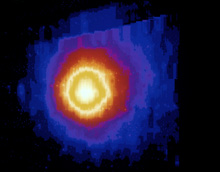
I suppose you are all aware that there is another spacecraft orbiting Mars.
http://mars.jpl.nasa.gov/mro/
So, a new four years of great images to come.
Thanks for looking up with me.
Larry Kellogg
Web Site: http://lkellogg.vttoth.com/LarryRussellKellogg/
BlogSpot: http://kelloggserialreports.blogspot.com/
RSS link: http://kelloggserialreports.blogspot.com/atom.xml
Newsltr.: https://news.altair.com/mailman/listinfo/lunar-update
=============================================================
Dwayne Brown(202)358-1726
Merrilee Fellows (818)393-0754
NASA Headquarters, Washington
Guy Webster (818)354-6278
Jet Propulsion Laboratory, Pasadena, Calif.
News Release: 2006-034
March 10,2006
Robotic NASA Craft Begins Orbiting Mars for Most-Detailed Exam
With a crucially timed firing of its main engines today, NASA's new mission to Mars successfully put itself into orbit around the red planet.
The spacecraft, Mars Reconnaissance Orbiter, will provide more science data than all previous Mars missions combined.
Signals received from the spacecraft at 2:16 p.m. Pacific Time after it emerged from its first pass behind Mars set off cheers and applause in control rooms at NASA's Jet Propulsion Laboratory, Pasadena, Calif., and at Lockheed Martin Space Systems, Denver.
"This is a great milestone to have accomplished, but it's just one of many milestones before we can open the champagne," said Colleen Hartman, deputy associate administrator for NASA's Science Mission Directorate. "Once we are in the prime science orbit, the spacecraft will perform observations of the atmosphere, surface, and subsurface of Mars in unprecedented detail."
The spacecraft traveled about 500 million kilometers (310 million miles) to reach Mars after its launch from Florida on Aug. 12, 2005. It needed to use its main thrusters as it neared the planet in order to slow itself enough for Mars' gravity to capture it. The thruster firing began while the spacecraft was still in radio contact with Earth, but needed to end during a tense half hour of radio silence while the spacecraft flew behind Mars.
"Our spacecraft has finally become an orbiter," said JPL's Jim Graf, project manager for the mission. "The celebration feels great, but it will be very brief because before we start our main science phase, we still have six months of challenging work to adjust the orbit to the right size and shape."
For the next half-year, the mission will use hundreds of carefully calculated dips into Mars' atmosphere in a process called "aerobraking."
This will shrink its orbit from the elongated ellipse it is now flying, to a nearly circular two-hour orbit. For the mission's principal science phase, scheduled to begin in November, the desired orbit is a nearly circular loop ranging from 320 kilometers (199 miles) to 255 kilometers (158 miles) in altitude, lower than any previous Mars orbiter. To go directly into such an orbit instead of using aerobraking, the mission would have needed to carry about 70 percent more fuel when it launched.
The instruments on Mars Reconnaissance Orbiter will examine the planet from this low-altitude orbit. A spectrometer will map water-related minerals in patches as small as a baseball infield. A radar instrument will probe for underground layers of rock and water. One telescopic camera will resolve features as small as a card table. Another will put the highest-resolution
images into broader context. A color camera will monitor the entire planet
daily for changes in weather. A radiometer will check each layer of the atmosphere for variations in temperature, water vapor and dust.
"The missions currently at Mars have each advanced what we know about the presence and history of water on Mars, and one of the main goals for Mars Reconnaissance Orbiter is to decipher when water was on the surface and where it is now," said JPL's Dr. Richard Zurek, project scientist for the mission. "Water is essential for life, so that will help focus future studies of whether Mars has ever supported life."
The orbiter can radio data to Earth at up to 10 times the rate of any previous Mars mission. Besides sending home the pictures and other information from its own investigations, it will relay data from surface missions, including NASA's Phoenix Mars Scout scheduled for launch in 2007 and Mars Science Laboratory in development for 2009.
Additional information about Mars Reconnaissance Orbiter is available online
at:
http://www.nasa.gov/mro
The mission is managed by JPL, a division of the California Institute of Technology, Pasadena, for the NASA Science Mission Directorate, Washington.
Lockheed Martin Space Systems, Denver, is the prime contractor for the project and built the spacecraft.
=============================================================
http://www.sfgate.com/cgi-bin/article.cgi?file=/news/archive/2006/03/10/stat
e/n143935S97.DTL&type=science
________________________________________
NASA spacecraft successfully enters orbit around Mars By ALICIA CHANG, AP Science Writer Friday, March 10, 2006
A NASA spacecraft successfully slipped into orbit around Mars Friday, joining a constellation of orbiters already circling the Red Planet after a critical firing of its engines and anxious minutes of silence.
Scientists cheered and applauded after the Mars Reconnaissance Orbiter emerged from the planet's shadow and signaled to NASA's Jet Propulsion Laboratory that the maneuver was a success.
"Oh I am very relieved," project manager Jim Graf said minutes later. "It was picture perfect."
The two-ton spacecraft is the most sophisticated ever to arrive at Mars and is expected to gather more data on the Red Planet than all previous Martian missions combined.
It will explore Mars and serve as a communications relay in low orbit for four years and is expected to churn out the most detailed information ever about the planet and its climate and landscape.
In the fall, the orbiter will begin exploring the Martian atmosphere, scan the surface for evidence of ancient water and scout for future landing sites to send robotic and possibly human explorers.
The $720 million mission is managed by JPL in Pasadena.
Snip.
=============================================================
WHAT THE MIND CAN CONCEIVE, AND BELIEVE, IT WILL ACHIEVE - LRK
=============================================================
Friday, March 10, 2006


Monday, March 06, 2006
Good day,
I received an e-mail from Dr. Turyshev at JPL this morning about their efforts to hear from Pioneer 10. (see below)
Doesn't look like they saw anything in the real-time signatures but they will run the recorded track through some software to search for a signal.
In looking at graphs of the bus voltage from the old Master Data Record files you could draw an extended line on the drop off of voltage and guess that you would be at about 26 volts today in 2006.
That is where it was thought the transmitter might not work so no surprise if they can't find any signal.
The last time we saw the carrier was back in January of 2003 but no data lock.
-------------------------------------------------------------
http://spaceprojects.arc.nasa.gov/Space_Projects/pioneer/PNhome.html
Snip
PIONEER 10 SPACECRAFT SENDS LAST SIGNAL After more than 30 years, it appears the venerable Pioneer 10 spacecraft has sent its last signal to Earth.
Pioneer's last, very weak signal was received on 23 January 2003. NASA engineers report that Pioneer 10's radioisotope power source has decayed, and it may not have enough power to send additional transmissions to Earth.
NASA's Deep Space Network (DSN) did not detect a signal during the last contact attempt on 7 February 2003. The previous three contacts, including the 23 January signal, were very faint, with no telemetry received. The last time a Pioneer 10 contact returned telemetry data was 27 April 2002. NASA has no additional contact attempts planned for Pioneer 10.
Snip
-------------------------------------------------------------
Distance makes a difference too. The 8 watt transmitter wouldn't be putting out a full 8 watts (a night light of power) and the signals seen at Earth were buried down in the noise you get from just pointing an antenna out into space. It is like looking for a needle in the front lawn down in the grass.
One spike looks a lot like the one next to it.
If you see something you think is your needle you can narrow the band pass filter and magnify what you are looking at. You don't see anything next to it though and so you have to look back and fourth and hope you recognize your needle.
-------------------------------------------------------------
Snip
http://spaceprojects.arc.nasa.gov/Space_Projects/pioneer/PNStat.html
The power source on Pioneer 10 finally degraded to the point where the signal to Earth dropped below the threshold for detection in its latest contact attempt on 7 February 2003. No more attempts at contact are planned at this time. The previous three contacts had very faint signals with no telemetry received. Pioneer's last, very weak signal was received on 23 January 2003. The last time a Pioneer 10 contact returned telemetry data was on 27 April 2002.
Project Manager: Larry Lasher
Snip
-------------------------------------------------------------
If I hear more about the analysis of the recorded tracks, will let you know.
Thanks for looking up with me.
Larry Kellogg
Web Site: http://lkellogg.vttoth.com/LarryRussellKellogg/
BlogSpot: http://kelloggserialreports.blogspot.com/
RSS link: http://kelloggserialreports.blogspot.com/atom.xml
Newsltr.: https://news.altair.com/mailman/listinfo/lunar-update
=============================================================
e-mail from Dr. Turyshev at JPL - LRK -
-------------------------------------------------------------
Dear Larry, Colleagues,
We carried out the observations of the Pioneer 10 spacecraft, per our proposal that was approved by NASA earlier last week, on Friday and Saturday nights (local time). There was no real-time detection of a carrier signal from the spacecraft.
We have carried out open-loop (RSR) recordings of the two passes for archiving. We will process the recordings using parameters that would increase the resolution over the real-time spectral reporting by the receiver and search for a signal.
At this time, our team does not suspect any errors in our planning, pointing, uplink strategy or ground receivers tuning predictions. If the signal is not detected in the post-pass processing then there is speculation that spacecraft components have degraded faster than thought or the RTG output was no longer sufficient to power the S-band TWT amplifier.
Now we are getting very close to start analysis of the entire data set that was recently assembled at JPL.
Best,
Slava
=============================================================
[Second page of a 12 page Power Point presentation describing the upcoming support. - LRK -]
-------------------------------------------------------------
* Three Supports performed over three days
-- DOY 062, 063, and 064 (March 3, 4, and 5)
* 70-m antenna used
* 400 kW uplink power
* Three different tune profiles for capturing the transponder
* Antenna's low noise path utilized
* Radio Science monitoring downlink for signal detection
* DTT system configured for throughput mode if acquisition is achieved.
* NOPE monitoring supports in ROC
* The Pioneer 10 RTLT is 24:56:25 (hh:mm:ss)
=============================================================
WHAT THE MIND CAN CONCEIVE, AND BELIEVE, IT WILL ACHIEVE - LRK
=============================================================
I received an e-mail from Dr. Turyshev at JPL this morning about their efforts to hear from Pioneer 10. (see below)
Doesn't look like they saw anything in the real-time signatures but they will run the recorded track through some software to search for a signal.
In looking at graphs of the bus voltage from the old Master Data Record files you could draw an extended line on the drop off of voltage and guess that you would be at about 26 volts today in 2006.
That is where it was thought the transmitter might not work so no surprise if they can't find any signal.
The last time we saw the carrier was back in January of 2003 but no data lock.
-------------------------------------------------------------
http://spaceprojects.arc.nasa.gov/Space_Projects/pioneer/PNhome.html
Snip
PIONEER 10 SPACECRAFT SENDS LAST SIGNAL After more than 30 years, it appears the venerable Pioneer 10 spacecraft has sent its last signal to Earth.
Pioneer's last, very weak signal was received on 23 January 2003. NASA engineers report that Pioneer 10's radioisotope power source has decayed, and it may not have enough power to send additional transmissions to Earth.
NASA's Deep Space Network (DSN) did not detect a signal during the last contact attempt on 7 February 2003. The previous three contacts, including the 23 January signal, were very faint, with no telemetry received. The last time a Pioneer 10 contact returned telemetry data was 27 April 2002. NASA has no additional contact attempts planned for Pioneer 10.
Snip
-------------------------------------------------------------
Distance makes a difference too. The 8 watt transmitter wouldn't be putting out a full 8 watts (a night light of power) and the signals seen at Earth were buried down in the noise you get from just pointing an antenna out into space. It is like looking for a needle in the front lawn down in the grass.
One spike looks a lot like the one next to it.
If you see something you think is your needle you can narrow the band pass filter and magnify what you are looking at. You don't see anything next to it though and so you have to look back and fourth and hope you recognize your needle.
-------------------------------------------------------------
Snip
http://spaceprojects.arc.nasa.gov/Space_Projects/pioneer/PNStat.html
The power source on Pioneer 10 finally degraded to the point where the signal to Earth dropped below the threshold for detection in its latest contact attempt on 7 February 2003. No more attempts at contact are planned at this time. The previous three contacts had very faint signals with no telemetry received. Pioneer's last, very weak signal was received on 23 January 2003. The last time a Pioneer 10 contact returned telemetry data was on 27 April 2002.
Project Manager: Larry Lasher
Snip
-------------------------------------------------------------
If I hear more about the analysis of the recorded tracks, will let you know.
Thanks for looking up with me.
Larry Kellogg
Web Site: http://lkellogg.vttoth.com/LarryRussellKellogg/
BlogSpot: http://kelloggserialreports.blogspot.com/
RSS link: http://kelloggserialreports.blogspot.com/atom.xml
Newsltr.: https://news.altair.com/mailman/listinfo/lunar-update
=============================================================
e-mail from Dr. Turyshev at JPL - LRK -
-------------------------------------------------------------
Dear Larry, Colleagues,
We carried out the observations of the Pioneer 10 spacecraft, per our proposal that was approved by NASA earlier last week, on Friday and Saturday nights (local time). There was no real-time detection of a carrier signal from the spacecraft.
We have carried out open-loop (RSR) recordings of the two passes for archiving. We will process the recordings using parameters that would increase the resolution over the real-time spectral reporting by the receiver and search for a signal.
At this time, our team does not suspect any errors in our planning, pointing, uplink strategy or ground receivers tuning predictions. If the signal is not detected in the post-pass processing then there is speculation that spacecraft components have degraded faster than thought or the RTG output was no longer sufficient to power the S-band TWT amplifier.
Now we are getting very close to start analysis of the entire data set that was recently assembled at JPL.
Best,
Slava
=============================================================
[Second page of a 12 page Power Point presentation describing the upcoming support. - LRK -]
-------------------------------------------------------------
* Three Supports performed over three days
-- DOY 062, 063, and 064 (March 3, 4, and 5)
* 70-m antenna used
* 400 kW uplink power
* Three different tune profiles for capturing the transponder
* Antenna's low noise path utilized
* Radio Science monitoring downlink for signal detection
* DTT system configured for throughput mode if acquisition is achieved.
* NOPE monitoring supports in ROC
* The Pioneer 10 RTLT is 24:56:25 (hh:mm:ss)
=============================================================
WHAT THE MIND CAN CONCEIVE, AND BELIEVE, IT WILL ACHIEVE - LRK
=============================================================
Wednesday, March 01, 2006
Good day.
There will be and attempt to contact Pioneer 10 this week, March 3, 4, and 5.
Earth has come around the Sun and will be directly within Pioneer 10's antenna pattern, if an antenna pattern there might be. Might be, because the fixed frequency oscillator is dead and the only way to wake up the spacecraft is to send up a strong signal which will wake up the variable frequency oscillator and let the spacecraft send back a signal at a known offset from what it sees coming up.
This will be the last time Earth will be here as the Sun drags us along as it goes on its way around the Solar System. Each year Earth moves over just a bit in space and in the past you could command Pioneer 10 to re-align itself to look at a 400 KW up-link signal from Earth but there is not enough power on board Pioneer 10 to do that now and no one is sending commands anyway. [Mission long over and I took all the equipment out of the Pioneer Operations space, sorry.]
[36 pictures of what is NOT there now, including me. Don't click on the link unless you have the time for them to down load. :-( ] http://lkellogg.vttoth.com/LarryRussellKellogg/PioneerPic.html
If Pioneer 10 is heard from then maybe they will get some Radio Science and some Doppler information that will give one more data point in understanding the Pioneer Anomaly. The Pioneer Master Data Records that have been saved are also being used to understand what the spacecraft was doing for 30 years.
I don't think there will be any data received from the spacecraft even if it is heard from as there have been hardware modifications at the Deep Space Network that took out some of the old equipment that was used in decoding the down link, and of course there isn't any hardware at all to look at the data where I used to work. [Those pictures above that you didn't look at.]
Will let you know if I hear of any successes in listening to the old bird.
:-)
Thanks for looking up with me.
Larry Kellogg
Web Site: http://lkellogg.vttoth.com/LarryRussellKellogg/
BlogSpot: http://kelloggserialreports.blogspot.com/
RSS link: http://kelloggserialreports.blogspot.com/atom.xml
Newsltr.: https://news.altair.com/mailman/listinfo/lunar-update
=============================================================
[Second page of a 12 page Power Point presentation describing the upcoming support. Good luck in understanding the acronyms. - LRK -]
* Three Supports performed over three days
-- DOY 062, 063, and 064 (March 3, 4, and 5)
* 70-m antenna used
* 400 kW uplink power
* Three different tune profiles for capturing the transponder
* Antenna's low noise path utilized
* Radio Science monitoring downlink for signal detection
* DTT system configured for throughput mode if acquisition is achieved.
* NOPE monitoring supports in ROC
* The Pioneer 10 RTLT is 24:56:25 (hh:mm:ss)
-------------------------------------------------------------
Maybe some help. - LRK -
http://www2.jpl.nasa.gov/basics/glossary.html
http://dsnra.jpl.nasa.gov/technical/acronyms.html
DTT Downlink Telemetry and Tracking Subsystem
Successor to the BVR in the NSP era.
NOPE Network Operations Project Engineer
BVR Block V Receiver
Standard DSN telemetry receiver: input typically two 300 MHz I.F.s, output
two digital data streams. This will be replaced by the DTT in the NSP era.
NSP Network Simplication Plan
Upgrade of the DSN controller subsystems
ROC ???
RTLT Round Trip Light Time
=============================================================
WHAT THE MIND CAN CONCEIVE, AND BELIEVE, IT WILL ACHIEVE - LRK
=============================================================
There will be and attempt to contact Pioneer 10 this week, March 3, 4, and 5.
Earth has come around the Sun and will be directly within Pioneer 10's antenna pattern, if an antenna pattern there might be. Might be, because the fixed frequency oscillator is dead and the only way to wake up the spacecraft is to send up a strong signal which will wake up the variable frequency oscillator and let the spacecraft send back a signal at a known offset from what it sees coming up.
This will be the last time Earth will be here as the Sun drags us along as it goes on its way around the Solar System. Each year Earth moves over just a bit in space and in the past you could command Pioneer 10 to re-align itself to look at a 400 KW up-link signal from Earth but there is not enough power on board Pioneer 10 to do that now and no one is sending commands anyway. [Mission long over and I took all the equipment out of the Pioneer Operations space, sorry.]
[36 pictures of what is NOT there now, including me. Don't click on the link unless you have the time for them to down load. :-( ] http://lkellogg.vttoth.com/LarryRussellKellogg/PioneerPic.html
If Pioneer 10 is heard from then maybe they will get some Radio Science and some Doppler information that will give one more data point in understanding the Pioneer Anomaly. The Pioneer Master Data Records that have been saved are also being used to understand what the spacecraft was doing for 30 years.
I don't think there will be any data received from the spacecraft even if it is heard from as there have been hardware modifications at the Deep Space Network that took out some of the old equipment that was used in decoding the down link, and of course there isn't any hardware at all to look at the data where I used to work. [Those pictures above that you didn't look at.]
Will let you know if I hear of any successes in listening to the old bird.
:-)
Thanks for looking up with me.
Larry Kellogg
Web Site: http://lkellogg.vttoth.com/LarryRussellKellogg/
BlogSpot: http://kelloggserialreports.blogspot.com/
RSS link: http://kelloggserialreports.blogspot.com/atom.xml
Newsltr.: https://news.altair.com/mailman/listinfo/lunar-update
=============================================================
[Second page of a 12 page Power Point presentation describing the upcoming support. Good luck in understanding the acronyms. - LRK -]
* Three Supports performed over three days
-- DOY 062, 063, and 064 (March 3, 4, and 5)
* 70-m antenna used
* 400 kW uplink power
* Three different tune profiles for capturing the transponder
* Antenna's low noise path utilized
* Radio Science monitoring downlink for signal detection
* DTT system configured for throughput mode if acquisition is achieved.
* NOPE monitoring supports in ROC
* The Pioneer 10 RTLT is 24:56:25 (hh:mm:ss)
-------------------------------------------------------------
Maybe some help. - LRK -
http://www2.jpl.nasa.gov/basics/glossary.html
http://dsnra.jpl.nasa.gov/technical/acronyms.html
DTT Downlink Telemetry and Tracking Subsystem
Successor to the BVR in the NSP era.
NOPE Network Operations Project Engineer
BVR Block V Receiver
Standard DSN telemetry receiver: input typically two 300 MHz I.F.s, output
two digital data streams. This will be replaced by the DTT in the NSP era.
NSP Network Simplication Plan
Upgrade of the DSN controller subsystems
ROC ???
RTLT Round Trip Light Time
=============================================================
WHAT THE MIND CAN CONCEIVE, AND BELIEVE, IT WILL ACHIEVE - LRK
=============================================================
Subscribe to:
Posts (Atom)