I have not seen the movie, "The Wonder of It All", but it sounds like I should.

Others have mentioned that they had and my thanks to Ron for his
review as presented at The Space Review.

A snip below, but do go read.
Let me know what you think if you have seen the movie.
- LRK -

I think the more publicity of our past missions to the Moon the better
and hopefully we will see more to come.
Where will the future take us?
Nations have started back to the Moon and maybe we will see some space
type commerce in the future as well.
Here around Earth we now have communications satellites that were
predicted by Arthur C. Clarke and think nothing of it.
- LRK -

At NSS Space Settlement page http://www.nss.org/settlement/ we have this.
--------------------------
"Clarke's Law"

Arthur C. Clarke, inventor of the concept of using geosynchronous
orbit for communication satellites, once wrote that new ideas like
this pass through three stages:

  * Stage 1: "It can't be done."
  * Stage 2: "It probably can be done, but it's not worth doing."
  * Stage 3: "I knew it was a good idea all along!"

When Clarke first published his idea of utilizing geosynchronous orbit
in 1945, that idea was in Stage 1 because it was technically
impossible to do so at the time. Today, of course, that idea is in
Stage 3, and our television programming and phone calls routinely go
through geosynchronous satellites.
--------------------------

And at http://www.lsi.usp.br/~rbianchi/clarke/ACC.Laws.html we see this.
--------------------------
In the book Profiles of the Future: An Inquiry into the Limits of the
Possible Arthur C. Clarke states his three Laws, which are formulated
as follows:

Clarke's First Law:
"When a distinguished but elderly scientist states that something is
possible he is almost certainly right. When he states that something
is impossible, he is very probably wrong."

Clarke defines the adjective 'elderly' as :"In physics, mathematics
and astronautics it means over thirty; in other disciplines, senile
decay is sometimes postponed to the forties. There are of course,
glorious exceptions; but as every researcher just out of college
knows, scientists of over fifty are good for nothing but board
meetings, and should at all costs be kept out of the laboratory". (in
Profiles of the Future.)

Clarke's Second Law:
"The only way of discovering the limits of the possible is to venture
a little way past them into the impossible."

Clarke's Third Law:
"Any sufficiently advanced technology is indistinguishable from magic."

--------------------------

If you stop in at the KurswellAI net
http://www.kurzweilai.net/meme/frame.html?main=/articles/art0361.html?
you will find:
--------------------------
Arthur C. Clarke Offers His Vision of the Future
by  Sir Arthur C. Clarke
   Ray Kurzweil

The science fiction visionary behind HAL offers his predictions of
salient events to come in this century.
--------------------------

It was exciting back in the 70's to watch us go to the Moon.
http://history.nasa.gov/alsj/frame.html
It is exciting to watch it again on DVDs from Spacecraft Films.
http://www.spacecraftfilms.com/
It should be even more exciting to watch us develop the Moon today and
on to Mars tomorrow.
[Unless congress kills our going to Mars keeps us here in the crib.]
http://www.thespacereview.com/article/998/1
- LRK -

Thanks for looking up with me.

Larry Kellogg

Web Site: http://lkellogg.vttoth.com/LarryRussellKellogg/
BlogSpot: http://kelloggserialreports.blogspot.com/
RSS link: http://kelloggserialreports.blogspot.com/atom.xml
Newsletter: https://news.altair.com/mailman/listinfo/lunar-update
==============================================================
http://www.thespacereview.com/article/996/1
Review: The Wonder of It All
by Ronald A. Wells
Monday, November 12, 2007

As the national interest slowly turns towards a deeper human
penetration into space, settlements on the Moon with later expeditions
to Mars are becoming more of a reality show than political leadership
of the past 35 years would belie This growing interest in space
received a huge boost a decade ago with the landing of a small robot
vehicle on Mars and from increasingly sophisticated Mars orbital
mapping spacecraft launched by NASA and later by ESA. An even greater
impetus stimulated the public's appetite about our neighboring worlds
when NASA landed two golf-cart sized rovers on opposite sides of Mars
in January 2004 which sent back thousands of photographs of their
treks across the surface. They are still roving and transmitting
pictures and data today, having recently survived one of the worst
dust storms since their arrival on the planet almost four years ago.
And the Vision for Space Exploration, as announced by President Bush
in January 2004, is intended to "�extend [a] human presence across the
solar system, starting with a human return to the Moon by the year
2020".

Although not greatly visible on the national public stage today as
they once were in the late 1960's and early 70's, an almost-forgotten
group of American heroes, the Apollo astronauts who traveled to the
Moon, including the scant dozen of them who walked on the surface for
times ranging from a few hours to three days, also returned to center
stage as actors about a decade ago in the cable TV series "From the
Earth to the Moon". The crew of Apollo 13, again as actors, was
featured in a movie by that name; and a special TV documentary,
"Failure Is Not an Option", narrated by Gene Kranz, the chief flight
director during the Apollo period, recounted the excitement of each of
the lunar missions with archival footage of actual events. Transcripts
of voice communications with the two Moonwalkers on each of the six
landed missions, together with supplementary photographs, mission
reports and related materials were provided by the Apollo Lunar
Surface Journal. Various books by and about the astronauts have also
been published.

But none of these media sources really bring to life the men
themselves who went to the Moon and walked on its surface. Two recent
productions have attempted to redress that situation: Jeff Roth's The
Wonder of it All and Duncan Kopp and Chris Riley's In the Shadow of
the Moon (see "Review: Two Shadows on the Moon", The Space Review,
September 24, 2007). It is worthwhile in this discussion, however, to
draw a few distinctions between the two because they approach their
subjects differently.

Snip
==============================================================
http://www.thespacereview.com/

Sustaining exploration: communications, relevance, and value

I---
It has become fashionable of late to critique and criticize NASA's
communications efforts, especially given the belief by many that NASA
has not done a good enough job communicating the importance of space
exploration to the general public.  In the first of a two-part
report, Mary Lynne Dittmar argues that such criticism is focused too
much on tactics rather than broader strategic concerns.
http://www.thespacereview.com/article/1000/1

Exploding Moon myths: or why there's no race to our nearest neighbor
---
Recent and upcoming lunar missions, and even announcements of
proposed missions, have given the impression to some that there is
some kind of new race to the Moon developing.  Dwayne Day find the
flaws the various explanations given for why these missions are all
taking place now.
http://www.thespacereview.com/article/999/1

Why "Save Mars" is worth the effort
---
Some space advocates have been pressing Congress to drop language in
the House version of the NASA budget that would prohibit spending on
any project exclusively intended to support human Mars exploration.
Chris Carberry explains why what appears to be a minor provision in
the overall bill is so critical.
http://www.thespacereview.com/article/998/1

Hillary Clinton's civil space policy
---
As the only presidential candidate of either party to release a
detailed science policy, Hillary Clinton's approach to space policy
has come under scrutiny.  Taylor Dinerman examines what Clinton said
-- and did not say -- and its implications for the agency and its
exploration plans.
http://www.thespacereview.com/article/997/1

Review: The Wonder of It All
---
As a new generation of space exploration ramps up, there is a renewed
interest in that original generation of space explorers.  Ron Wells
reviews the lesser-known of two new documentaries about the Apollo
astronauts and examines what sets it apart in its examination of the
only people to have walked on another world.
http://www.thespacereview.com/article/996/1

Snip
==============================================================
http://www.breitbart.com/article.php?id=071112234943.9wthyh4c&show_article=1
Russia, India to join in moon mission
Nov 12 07:49 PM US/Eastern

Copyright AFP 2007, AFP stories and photos shall not be published,
broadcast, rewritten for broadcast or publication or redistributed
directly or indirectly in any medium

Thanks for the link as passed by Bob MacBird, Conroe, Texas
Snip
==============================================================

WHAT THE MIND CAN CONCEIVE, AND BELIEVE, IT WILL ACHIEVE - LRK

==============================================================
Many folks would like to see us back on the Moon and developing its resources.
Monday, November 12, 2007


Wednesday, November 07, 2007
Discovery landed at 1:01:17 p.m. EST
Discovery landed at 1:01:17 p.m. EST
------------------------------------------------------------------------------
http://www.nasa.gov/mission_pages/shuttle/main/index.html
Space shuttle Discovery descended to a smooth landing at Kennedy Space
Center, Fla., concluding a successful assembly mission to the
International Space Station. With Commander Pam Melroy and Pilot George
Zamka at the controls, Discovery landed at 1:01:17 p.m. EST. The mission
lasted 15 days, 2 hours, 24 minutes and 2 seconds.
snip
------------------------------------------------------------------------------

Went to check on the shuttle landing and watch on NASA TV with Real
Media Player and the link would not connect, server limited.
Went to Windows Media link and watched it with the VLC media player.
http://www.nasa.gov/multimedia/nasatv/index.html

Good, glad to see folks are watching.

Thanks for looking up with me.

Larry Kellogg

Web Site: http://lkellogg.vttoth.com/LarryRussellKellogg/
BlogSpot: http://kelloggserialreports.blogspot.com/
RSS link: http://kelloggserialreports.blogspot.com/atom.xml
Newsletter: https://news.altair.com/mailman/listinfo/lunar-update
==============================================================
http://www.nasa.gov/mission_pages/shuttle/shuttlemissions/sts120/index.html
STS-120 is the 23rd shuttle mission to the International Space Station,
and launched an Italian-built U.S. multi-port module for the station.

Retired Air Force Col. Pamela A. Melroy commands the STS-120 mission
which took the Harmony Node 2 connecting module to the station. Melroy,
a veteran shuttle pilot, is the second woman to command a shuttle.
Marine Corps Col. George D. Zamka serves as pilot. The flight's mission
specialists are Scott E. Parazynski, Army Col. Douglas H. Wheelock,
Stephanie D. Wilson and Paolo A. Nespoli, a European Space Agency
astronaut from Italy. Zamka, Wheelock and Nespoli are making their first
spaceflight.

Expedition 15/16 Flight Engineer Clayton Anderson will return to Earth
from the space station aboard shuttle mission STS-120. That flight
carried his replacement, Daniel Tani, to the station. Tani will return
on shuttle mission STS-122.

Snip
==============================================================
http://www.nasa.gov/mission_pages/shuttle/main/index.html
Space shuttle Discovery descended to a smooth landing at Kennedy Space
Center, Fla., concluding a successful assembly mission to the
International Space Station. With Commander Pam Melroy and Pilot George
Zamka at the controls, Discovery landed at 1:01:17 p.m. EST. The mission
lasted 15 days, 2 hours, 24 minutes and 2 seconds.

During its stay at the station, which began Oct. 25, the STS-120 crew
continued the on-orbit construction of the station with the installation
of the Harmony Node 2 module and the relocation of the P6 truss.

The crew installed Harmony Oct. 26 and did four spacewalks at the
station. During the third spacewalk, the crew installed the P6 truss and
solar array pair in its permanent location outboard of the port truss.
The fourth spacewalk was changed during the mission so that the crew
could repair a torn solar array on the P6 truss. Following the
successful repair work, the crew was able to fully deploy the solar array.

Discovery also delivered a new station crew member, Flight Engineer
Daniel Tani.

STS-120 is the 120th shuttle mission and 23rd mission to visit the space
station. The next mission, STS-122, is slated to launch in December.

Snip
==============================================================

WHAT THE MIND CAN CONCEIVE, AND BELIEVE, IT WILL ACHIEVE - LRK

==============================================================
World's First Image Taking of the Moon by HDTV
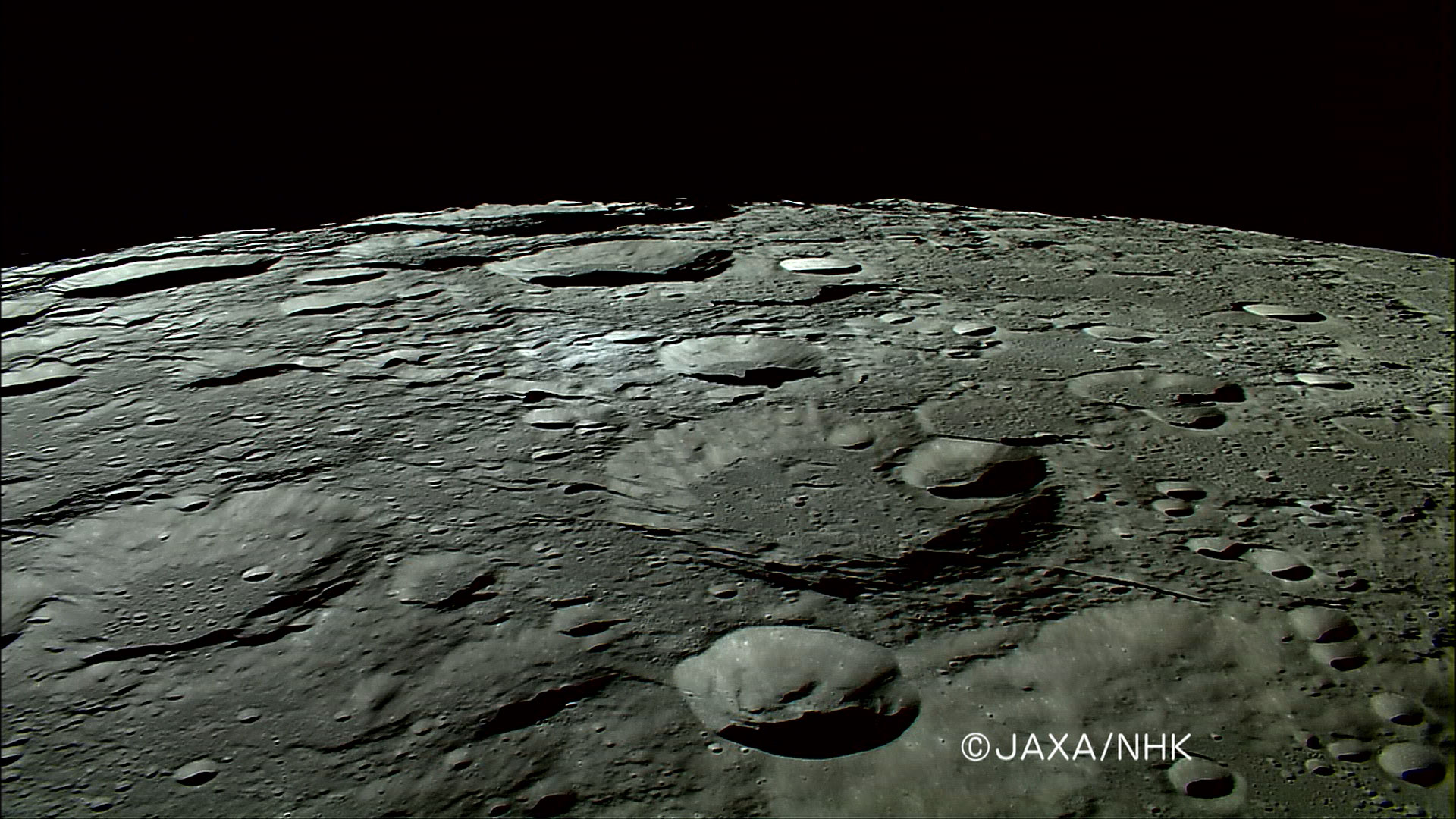
Looks like we are going to get some nice views of the Moon from 100 km.
- LRK -

----------------------------------------------------------------------

http://www.jaxa.jp/press/2007/11/20071107_kaguya_e.html#pict01
*North Pole Area (still image cut out from the first image shooting)*

----------------------------------------------------------------------

See more in the JAXA press release below.
- LRK -

KAGUYA(SELENE) mission web site.
http://www.jaxa.jp/projects/sat/selene/index_e.html

Go there.  It has this link to the movie in HD, no audio, titles in Japanese.
http://www.jaxa.jp/press/2007/11/20071107_kaguya_movie_e.html

While viewing the movie in my Firefox browser, down-loaded the flash file
with the Firefox extension DownloadHelper and later played it full screen
on my laptop with the VLC media player.

Just like being there.  Nice.

Thanks for looking up with me.

Larry Kellogg

Web Site: http://lkellogg.vttoth.com/LarryRussellKellogg/
BlogSpot: http://kelloggserialreports.blogspot.com/
RSS link: http://kelloggserialreports.blogspot.com/atom.xml
Newsletter: https://news.altair.com/mailman/listinfo/lunar-update
==============================================================

----------------------------------------------------------------------
        ***  JAXA MAIL SERVICE  ***
    Japan Aerospace Exploration Agency
----------------------------------------------------------------------
               KAGUYA (SELENE)
World's First Image Taking of the Moon by HDTV

                                   November 7, 2007 (JST)
                Japan Aerospace Exploration Agency (JAXA)
                     NHK (Japan Broadcasting Corporation)

The Japan Aerospace Exploration Agency (JAXA) and NHK (Japan
Broadcasting Corporation) have successfully performed the world's
first high-definition image taking by the lunar explorer "KAGUYA"
(SELENE,) which was injected into a lunar orbit at an altitude of
about 100 km on October 18, 2007, (Japan Standard Time. Following
times and dates are all JST.)

The image shooting was carried out by the onboard high definition
television (HDTV) of the KAGUYA, and it is the world's first high
definition image data acquisition of the Moon from an altitude about
100 kilometers away from the Moon.

The image taking was performed twice on October 31. Both were eight-
fold speed intermittent shooting (eight minutes is converged to one
minute.) The first shooting covered from the northern area of the
"Oceanus Procellarum" toward the center of the North Pole, then the
second one was from the south to the north on the western side of the
"Oceanus Procellarum." The moving image data acquired by the KAGUYA
was received at the JAXA Usuda Deep Space Center, and processed by NHK.

The satellite was confirmed to be in good health through telemetry
data received at the Usuda station.


Moon Images Shot by the Onboard HDTV of the KAGUYA

(1) North Pole Area
(still image cut out from the first image shooting)
http://www.jaxa.jp/press/2007/11/20071107_kaguya_e.html#pict01
This is a still image taken out from the first moving image shooting
when the KAGUYA flew from the northern area of the "Oceanus Procel
larum"(*1) to the center of the North Pole.
As the altitude near the North Pole is high, the angle of the coming
sunlight was lower, thus the shade of the crater topography looks
long in the image.
The moving image was taken at 4:07 a.m. on October 31, 2007 (JST) by
eight-fold speed intermittent shooting (eight minutes is converged to
one minute) from the KAGUYA, and the data was received at the JAXA
Usuda Deep Space Center on the same day.

(*1) Oceanus Procellarum:
The dark area on the Moon's surface called "ocean." It is located at
the left end of the northern hemisphere on the front side of the Moon
when we look up at it from the Earth.


(2) The western side of the "Oceanus Procellarum"
(cut out from the second image shooting)
http://www.jaxa.jp/press/2007/11/20071107_kaguya_e.html#pict02
This is a still image taken out from the second moving image shooting
when the KAGUYA flew from the south to the north on the western side
of the "Oceanus Procellarum."
The dark part on the right of the above image is the Ocean (Oceanus
Procellarum,) and the light area on the left is called the "highland."
The moving image was taken at 5:51 a.m. on Oct. 31, 2007 (JST) by
eight-fold speed intermittent shooting (eight minutes is converged to
one minute) from the KAGUYA, and the data was received at the JAXA
Usuda Deep Space Center on the same day.


(3) The west side of the "Oceanus Procellarum"
(cut out from the second image shooting)
http://www.jaxa.jp/press/2007/11/20071107_kaguya_e.html#pict03
This is a still image taken out from the end part of the second moving
image taking.
We can observe a crater called "Repsold," whose diameter is 107 km, at
the center on the near side of this image. The channel that crosses
this crater is called the "Repsold Valley," and its length is about
180 km (equivalent to the distance between Tokyo and Shizuoka on the
Tokaido Line in Japan.) The shooting time was the same as the above (2.)


Moving image of the Moon shot by the HDTV camera (480x270, no audio)
http://www.jaxa.jp/press/2007/11/20071107_kaguya_movie_e.html

Reference
http://www.jaxa.jp/press/2007/11/20071107_kaguya_e.html#ref01


This page URL:
http://www.jaxa.jp/press/2007/11/20071107_kaguya_e.html
---------------------------------------------------------------------
Publisher : Public Affairs Department
Japan Aerospace Exploration Agency (JAXA)
Marunouchi Kitaguchi Building,
1-6-5, Marunouchi, Chiyoda-ku, Tokyo 100-8260
Japan
TEL:+81-3-6266-6400

JAXA WEB SITE :
http://www.jaxa.jp/index_e.html

About This Mail Service :
To change registered e-mail address, or to cancel this service,
please access to
http://www.jaxa.jp/pr/mail/index_e.html

Snip
==============================================================

WHAT THE MIND CAN CONCEIVE, AND BELIEVE, IT WILL ACHIEVE - LRK

==============================================================
Subscribe to:
Posts (Atom)