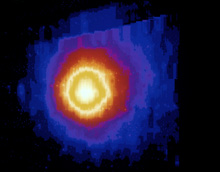
Many folks would like to see us back on the Moon and developing its resources.

Friday, October 09, 2009

NASA SPACECRAFT IMPACTS LUNAR CRATER IN SEARCH FOR WATER ICE

NASA SPACECRAFT IMPACTS LUNAR CRATER IN SEARCH FOR WATER ICE
http://www.nasa.gov/home/hqnews/2009/oct/HQ_09-236_LCROSS.html
Oct. 9, 200
-----------------------------------------------------------------------------------------
Grey Hautaluoma/Ashley Edwards
Headquarters, Washington
202-358-0668/1756
grey.hautaluoma-1@nasa.gov
ashley.edwards-1@nasa.gov

Jonas Dino
Ames Research Center, Moffett Field, Calif.
650-604-5612
jonas.dino@nasa.gov

RELEASE: 09-236

NASA SPACECRAFT IMPACTS LUNAR CRATER IN SEARCH FOR WATER ICE

MOFFETT FIELD, Calif. -- NASA's Lunar Crater Observation and Sensing
Satellite, or LCROSS, created twin impacts on the moon's surface
early Friday in a search for water ice. Scientists will analyze data
from the spacecraft's instruments to assess whether water ice is
present.

The satellite traveled 5.6 million miles during an historic 113-day
mission that ended in the Cabeus crater, a permanently shadowed
region near the moon's south pole. The spacecraft was launched June
18 as a companion mission to the Lunar Reconnaissance Orbiter from
NASA's Kennedy Space Center in Florida.

"The LCROSS science instruments worked exceedingly well and returned a
wealth of data that will greatly improve our understanding of our
closest celestial neighbor," said Anthony Colaprete, LCROSS principal
investigator and project scientist at NASA's Ames Research Center in
Moffett Field, Calif. "The team is excited to dive into data."

In preparation for impact, LCROSS and its spent Centaur upper stage
rocket separated about 54,000 miles above the surface of the moon on
Thursday at approximately 6:50 p.m. PDT.

Moving at a speed of more than 1.5 miles per second, the Centaur hit
the lunar surface shortly after 4:31 a.m. Oct. 9, creating an impact
that instruments aboard LCROSS observed for approximately four
minutes. LCROSS then impacted the surface at approximately 4:36 a.m.

"This is a great day for science and exploration," said Doug Cooke,
associate administrator for the Exploration Systems Mission
Directorate at NASA Headquarters in Washington. "The LCROSS data
should prove to be an impressive addition to the tremendous leaps in
knowledge about the moon that have been achieved in recent weeks. I
want to congratulate the LCROSS team for their tremendous achievement
in development of this low cost spacecraft and for their perseverance
through a number of difficult technical and operational challenges."


Other observatories reported capturing both impacts. The data will be
shared with the LCROSS science team for analysis. The LCROSS team
expects it to take several weeks of analysis before it can make a
definitive assessment of the presence or absence of water ice.

"I am very proud of the success of this LCROSS mission team," said
Daniel Andrews, LCROSS project manager at Ames. "Whenever this team
would hit a roadblock, it conceived a clever work-around allowing us
to push forward with a successful mission."

The images and video collected by the amateur astronomer community and
the public also will be used to enhance our knowledge about the moon.


"One of the early goals of the mission was to get as many people to
look at the LCROSS impacts in as many ways possible, and we
succeeded," said Jennifer Heldmann, Ames' coordinator of the LCROSS
observation campaign. "The amount of corroborated information that
can be pulled out of this one event is fascinating."

"It has been an incredible journey since LCROSS was selected in April
2006," said Andrews. "The LCROSS Project faced a very ambitious
schedule and an uncommonly small budget for a mission of this size.
LCROSS could be a model for how small robotic missions are executed.
This is truly big science on a small budget."

For more information about the LCROSS mission, including images and
video, visit:
http://www.nasa.gov/lcross

-end-
-----------------------------------------------------------------------------------------

Stay tuned for the data reduction - it will all be in the numbers.
- LRK -

Thanks for looking up with me.

Larry Kellogg

Web Site: http://lkellogg.vttoth.com/LarryRussellKellogg/
BlogSpot: http://kelloggserialreports.blogspot.com/
RSS link: http://kelloggserialreports.blogspot.com/atom.xml
Newsletter: https://news.altair.com/mailman/listinfo/lunar-update
Twitter: http://twitter.com/lrkellogg
==============================================================
http://seattletimes.nwsource.com/html/businesstechnology/2010029845_apusscishootthemoon.html?syndication=rss
Seattle Times
Moon crash: Public yawns, scientists celebrate
NASA's great lunar fireworks finale fizzled.

WASHINGTON —
NASA's great lunar fireworks finale fizzled.

By SETH BORENSTEIN
AP Science Writer

After gearing up for the space agency's much-hyped mission to hurl two
spacecraft into the moon, the public turned away from the sky Friday
anything but dazzled. Photos and video of the impact showed little
more than a fuzzy white flash.

In social media and live television coverage, many people were
disappointed at the lack of spectacle. One person even joked that
someone hit the pause button in mission control.

Yet scientists involved in the project were downright gleeful. Sure,
there were no immediate pictures of spewing plumes of lunar dust that
could contain water, but, they say, there was something more
important: chemical signatures in light waves. That's the real
bonanza, not pictures of geyser-like eruptions of debris, the
scientists said.

The mission was executed for "a scientific purpose, not to put on a
fireworks display for the public," said space consultant Alan Stern, a
former NASA associate administrator for science.

Scientists said the public expected too much. The public groused as if
NASA delivered too little.
snip
==============================================================

WHAT THE MIND CAN CONCEIVE, AND BELIEVE, IT WILL ACHIEVE - LRK

==============================================================

Wednesday, October 07, 2009

LCROSS - Lunar Impact coming up 7:31 a.m. EDT/4:31 a.m. PDT Friday Oct. 9, 2009

---------------------
http://www.nasa.gov/mission_pages/LCROSS/main/index.html
LCROSS Lunar Impact 7:31 a.m. EDT/4:31 a.m. PDT Friday Oct. 9

A live NASA TV Broadcast is planned for the LCROSS impacts starting at
6:15 a.m. EDT/3:15 a.m. PDT, Oct. 9, on NASA TV and www.nasa.gov/ntv.

The 1.5 hour broadcast includes:
Live footage from spacecraft camera
Real-time telemetry based animation
Views of LCROSS Mission and Science Operations
Broadcast commentary with expert guests
Prepared video segments
Views of the public impact viewing event at NASA Ames
Possible live footage from the University of Hawaii, 88-inch telescope
on Mauna Kea.
The live LCROSS Post-Impact News Conference will be 10 a.m. EDT/7 a.m.
PDT on NASA TV and www.nasa.gov/ntv.
---------------------

Geoff asked if the fuel used in LCROSS would contaminate the expected
readings when the upper stage of the Atlas crashes into the Moon.

The Centaur burns liquid hydrogen (LH2) and liquid oxygen (LOX) so
sounds like a good question.
http://en.wikipedia.org/wiki/Centaur_(rocket_stage)

I didn't know the answer so went looking and I must confess had not
read the LCROSS blog site.

Here is their blog with a history time line and looks like they are
trying to make sure their is no water on the booster stage.
- LRK -

----------------------------------
http://blogs.nasa.gov/cm/blog/lcrossfdblog
snip
DOY 267 (September 24): Cold Side Bakeout #3 and a Test of the –Z MGA

Despite previous efforts to rid the Centaur outer skin of water on
Cold Side Bakeout #1 and #2, our Navigation team continued to observe
the accelerating effects of escaping water at the end of the second of
those events. With the amounts of water remaining, the Science Team
was no longer concerned that this water could interfere with water
measurements at Impact – there was just too little left. However,
Navigation was still concerned that remaining water might push our
Centaur off course in the hours before Impact, after Separation when
we no longer had any control over its orbit.

Recall that we had planned to execute Cold Side Bakeout #3 on DOY 234
(August 22), but our plans were thwarted by the discovery of the
anomaly. Cold Side Bakeout #3 was unfinished business that had to be completed.

In an unrelated thread, we also wanted to test the antenna we’d be
using for Impact. LCROSS has two Medium Gain Antennas (MGA’s), one on
the +Z axis, the other on the –Z axis, used to downlink high-speed
science data to Earth. We had used the +Z MGA during Lunar Swingby,
but had never tested the –Z MGA in flight. We didn’t want to discover
a problem with this antenna in the hours before impact, so we devised
a test that would expose any issues immediately, and that would couple
very nicely with Cold Side Bakeout #3.

The combined Cold Side Bakeout #3 and –Z MGA Test took advantage of
the fact that LCROSS was passing right through the ecliptic plane, the
plane of the Earth’s orbit around the sun. The LCROSS +X axis was
perpendicular to the ecliptic plane at the time, and so by rotating
about the +X (roll) axis, we could simultaneously face the “cold side”
of the Centaur towards the sun, and the –Z MGA towards the Earth
(required to test communications via this antenna). It was a
perfectly-timed opportunity.

On DOY 267 (September 24), we performed the maneuver. Unlike previous
versions of Cold Side Bakeout, we stopped the spacecraft twice, once
at 135 degrees rotation, and again at 225 degrees. The first position
pointed the –Z MGA (which is canted by 45 degrees) straight at the
Earth, and warmed one side of the cold skin of the Centaur. After 20
minutes, LCROSS rotated another 90 degrees, moving the MGA off the
Earth, and moving another part of the cold face of the Centaur into
full sunlight. We characterized one “slice” of the –Z MGA antenna
gain pattern, confirmed that it was operational and mounted according
to specification, and removed more water from our impactor.

One of the risks of Cold Side Bakeouts is that we might induce a
thermal instability in our thrusters, as we had in Cold Side Bakeout
#1, prompting our improvised fault management to fire the thrusters to
keep them warm (see the post entitled “Our First Orbit Around the
Earth” for details). Happily, our thrusters remained thermally
stable, and we avoided any additional propellant cost.

snip
------------------------
http://blogs.nasa.gov/cm/blog/lcrossfdblog.blog/posts/index_2.html
Welcome Posted on May 09, 2009 02:53:46 PM | Paul.D Tompkins
Welcome everyone to the first installment of the LCROSS Flight Blog!
LCROSS stands for Lunar Crater and Observation and Sensing Satellite.
It is one of two spacecraft launching to the moon in June of 2009, as
part of a coordinated effort to explore the moon in unprecedented
detail, in preparation for human missions in the not-so-distant
future. If you’re not familiar with the mission concept, I’d suggest
you start with our project website:

http://lcross.arc.nasa.gov

or

http://www.nasa.gov/lcross

What you may not know is that LCROSS does not fly all by itself.
During our mission, a team, called the Mission Operations Team (or
Flight Team for short), will remotely operate the spacecraft from NASA
Ames Research Center in the Bay Area in California, as well as from
other operations facilities around the country and around the world.

My name is Paul Tompkins, and I’m the Flight Team Leader and one of
the Flight Directors for the LCROSS mission. In this blog, I’ll do my
best to describe what it’s like to be a part of this team. I’ll be
posting as often as possible as the LCROSS launch date approaches, and
during the mission to provide play-by-play updates of the mission.
Above all, I hope I can convey the excitement all of us on the team
are all feeling, and to get you excited about the moon!

snip
---------------------------------

First time I had seen the blog. Looks like an interesting read.
Nothing like the thrill of a good anomaly. :-)
- LRK -

---------------------------------
http://blogs.nasa.gov/cm/blog/lcrossfdblog.blog/posts/index.html
Once More Around the Earth: September 4 - October 5 Posted on Oct 05,
2009 03:14:59 PM | Paul.D Tompkins
The anomaly robbed the LCROSS Flight Team of precious time to prepare
for Impact. But with a healthy spacecraft, and enough propellant to
do the job, our team was all too happy to prepare for the future.
Ahead of us were five more Trajectory Correction Maneuvers (TCM 6 –
10) to precisely refine our crater targeting, then Separation, Centaur
Observation, Braking Burn, and finally, Impact. In the midst of our
TCM series, the Science Team continued refining their selection our
target – the specific crater, and the point within the crater - based
on the latest data from other missions. As a final confirmation of
the payload instruments, the Science Team also wanted to look at Earth
one last time before Impact. On top of all that, we needed to
practice those final two critical days as much as we could.

DOY 247-251 (September 4 – 8): Housekeeping

Out of Emergency Status, we resumed operations gradually, monitoring
spacecraft health and performing typical housekeeping duties. Of
special note, as a result of the anomaly and our very small propellant
margin, we decided to substitute Earth Look Cal 2, originally
scheduled for DOY 250 (September 7), with a new, more
propellant-efficient calibration maneuver that we termed “Earth Gaze”,
on DOY 261 (September 18; see below).

snip
---------------------------------

Brings back memories I have of the Lunar Prospector Mission.
Marcie Smith wrote the lunar-update log which got posted to the
lunar-update list, and here we are, just a few years later. :-)
- LRK -

--------------------------------
http://lunar.arc.nasa.gov/resources/mail.htm

Automatic Email sender: During the mission the lunar-update list
provided weekly status reports. Now that the mission has ended the
list is no longer being maintained.

The complete Status Report archive in an Adobe Acrobat Reader PDF file.
LPStatus.pdf (255 kb PDF file)
http://lunar.arc.nasa.gov/project/pdf/LPStatus.pdf
--------------------------------

Thanks for looking up with me.

Larry Kellogg

Web Site: http://lkellogg.vttoth.com/LarryRussellKellogg/
BlogSpot: http://kelloggserialreports.blogspot.com/
RSS link: http://kelloggserialreports.blogspot.com/atom.xml
Newsletter: https://news.altair.com/mailman/listinfo/lunar-update
Twitter: http://twitter.com/lrkellogg
==============================================================
http://www.nasa.gov/home/hqnews/2009/oct/HQ_M09-192_LCROSS_events.html
MEDIA ADVISORY: M09-192

NASA INVITES REPORTERS TO EVENTS FOR LCROSS LUNAR IMPACT

WASHINGTON -- NASA is inviting journalists to events this week in
Washington and California to observe the twin impacts of the Lunar
Crater Observation and Sensing Satellite, or LCROSS, and its rocket's
upper stage as they impact the moon. The goal of the mission is to
search for water ice on the moon.

The satellite and upper stage both are scheduled to hit a permanently
shadowed crater of the moon, four minutes apart, at 7:30 a.m. and
7:34 a.m. EDT on Friday, Oct. 9. NASA Television coverage begins at 6:30 a.m.

NASA will hold a pre-impact media teleconference on Thursday, Oct. 8
at 2:30 p.m. from NASA's Ames Research Center at Moffett Field,
Calif. NASA will provide a mission update and discuss what to expect
as the Centaur upper stage rocket and the LCROSS spacecraft impact
Cabeus crater, near the lunar south pole. Briefing participants on Oct. 8 are:

- Daniel Andrews, LCROSS project manager, Ames
- Anthony Colaprete, LCROSS project scientist and principal
investigator, Ames
- Jennifer Heldmann, coordinator for the LCROSS observation campaign,
Ames

Live audio of the teleconference will be streamed online at:
http://www.nasa.gov/newsaudio

Ames also will hold a post-impact news conference at 10 a.m. on Oct. 9
in the center's main auditorium in Building 201. The news conference
will be broadcast on NASA TV and the agency's Web site. Briefing
participants on Oct. 9 are:

- Daniel Dumbacher, deputy associate administrator for the Exploration
Systems Mission Directorate at NASA Headquarters in Washington
- Pete Worden, Ames center director
- Daniel Andrews, LCROSS project manager, Ames
- Anthony Colaprete, LCROSS project scientist and principal
investigator, Ames
- Jennifer Heldmann, coordinator for the LCROSS observation campaign,
Ames

To participate in the Oct. 8 teleconference and the Oct. 9 post-impact
news conference, contact
Jonas Dino at 650-604-5612 or
jonas.dino@nasa.gov or Rachel Prucey at 650-604-0643 or
rachel.l.prucey@nasa.gov.

Also on Oct. 9, reporters are invited to the Newseum in Washington to
view the LCROSS impacts. The Newseum is located at 555 Pennsylvania
Ave., NW. Journalists should arrive by 7 a.m. There will not be an
opportunity for questions at the Newseum event, but reporters may
participate by telephone in the 10 a.m. news conference that will take
place at Ames.

Reporters interested in attending the Newseum event in Washington
should RSVP to Grey Hautaluoma at grey.hautaluoma-1@nasa.gov or
Ashley Edwards at ashley.edwards-1@nasa.gov.

The NASA Exploration Center at Ames will serve as the press site for
the LCROSS impacts. The press site opens to journalists at 8:30 p.m.
on Thursday, Oct. 8, and will remain open until noon on Friday, Oct.
9. All accredited journalists must sign in at the Exploration Center
to receive badges and vehicle passes needed to gain access to the Ames
main auditorium for the post-impact news conference.

For more information about LCROSS, visit:
http://www.nasa.gov/lcross

For NASA TV downlink, schedule and streaming video information, visit:
http://www.nasa.gov/ntv

==============================================================

WHAT THE MIND CAN CONCEIVE, AND BELIEVE, IT WILL ACHIEVE - LRK

==============================================================

Tuesday, October 06, 2009

Lunar Impact Viewer's Guide

A very early film had folks riding to the Moon in a shell that was shot from Florida, USA.
The Moon is shown with a big bullet hitting in its eye.

Coming up on October 9th, 2009, the Moon is going to get hit again,but maybe not in its eye.
http://science.nasa.gov/headlines/y2009/05oct_lcrossvg.htm?list965414

---------------------------------------------
Lunar Impact Viewer's Guide

NASA Science News for October 5, 2009
On Friday morning, Oct. 9th, you can watch a pair of spacecraft crash into the Moon with your own eyes. The purposeful impacts are the climax of NASA's LCROSS mission to unearth signs of water in lunar soil. Today's story tells how and where to look.

FULL STORY at
http://science.nasa.gov/headlines/y2009/05oct_lcrossvg.htm?list965414

Check out our RSS feed at http://science.nasa.gov/rss.xml!
-----------------------------
snip
The impact site is crater Cabeus near the Moon's south pole. NASA is guiding the Lunar Crater Observation and Sensing Satellite ("LCROSS" for short) and its Centaur booster rocket into the crater's floor for a spectacular double-impact designed to "unearth" signs of lunar water.

There are two ways to watch the show.

First, turn on NASA TV. The space agency will broadcast the action live from the Moon, with coverage beginning Friday morning at 3:15 am PDT (10:15 UT). The first hour or so, pre-impact, will offer expert commentary, status reports from mission control, camera views from the spacecraft, and telemetry-based animations.

The actual impacts commence at 4:30 am PDT (11:30 UT). The Centaur rocket will strike first, transforming 2200 kg of mass and 10 billion joules of kinetic energy into a blinding flash of heat and light.

Researchers expect the impact to throw up a plume of debris as high as 10 km.

Close behind, the LCROSS mothership will photograph the collision for NASA TV and then fly right through the debris plume. Onboard spectrometers will analyze the sunlit plume for signs of water (H2O), water fragments (OH), salts, clays, hydrated minerals and assorted organic molecules.

snip

And that brings us to the second way to see the show: Grab your telescope.

"We expect the debris plumes to be visible through mid-sized backyard telescopes—10 inches and larger," says Brian Day of NASA/Ames. Day is an amateur astronomer and the Education and Public Outreach Lead for LCROSS. "The initial explosions will probably be hidden behind crater walls, but the plumes will rise high enough above the crater's rim to be seen from Earth."

The Pacific Ocean and western parts of North America are favored with darkness and a good view of the Moon at the time of impact. Hawaii is the best place to be, with Pacific coast states of the USA a close second. Any place west of the Mississippi River, however, is a potential observing site.
snip
---------------------------------------------

A lot of folks had fun looking for signs of the Lunar Prospector crash into the Moon with little to show for it except the experience of looking up.

Maybe a better chance this time although the Moon will be bright in your telescope.
- LRK -

UNLESS -
=========================================================
Adios, Star People
---
NASA's LCROSS spacecraft is on track to hit a crater on the Moon early Friday. Dwayne Day imagines the mission as a cover for something more belligerent in this short story.
http://www.thespacereview.com/article/1478/1

snip
=========================================================

Thanks for looking up with me.

Larry Kellogg

Web Site: http://lkellogg.vttoth.com/LarryRussellKellogg/
BlogSpot: http://kelloggserialreports.blogspot.com/
RSS link: http://kelloggserialreports.blogspot.com/atom.xml
Newsletter: https://news.altair.com/mailman/listinfo/lunar-update
Twitter: http://twitter.com/lrkellogg
==============================================================
In today's space news from SpaceRef:

-- White House Star Party Kicks Off Astronomy Events
http://www.spaceref.com/news/viewpr.html?pid=29339

"A bountiful fall harvest of astronomy events kicks off this week with a star party at the White
House. On Wednesday evening, October 7th, professional and amateur astronomers will set up
more than 20 telescopes on the White House lawn to give President Obama, his family, and a
group of lucky middle-school students an up-close-and-personal look at lunar craters and
mountains, the giant planet Jupiter and its moons, and other celestial wonders. "

snip
==============================================================
http://www.nasa.gov/home/hqnews/2009/oct/HQ_M09-192_LCROSS_events.html
MEDIA ADVISORY: M09-192

NASA INVITES REPORTERS TO EVENTS FOR LCROSS LUNAR IMPACT

WASHINGTON -- NASA is inviting journalists to events this week in Washington and California to observe the twin impacts of the Lunar Crater Observation and Sensing Satellite, or LCROSS, and its rocket's upper stage as they impact the moon. The goal of the mission is to search for water ice on the moon.

The satellite and upper stage both are scheduled to hit a permanently shadowed crater of the moon, four minutes apart, at 7:30 a.m. and 7:34 a.m. EDT on Friday, Oct. 9. NASA Television coverage begins at 6:30 a.m.

NASA will hold a pre-impact media teleconference on Thursday, Oct. 8 at 2:30 p.m. from NASA's Ames Research Center at Moffett Field, Calif. NASA will provide a mission update and discuss what to expect as the Centaur upper stage rocket and the LCROSS spacecraft impact
Cabeus crater, near the lunar south pole. Briefing participants on Oct. 8 are:

- Daniel Andrews, LCROSS project manager, Ames
- Anthony Colaprete, LCROSS project scientist and principal investigator, Ames
- Jennifer Heldmann, coordinator for the LCROSS observation campaign, Ames

Live audio of the teleconference will be streamed online at:
http://www.nasa.gov/newsaudio

Ames also will hold a post-impact news conference at 10 a.m. on Oct. 9 in the center's main auditorium in Building 201. The news conference will be broadcast on NASA TV and the agency's Web site. Briefing participants on Oct. 9 are:

- Daniel Dumbacher, deputy associate administrator for the Exploration Systems Mission Directorate at NASA Headquarters in Washington
- Pete Worden, Ames center director
- Daniel Andrews, LCROSS project manager, Ames
- Anthony Colaprete, LCROSS project scientist and principal investigator, Ames
- Jennifer Heldmann, coordinator for the LCROSS observation campaign, Ames

To participate in the Oct. 8 teleconference and the Oct. 9 post-impact news conference, contact Jonas Dino at 650-604-5612 or
jonas.dino@nasa.gov or Rachel Prucey at 650-604-0643 or
rachel.l.prucey@nasa.gov.

Also on Oct. 9, reporters are invited to the Newseum in Washington to view the LCROSS impacts. The Newseum is located at 555 Pennsylvania Ave., NW. Journalists should arrive by 7 a.m. There will not be an opportunity for questions at the Newseum event, but reporters may
participate by telephone in the 10 a.m. news conference that will take place at Ames.

Reporters interested in attending the Newseum event in Washington should RSVP to Grey Hautaluoma at grey.hautaluoma-1@nasa.gov or
Ashley Edwards at ashley.edwards-1@nasa.gov.

The NASA Exploration Center at Ames will serve as the press site for the LCROSS impacts. The press site opens to journalists at 8:30 p.m. on Thursday, Oct. 8, and will remain open until noon on Friday, Oct. 9. All accredited journalists must sign in at the Exploration Center to receive badges and vehicle passes needed to gain access to the Ames main auditorium for the post-impact news conference.

For more information about LCROSS, visit:
http://www.nasa.gov/lcross

For NASA TV downlink, schedule and streaming video information, visit:
http://www.nasa.gov/ntv

snip
========================================================

WHAT THE MIND CAN CONCEIVE, AND BELIEVE, IT WILL ACHIEVE - LRK

========================================================