http://stardustnext.jpl.nasa.
NASA Comet Hunter Spots Its Valentine
JPL Press Release
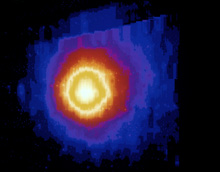
January 26, 2011 - PASADENA, Calif. -- NASA's Stardust spacecraft has downlinked its first images of comet Tempel 1, the target of a flyby planned for Valentine's Day, Feb. 14. The images were taken on Jan. 18 and 19 from a distance of 26.3 million kilometers (16.3 million miles), and 25.4 million kilometers (15.8 million miles) respectively. On Feb. 14, Stardust will fly within about 200 kilometers (124 miles) of the comet's nucleus.
snip
------------------------------
Valentines day has come and the folks at JPL are very pleased with the latest results of their comet chaser STARDUST-NExT.
- LRK -
------------------------------
http://stardustnext.jpl.nasa.
Stardust-NExT Introduction
 On January 15, 2006, the Stardust spacecraft completed one history-making mission and began another. Returning from a rendezvous with Comet Wild 2, the spacecraft approached Earth and jettisoned the capsule containing particles collected directly from the comet, as well as interstellar dust medium. The capsule landed safely and on-target southwest of Salt Lake City, Utah, completing the world's first sample return from a comet.
Now this spacecraft is on a new record-setting mission: a visit to Comet Tempel 1. Comet Tempel 1 was the comet previously targeted by the Deep Impact mission, making Stardust-NExT the first-ever follow-up mission to a comet.
snip
------------------------------
Stardust spacecraft has passed Tempel 1.
- LRK -
------------------------------
http://www.jpl.nasa.gov/news/
NASA's Stardust Spacecraft Completes Comet Flyby
February 14, 2011
PASADENA, Calif. - Mission controllers at NASA's Jet Propulsion Laboratory, Pasadena, Calif., watched as data downlinked from the Stardust spacecraft indicated it completed its closest approach with comet Tempel 1. An hour after closest approach, the spacecraft turned to point its large, high-gain antenna at Earth. It is expected that images of the comet's nucleus collected during the flyby will be received on Earth starting at about midnight California time (3 a.m. EST on Tuesday, Feb. 15).
Preliminary data already transmitted from the spacecraft indicate the time of closest approach was about 8:39 p.m. PST (11:39 p.m. EST), at a distance of 181 kilometers (112 miles) from Tempel 1.
This is a bonus mission for the comet chaser, which previously flew past comet Wild 2 and returned samples from its coma to Earth. During this bonus encounter, the plan called for the spacecraft to take images of the comet's surface to observe what changes occurred since a NASA spacecraft last visited. (NASA's Deep Impact spacecraft executed an encounter with Tempel 1 in July 2005).
Stardust-NExT is a low-cost mission that will expand the investigation of comet Tempel 1 initiated by NASA's Deep Impact spacecraft. JPL, a division of the California Institute of Technology in Pasadena, manages Stardust-NExT for NASA's Science Mission Directorate, Washington, D.C. Lockheed Martin Space Systems, Denver, built the spacecraft and manages day-to-day mission operations.
For more information about Stardust-NExT, visit: http://stardustnext.jpl.nasa.
Media contacts:
DC Agle 818-393-9011
Jet Propulsion Laboratory, Pasadena, Calif.
agle@jpl.nasa.gov
Dwayne Brown 202-358-1726
NASA Headquarters, Washington
dwayne.c.brown@nasa.gov
Blaine Friedlander 607-254-6235
Cornell University, Ithaca, N.Y.
bpf2@cornell.edu
snip
------------------------------
JPL getting pictures of Tempel 1.
- LRK -
------------------------------
http://www.jpl.nasa.gov/news/
Comet Hunter's First Images on the Ground
February 15, 2011
PASADENA, Calif. -- Mission controllers at NASA's Jet Propulsion Laboratory, Pasadena, Calif., have begun receiving the first of 72 anticipated images of comet Tempel 1 taken by NASA's Stardust spacecraft.
The first six, most distant approach images are available at http://www.nasa.gov/stardust and http://www.jpl.nasa.gov. Additional images, including those from closest approach, are being downlinked in chronological order and will be available later in the day.
A news conference will be held at 12:30 p.m. PST (3:30 p.m. EST) to allow scientists more time to analyze the data and images.
Stardust-NExT is a low-cost mission that expands on the investigation of comet Tempel 1 initiated by NASA's Deep Impact spacecraft. JPL, a division of the California Institute of Technology in Pasadena, manages Stardust-NExT for NASA's Science Mission Directorate, Washington, D.C. Joe Veverka of Cornell University, Ithaca, N.Y., is the mission's principal investigator. Lockheed Martin Space Systems, Denver, built the spacecraft and manages day-to-day mission operations.
More information about Stardust-NExT is available at http://stardustnext.jpl.nasa.
Media contacts:
DC Agle 818-393-9011
Jet Propulsion Laboratory, Pasadena, Calif.
agle@jpl.nasa.gov
Dwayne Brown 202-358-1726
NASA Headquarters, Washington
dwayne.c.brown@nasa.gov
Blaine Friedlander 607-254-6235
Cornell University, Ithaca, N.Y.
bpf2@cornell.edu
snip
------------------------------
Thanks for looking up with me.
- LRK -
Web Site: http://lkellogg.vttoth.com/
BlogSpot: http://kelloggserialreports.
RSS link: http://kelloggserialreports.
Newsletter: https://news.altair.com/
==============================
NASA Comet Hunter Spots Its Valentine
JPL Press Release
January 26, 2011 - PASADENA, Calif. -- NASA's Stardust spacecraft has downlinked its first images of comet Tempel 1, the target of a flyby planned for Valentine's Day, Feb. 14. The images were taken on Jan. 18 and 19 from a distance of 26.3 million kilometers (16.3 million miles), and 25.4 million kilometers (15.8 million miles) respectively. On Feb. 14, Stardust will fly within about 200 kilometers (124 miles) of the comet's nucleus.
 |
|---|
snip
------------------------------
Valentines day has come and the folks at JPL are very pleased with the latest results of their comet chaser STARDUST-NExT.
- LRK -
------------------------------
http://stardustnext.jpl.nasa.
Stardust-NExT Introduction
On January 15, 2006, the Stardust spacecraft completed one history-making mission and began another. Returning from a rendezvous with Comet Wild 2, the spacecraft approached Earth and jettisoned the capsule containing particles collected directly from the comet, as well as interstellar dust medium. The capsule landed safely and on-target southwest of Salt Lake City, Utah, completing the world's first sample return from a comet.Now this spacecraft is on a new record-setting mission: a visit to Comet Tempel 1. Comet Tempel 1 was the comet previously targeted by the Deep Impact mission, making Stardust-NExT the first-ever follow-up mission to a comet.
snip
------------------------------
Stardust spacecraft has passed Tempel 1.
- LRK -
------------------------------
http://www.jpl.nasa.gov/news/
NASA's Stardust Spacecraft Completes Comet Flyby
February 14, 2011
PASADENA, Calif. - Mission controllers at NASA's Jet Propulsion Laboratory, Pasadena, Calif., watched as data downlinked from the Stardust spacecraft indicated it completed its closest approach with comet Tempel 1. An hour after closest approach, the spacecraft turned to point its large, high-gain antenna at Earth. It is expected that images of the comet's nucleus collected during the flyby will be received on Earth starting at about midnight California time (3 a.m. EST on Tuesday, Feb. 15).
Preliminary data already transmitted from the spacecraft indicate the time of closest approach was about 8:39 p.m. PST (11:39 p.m. EST), at a distance of 181 kilometers (112 miles) from Tempel 1.
This is a bonus mission for the comet chaser, which previously flew past comet Wild 2 and returned samples from its coma to Earth. During this bonus encounter, the plan called for the spacecraft to take images of the comet's surface to observe what changes occurred since a NASA spacecraft last visited. (NASA's Deep Impact spacecraft executed an encounter with Tempel 1 in July 2005).
Stardust-NExT is a low-cost mission that will expand the investigation of comet Tempel 1 initiated by NASA's Deep Impact spacecraft. JPL, a division of the California Institute of Technology in Pasadena, manages Stardust-NExT for NASA's Science Mission Directorate, Washington, D.C. Lockheed Martin Space Systems, Denver, built the spacecraft and manages day-to-day mission operations.
For more information about Stardust-NExT, visit: http://stardustnext.jpl.nasa.
Media contacts:
DC Agle 818-393-9011
Jet Propulsion Laboratory, Pasadena, Calif.
agle@jpl.nasa.gov
Dwayne Brown 202-358-1726
NASA Headquarters, Washington
dwayne.c.brown@nasa.gov
Blaine Friedlander 607-254-6235
Cornell University, Ithaca, N.Y.
bpf2@cornell.edu
snip
------------------------------
JPL getting pictures of Tempel 1.
- LRK -
------------------------------
http://www.jpl.nasa.gov/news/
Comet Hunter's First Images on the Ground
February 15, 2011
PASADENA, Calif. -- Mission controllers at NASA's Jet Propulsion Laboratory, Pasadena, Calif., have begun receiving the first of 72 anticipated images of comet Tempel 1 taken by NASA's Stardust spacecraft.
The first six, most distant approach images are available at http://www.nasa.gov/stardust and http://www.jpl.nasa.gov. Additional images, including those from closest approach, are being downlinked in chronological order and will be available later in the day.
A news conference will be held at 12:30 p.m. PST (3:30 p.m. EST) to allow scientists more time to analyze the data and images.
Stardust-NExT is a low-cost mission that expands on the investigation of comet Tempel 1 initiated by NASA's Deep Impact spacecraft. JPL, a division of the California Institute of Technology in Pasadena, manages Stardust-NExT for NASA's Science Mission Directorate, Washington, D.C. Joe Veverka of Cornell University, Ithaca, N.Y., is the mission's principal investigator. Lockheed Martin Space Systems, Denver, built the spacecraft and manages day-to-day mission operations.
More information about Stardust-NExT is available at http://stardustnext.jpl.nasa.
Media contacts:
DC Agle 818-393-9011
Jet Propulsion Laboratory, Pasadena, Calif.
agle@jpl.nasa.gov
Dwayne Brown 202-358-1726
NASA Headquarters, Washington
dwayne.c.brown@nasa.gov
Blaine Friedlander 607-254-6235
Cornell University, Ithaca, N.Y.
bpf2@cornell.edu
snip
------------------------------
Thanks for looking up with me.
- LRK -
Web Site: http://lkellogg.vttoth.com/
BlogSpot: http://kelloggserialreports.
RSS link: http://kelloggserialreports.
Newsletter: https://news.altair.com/
==============================
http://stardust.jpl.nasa.gov/
http://stardust.jpl.nasa.gov/
This image and diagram show the comet Wild 2, which NASA's Stardust spacecraf t flew by on Jan. 2, 2004. The picture on the left is the closest short exposure of the comet, taken at an11.4-degree phase angle, the angle between the camera, comet and the Sun. The listed names on the right are those used by the Stardust team to identify features. "Basin" does not imply an impact origin.
http://stardust.jpl.nasa.gov/
This image and diagram show the comet Wild 2, which NASA's Stardust spacecraf t flew by on Jan. 2, 2004. The picture on the left is the closest short exposure of the comet, taken at an11.4-degree phase angle, the angle between the camera, comet and the Sun. The listed names on the right are those used by the Stardust team to identify features. "Basin" does not imply an impact origin.
snip
==============================
http://en.wikipedia.org/wiki/
81P/Wild
Comet 81P/Wild, also known as Wild 2 (pronounced /ˈvɪlt/ Vilt), is a comet named after Swiss astronomer Paul Wild, who discovered it in 1978 using a 40-cm Schmidt telescope at Zimmerwald.[4]
For most of its 4.5 billion-year lifetime, Wild 2 probably had a more distant and circular orbit. In September 1974, it passed within less than one million kilometers of the planet Jupiter, whose strong gravitational pull perturbed the comet's orbit and brought it into the inner Solar System.[5] Its orbital period changed from 43 years to about 6 years,[5] and its perihelion is now about 1.59 AU (astronomical unit).[6]
snip
==============================
http://deepimpact.umd.edu/
Discovery
Comet 9P/Tempel 1 was discovered on April 3, 1867 by Ernst Wilhelm Leberecht Tempel of Marseille, France while visually searching for comets. The comet was then 9th magnitude and described by Tempel as having an apparent diameter of 4 to 5 arcmin across. Later calculations revealed that the comet had been situated 0.71 AU from the Earth and 1.64 AU from the sun at that time.
snip
==============================
WHAT THE MIND CAN CONCEIVE, AND BELIEVE, IT WILL ACHIEVE - LRK
==============================
==============================
http://en.wikipedia.org/wiki/
81P/Wild
Comet 81P/Wild, also known as Wild 2 (pronounced /ˈvɪlt/ Vilt), is a comet named after Swiss astronomer Paul Wild, who discovered it in 1978 using a 40-cm Schmidt telescope at Zimmerwald.[4]
For most of its 4.5 billion-year lifetime, Wild 2 probably had a more distant and circular orbit. In September 1974, it passed within less than one million kilometers of the planet Jupiter, whose strong gravitational pull perturbed the comet's orbit and brought it into the inner Solar System.[5] Its orbital period changed from 43 years to about 6 years,[5] and its perihelion is now about 1.59 AU (astronomical unit).[6]
snip
==============================
http://deepimpact.umd.edu/
Discovery
Comet 9P/Tempel 1 was discovered on April 3, 1867 by Ernst Wilhelm Leberecht Tempel of Marseille, France while visually searching for comets. The comet was then 9th magnitude and described by Tempel as having an apparent diameter of 4 to 5 arcmin across. Later calculations revealed that the comet had been situated 0.71 AU from the Earth and 1.64 AU from the sun at that time.
snip
==============================
WHAT THE MIND CAN CONCEIVE, AND BELIEVE, IT WILL ACHIEVE - LRK
==============================