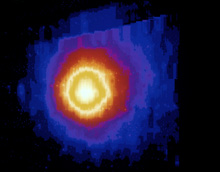
I thought we were going to go to the Moon and soon we would see this
view as shown on inside of the NASA SP-509 boxed set of books compiled
from the NASA Space Institute 1992 Summer Study. Some number of years
back the books were scanned and made available on-line. I thought we
would be reporting on the results of the ideas discussed and see them
unfold in real time.
- LRK -
Now it doesn't look so promising. See what we are missing out on.
http://lkellogg.vttoth.com/LarryRussellKellogg/reports.html
LarryKelloggReports# - has been frozen in time.
Updated some dead links and maybe you can use them to view on-line.
http://lkellogg.vttoth.com/LarryRussellKellogg/LarryKelloggReports.htm
If you want the boxed set of NASA SP-509 you might buy one from Univelt
for $130. :-)
- LRK -
-----------------------------------------------
http://www.univelt.com/univeltdist/NASAoopb.htm
snip
SPACE RESOURCES, Edited by Mary Fae McKay, David S. McKay and Michael
B. Duke, 1992, 942p., in an Overview Plus Four Technical Volumes, NASA
SP-509, Soft Cover $130.00
This volume is a must for those wanting a background on, and help in
understanding, how Space Resources must be used to support life in
space, including on the Moon and in exploring Mars. It emphasizes the
concept that space travelers must apply their high technology tools in
using local resources away from the Earth.
The concept for this report was developed at a NASA-sponsored summer
study held at the Scripps Campus at U.C. San Diego, 1984, under the
auspices of the American Society for Engineering Education; and was
jointly managed by the California Space Institute and NASA Johnson
Space Center under the direction of the Office of Aeronautics and
Space Technology (OAST) at NASA Headquarters. Many individuals, who
are experts in the various disciplines of space sciences/astronautics
participated in this study and contributed their expertise in
preparing this written report which incorporates the latest research
concepts current just before the date of publication of the report.
This Space Resources report is divided into a brief overview and four
detailed technical volumes:
Vol. 1, Scenarios;
Vol. 2, Energy, Power and Transport;
Vol. 3, Materials;
Vol. 4, Social Concerns.
The volumes cover how space resources can be used in the development
of future space activities, and define the necessary research and
development that must precede the practical utilization of these
resources. Space resources considered include lunar soil, oxygen
derived from lunar soil, material retrieved from near-Earth asteroids,
abundant sunlight, low gravity, and high vacuum. The direct use of
these resources, the potential demand for products from them, the
techniques for retrieving and processing space resources, the
necessary infrastructure, and the economic tradeoffs are analyzed. The
central conclusion is that near-Earth resources can indeed foster the
growth of human activities in space.
Numerous Illustrations included.
-----------------------------------------------
If you want to learn how to launch rockets here and to the Moon, there
are some early books written by Martin Marietta back in 1963.
(NASA SP-33 and NASA SP-34 to name two)
These have been scanned and are on the NASA Technical Reports Server
but I found them hard to down load as the server often times out or
takes too long to connect. If you want to try here is the link to the
Develop Space net - Astrodynamics Library where the pdf files have
been listed.
http://wiki.developspace.net/Astrodynamics_Library
Here is a link to NASA SP-33 Orbital Flight Handbook Part 1 that can
be read on-line.
http://www.scribd.com/doc/8532290/NASA-Orbital-Flight-HandbookPart1
[Didn't find Part 2 or Part 3 on line. - LRK - ]
and
Space Flight Handbooks. Volume 2- Lunar Flight Handbook. Part 1 -
Background Material, NASA-SP-34
http://www.scribd.com/doc/24339724/Space-Flight-Handbooks-Volume-2-Lunar-Flight-Handbook-Part-1-Background-Material-Nasa-sp-34-Pt-1
Space Flight Handbooks. Volume 2- Lunar Flight Handbook Part 2 - Lunar
Mission Phases, NASA-SP-34,
http://www.scribd.com/Space-Flight-Handbooks-Volume-2-Lunar-Flight-Handbook-Part-2-Lunar-Mission-Phases-Nasa-sp-34-Pt-2/d/24341707
We could update Larry Kellogg Reports but I don't know what we should report on.
Thanks for looking up with me.
Larry Kellogg
Web Site: http://lkellogg.vttoth.com/LarryRussellKellogg/
BlogSpot: http://kelloggserialreports.blogspot.com/
RSS link: http://kelloggserialreports.blogspot.com/atom.xml
Newsletter: https://news.altair.com/mailman/listinfo/lunar-update
==============================================================
http://kelloggserialreports.blogspot.com/2008/09/lunar-flight-handbook-nasa-sp-34-part1.html
Past post on about NASA SP-34
The links are to the NASA NTRS server and don't always oblige when
accessed and the files are large. - LRK -
snip
==============================================================
http://www.sti.nasa.gov/STI-public-homepage.html
NASA Technical Reports Server
Access to unlimited/unrestricted NASA and NACA reports and journal
articles, many available as full-text, searchable PDF files; advanced
searches include non-NASA information received through automated
harvesting..
snip
==============================================================
WHAT THE MIND CAN CONCEIVE, AND BELIEVE, IT WILL ACHIEVE - LRK
==============================================================
Friday, February 26, 2010


Saturday, February 13, 2010
Hydrogen solid storage - Are we going to hear more about this?
Note: A number of links are now dead as Ovonic Hydrogen Systems has been acquired by BASIF and there are some patent disputes. 09/24/15
https://en.wikipedia.org/wiki/Cobasys
- LRK -
Hydrogen and Oxygen, burned to make a lot of hot steam to provide
thrust for a rocket - to where?
Well, that is a question yet to be answered.
Getting back to a more down to Earth use of Hydrogen, we hear about
using Hydrogen to fuel cars.
It is hard to compress and store hydrogen and finding ways to make it
easier for the everyday person to use Hydrogen in a fuel cell would be
good.
Hydrogen solid storage - Are we going to hear more about this?
Google started a new service, "BUZZ" and I was looking at some posts
by folks on my Gmail List.
I noticed a comment about a video - Breaking News Videos from CNN.com
- where it talks about a way to make Hydrogen in your home and store
it in a solid form that can be used to free up Hydrogen to use in a
fuel cell that in turn can produce electricity to run a motor.
http://www.cnn.com/video/?/
If you watch the video you will see the products from the company,
Horizon, and a demo of using stored Hydrogen in a small radio
controlled car.
Here are a link to information about the 'HYDROSTIK' refillable
solid-state hydrogen cartridges, the 'HYDROFILL' home hydrogen
refueling unit for the HydroSTIK, and a MiniPAK "Personal Power
Center", that can be used to recharge our many electronic gadgets.
----------------------------------------------------------------
http://www.horizonfuelcell.
HYDROSTIK - The fuel cartridge used in the MiniPak called HydroSTIK
has a battery-like form factor and contains a special metal alloy that
allows hydrogen to be stored in a solid-state, as part of the metal
alloy matrix inside the cartridge. In contrast with ordinary
compressed hydrogen tanks, the pressure inside the canister is very
low, making this device the safest and most practical means of storing
hydrogen. The HydroSTIK has the additional advantages of being
refillable (from pressurized gas bottles, or from water-electrolysis
based devices), non-toxic, eco-friendly, and competitive on
cost/performance with existing battery devices. Each HydroSTIK can
store 15Wh of energy, enough for 2 to 3 charges of a 3G smartphone, or
4-6 charges for average cellphones, which is more than what present
primary and rechargeable batteries are able to offer at equivalent
cost.
HYDROFILL - The HydroFILL is a "world-first" small-scale home hydrogen
station that allows consumers or retailers/distributors to refill
solid state canisters in a simple way, using water and electricity as
only input. By adding water, and plugging the HydroFILL into a
electrical wall-socket (or a solar panel), consumers can generate
hydrogen and store it in a solid form automatically in HydroSTIK
cartrridges. Once full, the battery-like "solid-state"HydroSTIKs can
be unplugged from the HydroFILL and placed into the MiniPak (or other
fuel cell devices) to deliver power via a USB port.
------------------------------
And this is about a company in the USA that has a number of 'Green'
products including storing Hydrogen in a solid form.
http://www.ovonic.com/pdfs/
http://ovonics.com/
- LRK -
------------------------------
http://www.ovonic.com/PDFs/
Hydrogen Hybrid Vehicle Powered With Ovonic® Solid State Hydrogen Storage
A practical first step on the road to a hydrogen-fueled future
Rochester Hills, Mich., September 21, 2005
There is no doubt that hydrogen is one of the most promising fuels of
the future. The only remaining questions are how and when America’s
transportation fleet will make the leap to this clean, renewable
energy carrier. Energy Conversion Devices, Inc. (ECD Ovonics)
(NASDAQ: ENER) is convinced that the when is soon and the how is by
means of a methodical transition from today’s fossil-fueled vehicles
to cars and trucks engineered for hydrogen propulsion. To take a long
stride forward on this path, ECD Ovonics and its partners
successfully completed a demonstration project to modify a commercial
gasoline/electric hybrid vehicle to run on hydrogen utilizing a new
low-pressure, metal hydride hydrogen storage system developed and
manufactured by Ovonic Hydrogen Systems, LLC.
snip
------------------------------
Some more information just to make sure the word gets out that there
are ways to store Hydrogen that may prove to be useful to the general
public.
- LRK -
------------------------------
http://ovonics.com/ib_hy_
Ovonic Hydrogen Systems is proud to be the first manufacturer of metal
hydride storage systems authorized by the US Department of
Transportation (DOT) to offer a family of portable canisters that can
be transported with hydrogen. This authorization allows ready-to-use
charged canisters to be shipped to and transported by you and your
customers. A copy of our DOT special permit must accompany shipment of
the canisters.
------------------------------
This next link contains information from 2005 and before. It takes
time for new technologies to make it to market and of course there
needs to be a market.
Electric cars have been around since the beginning of car history but
they have not made it to the mass market. Now we have been seeing the
high price of oil and gasoline so the Hybrid car is gaining
acceptance. There is more talk about using Hydrogen as a fuel but
handling Hydrogen presents problems, if not real, at least in the
public eye. You have watched the shuttle launches with fueling of LOX
and un-filling when something isn't just right. Even if using gaseous
Hydrogen there is the problem of storing enough in a car's tanking
system to have a suitable range. Storing Hydrogen in a solid state
looks interesting. Will we hear more about it?
- LRK -
------------------------------
http://www.greencar.com/
Ovonic H2 Prius Showcases Solid Hydrogen Storage Technology
As the “hydrogen highway” vision takes form through incremental
technology advancements and demonstrations on many levels, much of the
glory is captured by hydrogen fuel cell vehicles. It’s true that
they’re marvels of technology and are deserving of this attention. As
shared in Green Car Journal’s Summer 2005 issue (“Hydrogen/Where We
Are on the Drive to the Future”), automakers have come a long way and
these vehicles are so good, they make it seem effortless to drive on
this most environmentally positive fuel. But that’s far from the case.
snip
Stanford Ovshinsky
This story begins and ends with Stanford Ovshinsky, an inventor of
rarified stature who, many decades ago, made discoveries involving
amorphous and disordered materials that created a whole new area of
materials science. He was recognized with a Time Magazine “Heroes of
the Planet Award” because of this work and how it led to many
breakthrough applications, including his patented nickel-metal-hydride
batteries (he and the company he founded, Rochester Hills,
Michigan-based Energy Conversion Devices, hold the patents). As it
turns out, this work has also led to the ability to store hydrogen in
solid form at low pressure, a technology being developed by ECD
business unit Ovonic Hydrogen Systems.
This is no small thing. Before we can buy a hydrogen-fueled vehicle in
the showroom, some big technical hurdles need to be overcome in the
lab, and one of the biggest is hydrogen storage. A hydrogen vehicle’s
range depends directly on how efficiently this fuel can be converted
to motive power and, more fundamentally, how much fuel can be stored
on-board. Range will be especially important in the early years of
hydrogen vehicle commercialization since a refueling infrastructure
will still be in its infancy.
snip
Then there’s the approach offered by Ovonic Hydrogen Systems’ solid
hydrogen storage, a concept so clever and intriguing it seems
improbable…yet it works. A tank containing powdered metal alloys is
filled with hydrogen at a relatively low 1,500 psi. Removing heat
during the process causes the metal to absorb hydrogen like a sponge,
and a new material called a metal hydride is created. Hydrogen stored
in solid form like this is in a safer state and can be stored within a
tank at a lower 250 psi. On-board systems determine when hydrogen is
needed by an engine or fuel cell, providing heat to reverse the
process so gaseous hydrogen is released from the hydride and into the
fuel system. In an interesting phenomenon, a greater volume of
hydrogen can be stored in the same size cylinder with metal alloy than
without it, a consideration that provides better driving range.
snip
------------------------------
Well there you go. Happy tanking. If you don't see this again, maybe
one will need to look into who controls our energy sources.
Just an added thought, could we use some Hydrogen solid storage tanks
at a Lunar Base?
Ooops, maybe I shouldn't be thinking such Lunar Thoughts.
- LRK -
Thanks for looking up with me.
Larry Kellogg
Web Site: http://lkellogg.vttoth.com/
BlogSpot: http://kelloggserialreports.
RSS link: http://kelloggserialreports.
Newsletter: https://news.altair.com/
Twitter: http://twitter.com/lrkellogg
==============================
http://www.wired.com/science/
Hydrogen: Less Bang for the Buck
John Gartner Email 03.19.04
The Department of Energy says that switching from gasoline- to
hydrogen-fueled cars is an important way to ensure national security
by reducing U.S. dependence on foreign oil. But the thought of driving
a vehicle that contains a highly pressurized hydrogen tank could make
some drivers uneasy.
To reduce the risk of accidentally releasing hydrogen that could
ignite and cause an explosion, scientists have developed new storage
systems that "sponge" up the gaseous hydrogen and store it inside
metal as a solid.
Many of the fuel cell cars in development store hydrogen as a gas in
tanks pressurized from 5,000 to 10,000 pounds per square inch,
requiring reinforced tanks and special nozzles to prevent hydrogen
from escaping into the air. This also puts a strain on the hydrogen
tanks and valves, said Jeffrey Schmidt, a systems engineer at Energy
Conversion Devices, or ECD.
"A minute leak could at 5,000 psi put a lot of hydrogen into the air,"
said Schmidt.
ECD has developed a metal-hydride storage system that "sponges"
gaseous hydrogen so that it is contained within a solid material,
which Schmidt says reduces the risk of serious accidents and allows
more hydrogen to be stored in the vehicle.
ECD's Ovonic solid hydrogen storage system absorbs about 6 pounds of
hydrogen into a metal hydride and produces hydrogen on demand to feed
a fuel cell or internal combustion engine.
snip
==============================
http://www.physorg.com/
More Solid than Solid: A Potential Hydrogen-Storage Compound
April 2, 2008 More solid than solid: A potential hydrogen-storage compound
MOF-74 resembles a series of tightly packed straws comprised mostly of
carbon atoms (white balls) with columns of zinc ions (blue balls)
running down the walls. Heavy hydrogen molecules (green balls)
adsorbed in MOF-74 pack into the tubes more densely than they would in
solid form. Credit: NIST
A research team from NIST, the University of Maryland and the
California Institute of Technology studied metal-organic frameworks
(MOFs). One of several classes of materials that can bind and release
hydrogen under the right conditions, they have some distinct
advantages over competitors. In principle they could be engineered so
that refueling is as easy as pumping gas at a service station is
today, and MOFs don’t require the high temperatures (110 to 500 C)
some other materials need to release hydrogen.
In particular, the team examined MOF-74, a porous crystalline powder
developed at the University of California at Los Angeles. MOF-74
resembles a series of tightly packed straws comprised of mostly carbon
atoms with columns of zinc ions running down the inside walls. A gram
of the stuff has about the same surface area as two basketball courts.
The researchers used neutron scattering and gas adsorption techniques
to determine that at 77 K (-196 C), MOF-74 can adsorb more hydrogen
than any unpressurized framework structure studied to date—packing the
molecules in more densely than they would be if frozen in a block.
NCNR scientist Craig Brown says that, though his team doesn’t
understand exactly what allows the hydrogen to bond in this fashion,
they think the zinc center has some interesting properties.
snip
==============================
WHAT THE MIND CAN CONCEIVE, AND BELIEVE, IT WILL ACHIEVE - LRK
==============================
Airborne laser shoots down missile in mid-flight
I subscribe to Jonathan's Space Report and in his latest email he
mentions an airborne laser test.
I did an Internet search for - Missile Defense Agency shoots down two
missiles with Airborne Laser - and found a number of references.
Just part of the billions spent on Star Wars.
The Christian Science Monitor says that the Pentagon isn’t happy with
the price tag, and that Defense Secretary Robert Gates canceled the
original order for a second airborne laser system, but held onto the
original aircraft for further experiments.
Will be interesting to see where the next billions of dollars are spent.
Probably not on going to the Moon now that it is a lessor priority.
- LRK -
---------------------------------------------------------
http://www.planet4589.org/space/jsr/jsr.html
Jonathan's Space Report - Latest Issue
The Space Report ("JSR") is issued about twice a month. It describes
all space launches, including both piloted missions and automated
satellites.
Jonathan's Space Report
No. 623 2010 Feb 13 Somerville, MA
----------------------------------------------------------------------------------
Editorial
----------
In an attempt to enter the 2010s, JSR updates are now available on
Facebook - look for "Jonathan's Space Report" - and Twitter - follow
"planet4589".
snip
Missile tests
-------------
The DRDO (India's defense missile agency) launched the fourth Agni III
missile from the IC4 pad on Inner Wheeler Island in Orissa on Feb 7. It
flew south or southwest over the Bay of Bengal and the Indian Ocean,
splashing down in the southern hemisphere after a 3500 km range flight
to orbital parameters of around -4070 x 350 km x (80 to 131) deg - the
exact direction of the flight is not known.
On Feb 12 the Missile Defense Agency tested the Airborne Laser against
a Scud launched from a floating platform in the Pacific and a Black Brant IX
launched from San Nicolas I. on the S Californian coast. Apogees of
the targets were probably in the 100-200 km range.
snip
---------------------------------------------------------
Here is a snip from the Christian Science Monitor article.
- LRK -
---------------------------------------------------------
http://www.csmonitor.com/Innovation/Horizons/2010/0212/Airborne-laser-shoots-down-missile-in-mid-flight
Airborne laser shoots down missile in mid-flight
The US military's airborne laser scores its first direct hit.
By Chris Gaylord / February 12, 2010
Last night, the military officially entered the age of airborne laser
weapons. A large laser mounted to the front of a modified 747 jet
successfully detected and shot down a ballistic missile while both
were in mid-flight.
The airborne laser program – part Star Wars (the sci-fi flick) and
part Star Wars (the Strategic Defense Initiative) – has taken years of
work and billions of dollars it get here. But the Pentagon can now
witness the firepower of this fully armed and operational battle
station.
"While ballistic missiles like the one [the Airborne Laser Testbed]
destroyed move at speeds of about 4,000 miles per hour, they are no
match for a super-heated, high-energy laser beam racing towards it at
670 million mph," says defense contractor Northrop Grumman in a
release after announcing the successful test Friday.
snip
In a massive collaboration, Northrop Grumman constructed the
megawatt-class high-energy laser, Lockheed Martin designed the firing
system, and Boeing tied everything together with the U.S. Missile
Defense Agency.
snip
---------------------------------------------------------
I wonder what civilian firms are going to carry us to space?
- LRK -
---------------------------------------------------------
http://www.mda.mil/news/10news0002.html
10-NEWS-0002
February 11, 2010
Airborne Laser Testbed Successful in Lethal Intercept Experiment
The Missile Defense Agency demonstrated the potential use of directed
energy to defend against ballistic missiles when the Airborne Laser
Testbed (ALTB) successfully destroyed a boosting ballistic missile.
The experiment, conducted at Point Mugu Naval Air Warfare
Center-Weapons Division Sea Range off the central California coast,
serves as a proof-of-concept demonstration for directed energy
technology. The ALTB is a pathfinder for the nation’s directed energy
program and its potential application for missile defense technology.
At 8:44 p.m. (PST), February 11, 2010, a short-range
threat-representative ballistic missile was launched from an at-sea
mobile launch platform. Within seconds, the ALTB used onboard sensors
to detect the boosting missile and used a low-energy laser to track
the target. The ALTB then fired a second low-energy laser to measure
and compensate for atmospheric disturbance. Finally, the ALTB fired
its megawatt-class High Energy Laser, heating the boosting ballistic
missile to critical structural failure. The entire engagement occurred
within two minutes of the target missile launch, while its rocket
motors were still thrusting.
This was the first directed energy lethal intercept demonstration
against a liquid-fuel boosting ballistic missile target from an
airborne platform. The revolutionary use of directed energy is very
attractive for missile defense, with the potential to attack multiple
targets at the speed of light, at a range of hundreds of kilometers,
and at a low cost per intercept attempt compared to current
technologies.
Less than one hour later, a second solid fuel short-range missile was
launched from a ground location on San Nicolas Island, Calif. and the
ALTB successfully engaged the boosting target with its High Energy
Laser, met all its test criteria, and terminated lasing prior to
destroying the second target. The ALTB destroyed a solid fuel missile,
identical to the second target, in flight on February 3, 2010.
---------------------------------------------------------
Does this mean we can now add to the space debris at the speed of light?
- LRK -
---------------------------------------------------------
http://abcnews.go.com/Technology/wireStory?id=9815043
Flying Laser Zaps Missile in First for U.S.
Military Experiment Uses Laser on 747 off California to Destroy Target
By Jim Wolf
February 12, 2010
WASHINGTON (Reuters) - A high-powered laser aboard a modified Boeing
Co 747 jumbo jet shot down an in-flight ballistic missile for the
first time, highlighting a new class of ray guns best known from
science fiction.
[ Three pages of info that copyright wise not to be redistributed so
if interested go to the link and read for yourelf. - LRK -]
---------------------------------------------------------
Well all of that is not about going to the Moon, but then I guess I
will have to wait and report about others doing that.
- LRK -
Thanks for looking up with me.
Larry Kellogg
Web Site: http://lkellogg.vttoth.com/LarryRussellKellogg/
BlogSpot: http://kelloggserialreports.blogspot.com/
RSS link: http://kelloggserialreports.blogspot.com/atom.xml
Newsletter: https://news.altair.com/mailman/listinfo/lunar-update
Twitter: http://twitter.com/lrkellogg
==============================================================
http://www.mda.mil/global/documents/pdf/06fyi0087.pdf
27 October 2006
Remarks by Lt Gen Obering at the Airborne Laser Rollout Celebration
Wichita, Kansas - 27 October 2006
Lt Gen Obering: Congressman Tiehart, Lt. Gov. Moore, Mr. Mayor, Mr.
Albaugh, Mr. Renard, Mr. Graham, and those who really count the most,
who get the job done, all of you.
I’m honored to be here today to express my thanks to all the members
of the Airborne Laser Team – government and contractor, military and
civilian, workers and the family members who support them – for the
extraordinary job all of you have done to reach this important
milestone in the Ballistic Missile Defense program.
You have overcome some formidable challenges to get us to where we are
today. But before I talk about that, I think it’s appropriate to step
back to ask some fundamental questions. Why have you been working so
hard? Why have many of you missed birthday celebrations, weekends, or
cut short vacations? Why is this capability needed so badly?
snip
==============================================================
http://www.huffingtonpost.com/2010/02/12/airborne-laser-testbed-sh_n_460446.html
DEO: Airborne Laser Shoots Down Missile In First Successful Test
First Posted: 02-12-10 02:10 PM | Updated: 02-12-10 04:07 PM
The U.S. Missile Defense Agency announced that its high-powered
airborne laser successfully shot down a ballistic missile during a
recent test.
The Airborne Laser Testbed's in-air destruction of the missile took
place on Thursday evening in central California. It was the first time
the 'futuristic directed energy weapon' succeeded in shooting down a
missile during a test.
snip
Its description on YouTube reads:
A short-range threat-representative ballistic missile was launched
from an at-sea mobile launch platform. Within seconds, the Airborne
Laser Testbed (ALTB) used onboard sensors to detect the boosting
missile and used a low-energy laser to track the target. The ALTB then
fired a second low-energy laser to measure and compensate for
atmospheric disturbance. Finally, the ALTB fired its megawatt-class
High Energy Laser, heating the boosting ballistic missile to critical
structural failure. The entire engagement occurred within two minutes
of the target missile launch, while its rocket motors were still
thrusting.
snip
http://www.youtube.com/watch?v=PQwLPC5MN1U&feature=player_embedded
==============================================================
WHAT THE MIND CAN CONCEIVE, AND BELIEVE, IT WILL ACHIEVE - LRK
==============================================================
Jonathan's Space Report - Latest Issue
The Space Report ("JSR") is issued about twice a month. It describes
all space launches, including both piloted missions and automated
satellites.
Jonathan's Space Report
No. 623 2010 Feb 13 Somerville, MA
------------------------------
Editorial
----------
In an attempt to enter the 2010s, JSR updates are now available on
Facebook - look for "Jonathan's Space Report" - and Twitter - follow
"planet4589".
snip
Missile tests
-------------
The DRDO (India's defense missile agency) launched the fourth Agni III
missile from the IC4 pad on Inner Wheeler Island in Orissa on Feb 7. It
flew south or southwest over the Bay of Bengal and the Indian Ocean,
splashing down in the southern hemisphere after a 3500 km range flight
to orbital parameters of around -4070 x 350 km x (80 to 131) deg - the
exact direction of the flight is not known.
On Feb 12 the Missile Defense Agency tested the Airborne Laser against
a Scud launched from a floating platform in the Pacific and a Black Brant IX
launched from San Nicolas I. on the S Californian coast. Apogees of
the targets were probably in the 100-200 km range.
snip
------------------------------
Here is a snip from the Christian Science Monitor article.
- LRK -
------------------------------
http://www.csmonitor.com/
Airborne laser shoots down missile in mid-flight
The US military's airborne laser scores its first direct hit.
By Chris Gaylord / February 12, 2010
Last night, the military officially entered the age of airborne laser
weapons. A large laser mounted to the front of a modified 747 jet
successfully detected and shot down a ballistic missile while both
were in mid-flight.
The airborne laser program – part Star Wars (the sci-fi flick) and
part Star Wars (the Strategic Defense Initiative) – has taken years of
work and billions of dollars it get here. But the Pentagon can now
witness the firepower of this fully armed and operational battle
station.
"While ballistic missiles like the one [the Airborne Laser Testbed]
destroyed move at speeds of about 4,000 miles per hour, they are no
match for a super-heated, high-energy laser beam racing towards it at
670 million mph," says defense contractor Northrop Grumman in a
release after announcing the successful test Friday.
snip
In a massive collaboration, Northrop Grumman constructed the
megawatt-class high-energy laser, Lockheed Martin designed the firing
system, and Boeing tied everything together with the U.S. Missile
Defense Agency.
snip
------------------------------
I wonder what civilian firms are going to carry us to space?
- LRK -
------------------------------
http://www.mda.mil/news/
10-NEWS-0002
February 11, 2010
Airborne Laser Testbed Successful in Lethal Intercept Experiment
The Missile Defense Agency demonstrated the potential use of directed
energy to defend against ballistic missiles when the Airborne Laser
Testbed (ALTB) successfully destroyed a boosting ballistic missile.
The experiment, conducted at Point Mugu Naval Air Warfare
Center-Weapons Division Sea Range off the central California coast,
serves as a proof-of-concept demonstration for directed energy
technology. The ALTB is a pathfinder for the nation’s directed energy
program and its potential application for missile defense technology.
At 8:44 p.m. (PST), February 11, 2010, a short-range
threat-representative ballistic missile was launched from an at-sea
mobile launch platform. Within seconds, the ALTB used onboard sensors
to detect the boosting missile and used a low-energy laser to track
the target. The ALTB then fired a second low-energy laser to measure
and compensate for atmospheric disturbance. Finally, the ALTB fired
its megawatt-class High Energy Laser, heating the boosting ballistic
missile to critical structural failure. The entire engagement occurred
within two minutes of the target missile launch, while its rocket
motors were still thrusting.
This was the first directed energy lethal intercept demonstration
against a liquid-fuel boosting ballistic missile target from an
airborne platform. The revolutionary use of directed energy is very
attractive for missile defense, with the potential to attack multiple
targets at the speed of light, at a range of hundreds of kilometers,
and at a low cost per intercept attempt compared to current
technologies.
Less than one hour later, a second solid fuel short-range missile was
launched from a ground location on San Nicolas Island, Calif. and the
ALTB successfully engaged the boosting target with its High Energy
Laser, met all its test criteria, and terminated lasing prior to
destroying the second target. The ALTB destroyed a solid fuel missile,
identical to the second target, in flight on February 3, 2010.
------------------------------
Does this mean we can now add to the space debris at the speed of light?
- LRK -
------------------------------
http://abcnews.go.com/
Flying Laser Zaps Missile in First for U.S.
Military Experiment Uses Laser on 747 off California to Destroy Target
By Jim Wolf
February 12, 2010
WASHINGTON (Reuters) - A high-powered laser aboard a modified Boeing
Co 747 jumbo jet shot down an in-flight ballistic missile for the
first time, highlighting a new class of ray guns best known from
science fiction.
[ Three pages of info that copyright wise not to be redistributed so
if interested go to the link and read for yourelf. - LRK -]
------------------------------
Well all of that is not about going to the Moon, but then I guess I
will have to wait and report about others doing that.
- LRK -
Thanks for looking up with me.
Larry Kellogg
Web Site: http://lkellogg.vttoth.com/
BlogSpot: http://kelloggserialreports.
RSS link: http://kelloggserialreports.
Newsletter: https://news.altair.com/
Twitter: http://twitter.com/lrkellogg
==============================
http://www.mda.mil/global/
27 October 2006
Remarks by Lt Gen Obering at the Airborne Laser Rollout Celebration
Wichita, Kansas - 27 October 2006
Lt Gen Obering: Congressman Tiehart, Lt. Gov. Moore, Mr. Mayor, Mr.
Albaugh, Mr. Renard, Mr. Graham, and those who really count the most,
who get the job done, all of you.
I’m honored to be here today to express my thanks to all the members
of the Airborne Laser Team – government and contractor, military and
civilian, workers and the family members who support them – for the
extraordinary job all of you have done to reach this important
milestone in the Ballistic Missile Defense program.
You have overcome some formidable challenges to get us to where we are
today. But before I talk about that, I think it’s appropriate to step
back to ask some fundamental questions. Why have you been working so
hard? Why have many of you missed birthday celebrations, weekends, or
cut short vacations? Why is this capability needed so badly?
snip
==============================
http://www.huffingtonpost.com/
DEO: Airborne Laser Shoots Down Missile In First Successful Test
First Posted: 02-12-10 02:10 PM | Updated: 02-12-10 04:07 PM
The U.S. Missile Defense Agency announced that its high-powered
airborne laser successfully shot down a ballistic missile during a
recent test.
The Airborne Laser Testbed's in-air destruction of the missile took
place on Thursday evening in central California. It was the first time
the 'futuristic directed energy weapon' succeeded in shooting down a
missile during a test.
snip
Its description on YouTube reads:
A short-range threat-representative ballistic missile was launched
from an at-sea mobile launch platform. Within seconds, the Airborne
Laser Testbed (ALTB) used onboard sensors to detect the boosting
missile and used a low-energy laser to track the target. The ALTB then
fired a second low-energy laser to measure and compensate for
atmospheric disturbance. Finally, the ALTB fired its megawatt-class
High Energy Laser, heating the boosting ballistic missile to critical
structural failure. The entire engagement occurred within two minutes
of the target missile launch, while its rocket motors were still
thrusting.
snip
http://www.youtube.com/watch?
==============================
WHAT THE MIND CAN CONCEIVE, AND BELIEVE, IT WILL ACHIEVE - LRK
==============================
Subscribe to:
Posts (Atom)