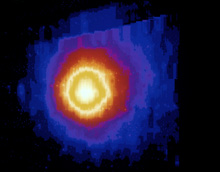
Many folks would like to see us back on the Moon and developing its resources.

Saturday, December 05, 2009

LCROSS Science Briefing November 13th 2009

One advantage to social networking is being able to see what others have seen that you may ave missed.
http://www.youtube.com/watch?v=5xVlBa6YKH4
- LRK -
-----
Bob_Richards

RT @NASA_Ames: [News] @LCROSS_NASA team Press Conference http://bit.ly/6QW8wR
[splashdown results, intro by Pete @Worden]
-----
The LCROSS Press Conference on YouTube is an hour and 20 minutes with the first 31 minutes the presentation the rest devoted to questions and answers.

I found it interesting and you could sense the excitement of the presenters.

Watching it brought back fond memories of sitting in the same auditorium when I was working at NASA Ames Research Center.

A Facebook link about LCROSS
- LRK -

http://www.facebook.com/posted.php?id=154478180006&share_id=175094893166&comments=1
Links on "LCROSS Lunar Impactor Mission"

http://www.nasa.gov/mission_pages/LCROSS/main/prelim_water_results.html
LCROSS Impact Data Indicates Water on Moon

It will be interesting to see what develops as a result of spacecraft orbiting the Moon and finding more about our nearest neighbor.

We will wait for the results from the LRO mission and how their data complements what is being seen from LCROSS.
http://lunar.gsfc.nasa.gov/

http://www.examiner.com/x-958-Tampa-Space-Program-News-Examiner~y2009m11d13-LROLCROSS-Mission-a-success--Water-on-the-moon
http://article.wn.com/view/2009/11/13/LRO_LCROSS_Mission_a_success_Water_on_the_moon_puts_moonfirs/
http://www.thaindian.com/newsportal/sci-tech/indias-lunar-mission-finds-water-on-moon-roundup_100251903.html

Exciting times and next year should be interesting too.
I hope the excitement finds its way into the ears of our Congress as well.

http://www.nasa.gov/pdf/344612main_Agency_Summary_Final_updates_5_6_09_R2.pdf
NASA FY 2010 Budget Request Summary

Mother may I have a cookie? Have you eaten all of your dinner?
Now where was the cookie jar hidden?

Thanks for looking up with me.

Larry Kellogg

Web Site: http://lkellogg.vttoth.com/LarryRussellKellogg/
BlogSpot: http://kelloggserialreports.blogspot.com/
RSS link: http://kelloggserialreports.blogspot.com/atom.xml
Newsletter: https://news.altair.com/mailman/listinfo/lunar-update
Twitter: http://twitter.com/lrkellogg
Facebook: http://www.facebook.com/lrkellogg
Google Wave: larry.kellogg@googlewave.com
Google Wave Invite info:
http://www.googlewaveinvite.com/category/google-wave-news/
https://wave.google.com/wave/
==============================================================
http://www.planetary.org/news/2009/1113_LCROSS_Lunar_Impactor_Mission_Yes_We.html
Planetary News: The Moon (2009)
LCROSS Lunar Impactor Mission: "Yes, We Found Water!"
By Emily Stewart Lakdawalla
November 13, 2009

Members of the LCROSS science team were evidently delighted to be able to report at last that when the spacecraft's spent Centaur upper stage smashed into the Moon on October 9, it excavated a crater into a spot on the lunar surface that contained "a significant amount" of water, the mission's principal investigator, Tony Colaprete, said in a press briefing today. The ejecta plume from the impact contained at least 100 kilograms of water. But the same data that conclusively identifies water also indicates that the plume contained a surprisingly complex cocktail of other elements and compounds that the team is now struggling to identify.

snip
==============================================================
http://www.nasa.gov/home/hqnews/2009/dec/HQ_09-282_SLI.html
NASA CHALLENGES 350 ROCKETEERS NATIONWIDE TO AIM A MILE HIGH

HUNTSVILLE, Ala. -- NASA has invited more than 350 student rocketeers from middle schools, high schools, colleges and universities -- 37 teams nationwide -- to take part in the 2009-2010 NASA Student Launch Projects. Their challenge is to build powerful rockets of their own design, complete with a working science payload, and launch them to an altitude of 1 mile.

These annual rocketeering projects are the Student Launch Initiative for middle school and high school teams and the University Student Launch Initiative for colleges and universities. Both challenges are designed to inspire students to parlay their interests in science, technology, engineering and mathematics into rewarding careers in fields critical to NASA's mission of exploration and scientific discovery.

snip
==============================================================
http://www.nasa.gov/home/hqnews/2009/dec/HQ_09-278_Moon_work.html
MOON WORK DESIGN CONTEST OFFERS NASA INTERNSHIPS TO WINNERS

WASHINGTON -- Talented engineering students who have ideas on how future explorers might live on the moon could find themselves working at NASA as paid interns.

The 2010 NASA Moon Work engineering design challenge seeks to motivate college students by giving them first-hand experience with the process of developing new technologies. To participate in the contest, students will submit their original design for tools or instruments that can help astronauts live and work on the moon.

Top-ranked students will be offered a chance to intern with a team from NASA's Exploration Technology Development Program.

The Exploration Technology Development Program develops new technologies that will enable NASA to conduct future human exploration missions while reducing mission risk and cost. The program is maturing near-term technologies to help enable the first flight of the Orion crew exploration vehicle and developing long-lead technologies needed for possible lunar exploration missions.

snip
==============================================================
http://www.nasa.gov/home/hqnews/2009/nov/HQ_09-277_glove_challenge.html
NASA AWARDS $350,000 TO WINNING ASTRONAUT GLOVE DESIGNERS

WASHINGTON -- NASA's Centennial Challenges program awarded $350,000 this week to a pair of designers who developed concepts for more flexible space gloves that could make it easier for astronauts to perform tasks.

The 2009 Astronaut Glove Challenge awarded a first place prize of $250,000 to Peter Homer of Southwest Harbor, Maine, and a second place prize of $100,000 to Ted Southern of Brooklyn, N.Y. The competition seeks innovative spacesuit glove design concepts to reduce the effort needed to do work during spacewalks. In this challenge, competitors demonstrated their glove design by performing a range of tasks with the glove in a pressurized chamber.

snip
==============================================================

WHAT THE MIND CAN CONCEIVE, AND BELIEVE, IT WILL ACHIEVE - LRK

==============================================================

Tuesday, December 01, 2009

The Pioneer Anomaly in the Light of New Data

Carl Walter asked me for an update on the Pioneer Anomaly and I had to check and see if anything new was being published.
I thought I would check and see if Dr. Slava Turyshev and Viktor Toth might have something and sure enough, google found this. [Note: Viktor hosts my web site so maybe a bit biased. - LRK -]
-------------------------------------------------------------
The Pioneer Anomaly in the Light of New Data
Abstract
The radio-metric tracking data received from the Pioneer 10 and 11 spacecraft from the distances between 20–70 astronomical units from the Sun has consistently indicated the presence of a small, anomalous, blue-shifted Doppler frequency drift that limited the accuracy of the orbit reconstruction for these vehicles. This drift was interpreted as a sunward acceleration of aP = (8.74±1.33)×10−10 m/s2 for each particular spacecraft. This signal has become known as the Pioneer anomaly; the nature of this anomaly is still being investigated.

Recently new Pioneer 10 and 11 radio-metric Doppler and flight telemetry data became available. The newly available Doppler data set is much larger when compared to the data used in previous investigations and is the primary source for new investigation of the anomaly. In addition, the flight telemetry files, original project documentation, and newly developed software tools are now used to reconstruct the engineering history of spacecraft. With the help of this information, a thermal model of the Pioneers was developed to study possible contribution of thermal recoil force acting on the spacecraft. The goal of the ongoing efforts is to evaluate the effect of on-board systems on the spacecrafts’ trajectories and possibly identify the nature of this anomaly.

Techniques developed for the investigation of the Pioneer anomaly are applicable to the New Horizons mission. Analysis shows that anisotropic thermal radiation from on-board sources will accelerate this spacecraft by ∼41×10−10 m/s2.We discuss the lessons learned from the study of the Pioneer anomaly for the New Horizons spacecraft. Keywords Pioneer anomaly · gravitational experiments · deep-space navigation · thermal modeling.

Slava G. Turyshev
Jet Propulsion Laboratory, California Institute of Technology,
4800 Oak Grove Drive, Pasadena, CA 91109 USA
E-mail: turyshev@jpl.nasa.gov
Viktor T. Toth
Ottawa, ON K1N 9H5, Canada
E-mail: vttoth@vttoth.com
-------------------------------------------------------------
We haven't always had spacecraft you know.
I just finished reading a chapter from "The YOUNG FOLKS TREASURY", Vol. VIII, "WONDERS OF SCIENCE AND INVENTION", entitled "The Motor Vehicle," by Herbert T. Wade, where he talks about cars that used steam, or electricity, or even a gas-engine. Oh, I failed to mention, the books were copyright 1909, a year before my mom started her life of living through all these technological advances. :-)
[Note to myself - I can still read a hundred year old book - Wonder if my Amiga computer still works.]
I can't wait to read the next chapter, "The Flying Machine," and then "The Gyroscope and Its Applications."
Could they have even thought about Cell Phones that show pictures that rotate to match which way you hold it?
Are we having fun yet? And what will we think of when we start developing the resources of the Moon?
https://wave.google.com/wave/
==============================================================
Viktor Toth's articles on arXiv
http://arxiv.org/a/toth_v_1
snip
[7] arXiv:0906.0399 [ps, pdf, other]
Title: The Pioneer Anomaly in the Light of New Data
Comments: 19 pages, 5 figures
Subjects: General Relativity and Quantum Cosmology (gr-qc)
snip
[9] arXiv:0903.0075 [pdf]
Title: Study of the Pioneer Anomaly: A scientific detective story
Authors: Viktor T. Toth
Comments: 4 pages, 1 figure. Invited article
Journal-ref: The Postgraduate Magazine 2007;1:24-30 (School of Mathematics and Statistics, University of Newcastle Upon Tyne)
Subjects: Space Physics (physics.space-ph)
snip
[12] arXiv:0901.3466 [ps, pdf, other]
Title: Independent analysis of the orbits of Pioneer 10 and 11
Authors: Viktor T. Toth
Comments: 22 pages, 5 figures; accepted for publication in IJMPD
Journal-ref: Int.J.Mod.Phys.D18:717-741,2009
Subjects: Space Physics (physics.space-ph); General Relativity and Quantum Cosmology (gr-qc)
snip
Title: Pioneer Anomaly: Evaluating Newly Recovered Data
Comments: 12 pages, 15 figures, invited talk at the "III Mexican Meeting on Mathematical and Experimental Physics," Mexico City, Mexico, 10-14 September 2007
Journal-ref: AIPConf.Proc.977:264-283,2008
Subjects: General Relativity and Quantum Cosmology (gr-qc)
[19] arXiv:0710.0191 [ps, pdf, other]
Title: Physics Engineering in the Study of the Pioneer Anomaly
Comments: 6 pages, 5 figures, invited talk at the "IV Physics Engineering International Meeting," Mexico City, Mexico, 15-19 October 2007
Subjects: Space Physics (physics.space-ph); General Relativity and Quantum Cosmology (gr-qc); General Physics (physics.gen-ph)
[20] arXiv:gr-qc/0603016 [ps, pdf, other]
Title: The Pioneer Anomaly: Seeking an explanation in newly recovered data
Comments: Final manuscript prior to publication; 20 pages, 23 figures, 1 table
Journal-ref: Can.J.Phys.84:1063-1087,2006
Subjects: General Relativity and Quantum Cosmology (gr-qc)
[21] arXiv:gr-qc/0512121 [ps, pdf, other]
Title: The Study of the Pioneer Anomaly: New Data and Objectives for New Investigation
Comments: 43 pages, 40 figures, 3 tables, minor changes before publication
Journal-ref: Int.J.Mod.Phys.D15:1-56,2006
Subjects: General Relativity and Quantum Cosmology (gr-qc)

snip
==============================================================

WHAT THE MIND CAN CONCEIVE, AND BELIEVE, IT WILL ACHIEVE - LRK

==============================================================

Friday, November 20, 2009

What an interesting time we live in.

I am watching on cable TV the Numb3s program where mathematics is used to solve FBI crime cases.
I know, it is TV, but still, an interesting program that shows how mathematics can be useful, well if you are a math genius. :-)
http://www.cbs.com/primetime/numb3rs/

At the same time I am watching on my laptop the live TV of the STS-129 crew and the those on the ISS with a Bluetooth wireless headset so as not to bother others.
This has been from launch to docking to working on EVAs.
http://www.nasa.gov/mission_pages/shuttle/shuttlemissions/sts129/
http://www.nasa.gov/multimedia/nasatv/index.html
http://tinyurl.com/ykh2hb8 for Plantronics

Then there is Google's new Wave where a YouTube of NASA TV live has been made available to those that have received invitations to the pre-Beta release of Wave.
https://wave.google.com/wave/#restored:wave:googlewave.com!w%252BAAcnCi2UA

And a Wave that has useful links for the STS-129 mission.
https://wave.google.com/wave/#restored:wave:googlewave.com!w%252BNH3IxUaoG

We now have intelligent cell phones where you can send pictures, use GPS navigation, play games, search the Internet, and even call a friend by way of voice or text.
http://www.verizonwireless.com/b2c/index.html
http://www.wireless.att.com/cell-phone-service/cell-phones/pda-phones-smartphones.jsp
http://pocketpccentral.net/device_menus/android.htm
http://reviews.cnet.com/smartphone-reviews/

Missions are now taking place at our nearest neighbor, the Moon or have recently ended.
http://en.wikipedia.org/wiki/List_of_current_and_future_lunar_missions
http://www.sfgate.com/cgi-bin/article.cgi?f=/c/a/2009/06/17/MNJ41887O2.DTL
http://news.cnet.com/8301-19514_3-10268241-239.html
http://www.kaguya.jaxa.jp/index_e.htm
http://www.astrobio.net/pressrelease/3240/early-end-to-indias-moon-mission
http://www.chinadaily.com.cn/china/2009-03/01/content_7523687.htm

And of course there have been and are deep space probes.
http://www.vttoth.com/probes/probes.asp
http://en.wikipedia.org/wiki/Space_probe
http://www.nasa.gov/missions/deepspace/index.html

Now when do we as Earth bound citizens learn to live off world and establish a human presence?
http://lkellogg.vttoth.com/LarryRussellKellogg/colonies.html
http://www.lpi.usra.edu/education/explore/colonies/
http://www.nss.org/settlement/library.html

Thanks for looking up with me.

Larry Kellogg

Web Site: http://lkellogg.vttoth.com/LarryRussellKellogg/
BlogSpot: http://kelloggserialreports.blogspot.com/
RSS link: http://kelloggserialreports.blogspot.com/atom.xml
Newsletter: https://news.altair.com/mailman/listinfo/lunar-update
Twitter: http://twitter.com/lrkellogg
Google Wave Invite info: http://mashable.com/2009/09/29/google-wave-invites-2/
http://www.googlewaveinvite.com/
https://services.google.com/fb/forms/wavesignup/
http://www.googlewaveinvite.com/category/google-wave-news/

==============================================================
http://writings.mike-combs.com/deaddebr.htm
Deadly Debris
By Mike Combs
mikecombs@aol.com
Copyright © 1995

In a low Earth orbit, a glove slowly tumbled in the brilliant sunshine. The glove's career as a tiny artificial satellite of the earth began on the day an astronaut of the early American space program had neglected to keep up with it. While the spacewalker was distracted with other matters, the glove had decided to venture out of the space capsule. By the time he took note of this, it had drifted beyond his reach.

The orbiting item of apparel had even deserved mention in books and magazine articles as an example of the kind of objects Space Command could track with its space-scanning radars. The glove dutifully returned every radar signal bounced up to it. As it rounded the blue-and-white globe below, it was privy to the kind of view which had never failed to deeply move the humans who had made it. The glove alternately warmed in the unimpeded rays of the sun and chilled in the shadow of the Earth as it progressed through innumerable ninety-minute days.

On this day, however, its circular journeys were coming to an end. The glove's path was intersecting with that of a defunct Russian weather satellite. It hit the bulky space platform almost dead-on with a velocity which would have made a rifle bullet seem a dawdler. The metal and plastic structure erupted with myriad pieces of debris. Mere minutes later, that swarm of fragments began slamming into the abandoned lower stage of a rocket launched over a decade ago. The giant cylinder pitched about crazily before being riddled and then disintegrated by the densest part of the swarm. It added its particles to the rapidly-moving cloud of space junk, and now the swarm was more dangerous still. Satellites, both functional and long disused, fell to the rapid attack and in turn became part of the Kamikaze assault themselves. Like a splitting nucleus which split other nuclei which split still more in an out-of-control nuclear chain reaction, the belt of speeding debris grew and spread along its orbit, devastating everything in its path.
* * *
snip
==============================================================
http://www.latimes.com/news/nationworld/nation/la-sci-moon14-2009nov14,0,2036369.story

'The moon is alive,' NASA says after water discovery

The mission that plunged a rocket into the moon's surface last month detected about 25 gallons of water in the form of vapor and ice --enough to inspire hope for a lunar colony.

Scientists have found "significant" amounts of water in a crater at the moon's south pole, a major discovery that will dramatically revise the characterization of the moon as a dead world and likely make it a more attractive destination for future human space missions.

"The moon is alive," declared Anthony Colaprete, the chief scientist for the Lunar Crater Observation and Sensing Satellite mission.

snip
==============================================================
http://www.orbitaldebris.jsc.nasa.gov/index.html
NASA Orbital Debris Program Office

The NASA Orbital Debris Program Office, located at the Johnson Space Center, is the lead NASA center for orbital debris research. It is recognized world-wide for its initiative in addressing orbital debris issues. The NASA Orbital Debris Program Office has taken the international lead in conducting measurements of the environment and in developing the technical consensus for adopting mitigation measures to protect users of the orbital environment. Work at the Center
continues with developing an improved understanding of the orbital debris environment and measures that can be taken to control debris growth.

snip

=========================================================

WHAT THE MIND CAN CONCEIVE, AND BELIEVE, IT WILL ACHIEVE - LRK

=========================================================