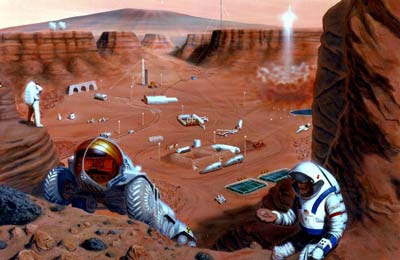
Many folks would like to see us back on the Moon and developing its resources.

Showing posts with label Mars One. Show all posts

Tuesday, February 04, 2014

Psychological and sociological issues affecting space travel

Do you want to sign up for MARS ONE and be one of the first to establish a permanent settlement on Mars?
Will you be able to put up with your fellow crew members on the long trip out in confined quarters?

In the Navy I attended a 5 week leadership course where we had three men to our sleeping quarters and were subject to strict discipline requirements that had me ready to punch out one of my room mates. Gear adrift, just a feather on my bed. Continual adjustment of towels hanging on locker or checking of furniture alignment. OK, maybe a bit sensitive to boot camp requirements all over again as I was now a Chief (E7) in the Navy. Maybe I would not be of sound mind after a six month cruise to Mars in a tin can.
- LRK -

-----------------------------------
Psychological and sociological issues affecting space travel
From Wikipedia, the free encyclopedia
Psychological and sociological issues affecting space travel are important to human spaceflight, particularly to long-duration expeditionary missions. Although robotic spacecraft have landed on Mars, plans have also been discussed for a human expedition, perhaps in the 2030s,[1] or as early as 2021[2] for a return mission, or even in 2018 for a 501-day flyby mission for a crew of two with no landing on Mars.[3]
A typical Mars return expedition is projected to last two to three years and may involve a crew of four to seven people,[citation needed] although shorter flyby missions of approximately one and half years with only two people have been proposed,[3] as well as one-way missions that include landing on Mars with no return trip planned.[4] Although there are a number of technological and physiological issues involved with such a mission that remain to be worked out, there are also a number of behavioral issues affecting the crew that are being addressed before such missions fly. In preparing for such an expedition, important psychological, interpersonal and psychiatric issues occurring in human spaceflight missions are under study by national space agencies and others.
...
----------------------------------

MARS-500 an experiment to see how a crew might fair on a long space mission.
- LRK -

-----------------------------------
MARS-500
The Mars-500 mission was a psychosocial isolation experiment conducted between 2007 and 2011 by Russia, the European Space Agencyand China, in preparation for an unspecified future manned spaceflight to the planet Mars.[1] The experiment's facility was located at theRussian Academy of SciencesInstitute of Biomedical Problems (IBMP) in Moscow, Russia.[1]
Between 2007 and 2011, three different crews of volunteers lived and worked in a mock-up spacecraft. The final stage of the experiment, which was intended to simulate a 520-day manned mission, was conducted by a crew consisting of three Russians (Alexey Sitev, Sukhrob Kamolov, Alexander Smoleevskij), a Frenchman (Romain Charles), an Italian (Diego Urbina) and a Chinese citizen (Yue Wang). The experiment helped plan the interplanetary mission, identifying possible problems and solutions. The mock-up facility simulated the Earth-Mars shuttle spacecraft, the ascent-descent craft, and the martian surface. Volunteer crew used in the three stages included professionals with experience in fields such as engineering, medicine, biology, and human spaceflight.
The Orbital Piloted Assembly and Experiment Complex (OPSEK) is the Russian successor to the International Space Station (ISS), with the primary mission of supporting deep space exploration. OPSEK is being assembled whilst attached to the ISS. Rassvet, a planned OPSEK module, arrived in orbit in 2010. All the main components of a Mars expedition would first dock at the station, before leaving for Mars.[2][3]
...
http://www.space.com/70-mars-500-mock-mission-to-mars.html
-----------------------------------

Lessons learned from Mars-500, not for everyone.
5 Things Russia’s Fake Mars Mission Says About Space Travel (And Office Life)

After spending 17 months in a simulated Mars-bound spaceship in Moscow, six study participants selected by the Russian Academy of Sciences and the European Space Agency have returned to the outside world with new data about how people cope with life in confined spaces—including terrestrial office cubes.
It sounds like the setup for a horror movie: Lock six people up on a confined space together for 17 months and see what happens. But the Russian Academy of Sciences and Roscosmos, the Russian space agency, put together the Mars-500 project in the interests of science—and the half-dozen participants managed to avoid killing one another. 

Read more: 5 Things Russia’s Fake Mars Mission Says About Space Travel (And Office Life) - Popular Mechanics
Follow us: @PopMech on Twitter | popularmechanics on Facebook
Visit us at PopularMechanics.com

-----------------------------------

I didn't get to see the Canadian mini-series "Race to Mars" but it sounds like it would have given us an idea of what it would be like to go to Mars.
- LRK -

-----------------------------------
From Wikipedia, the free encyclopedia
Race to Mars is a 2007 Canadian television mini-series about a fictitious mission to Mars that is based on contemporary international research. The first part aired on Discovery Channel Canada and its High Definition channel on September 23, 2007 and the second part on September 30. It was produced in association with Galafilm Inc. William Shatnernarrates the miniseries.
A companion book of the same title, written by Dana Berry, was also published in September 2007. It was offered as a selection of the Science Fiction Book Club.
Mars Rising, a companion 6-episode documentary mini-series, aired from October 7 to October 21, 2007, using sequences shot for Race to Mars.
PLOT
The four-hour mini-series begins in the year 2026, with a test lander exploding on landing. Jumping to 2029, the narrator explains the mission, 'Project Olympus' and shows the fourNTR spacecraft: Cargo lander Shirase, Mars Surface Habitat Atlantis, Mars lander Gagarin, and Crew Transfer Vehicle Terra Nova. In early 2030, the international crew of sixastronauts from the United StatesRussiaFranceCanada and Japan board Terra Nova to begin their 582 day-month journey to Mars and back. They suffer numerous equipment failures along the way, eventually traced back to fraud on the part of a subcontractor. The international team is racing against China, who have already landed a robot on Mars. The astronauts successfully land on Mars, but astrobiologist Hiromi's arm is broken by a faulty landing gear. Later, the Chinese robot finds water, but it contains too much calcium chloridefor it to contain life. Meanwhile, the crew's drilling equipment is irreparably damaged by a Martian dust devil. The crew sends an impassioned plea back to Earth to asking to allow them to cannibalize the Chinese robot lander, saying that the exploration of Mars should be for humankind and not be limited by politics.
The crew's proposal is accepted, and they redouble their drilling efforts. After days of non-stop work, they finally strike water, but crew member Hiromi is killed when pressure builds in the well causing an explosion that knocks over a beam of the drilling platform and crushes his spacesuit. After they ascend back to the main spacecraft for the journey home, the entire crew becomes gravely ill. They suspect infection by Martian microbes, but commander Rick Erwin refuses to open the seals on their Martian samples for fear of further contamination. It is discovered that carbon monoxide poisoning is the actual culprit, and they manage to deal with the problem. On final approach to Earth it is discovered that the Terra Nova's braking thrusters are malfunctioning making a safe return impossible unless repairs are carried out. After a dangerous spacewalk they repair the damage, but astronaut Antoine Hebert is nearly killed by electrocution. The mini-series ends as Olympus' crew module prepares to land and then cuts to a scene in the year 2095 to show a Mars base named for Robert H. Goddard, situated near to Hiromi's grave site.
...
http://www.racetomars.ca/mars/article_effects.jsp
-----------------------------------

Maybe a television series would tend to play on the sensational aspects of a long duration human mission.
Still, we have enough Earth bound examples of psychiatric effects of solitary confinement for inmates.
Even though those volunteering to go to Mars probably wouldn't be considered prisoners or be as restricted in activities, it might prove beneficial to be aware of potential problems from long term isolation. 
- LRK -

-----------------------------------
Overview: Neuropsychiatric Effects of Solitary Confinement
Stuart Grassian, M.D.

My observations and conclusions regarding the psychiatric effects of solitary
confinement have been cited in a number of federal court decisions, for example:
Davenport v. DeRobertis, 844 F.2d 1310, and Madrid v. Gomez, 889F.Supp.1146. I
prepared a written declaration for Madrid describing the medical literature and historical
experience concerning the psychiatric effects of solitary confinement and of other
conditions of restricted environmental and social stimulation. I have prepared the
general (non-institution specific) and non-redacted (non-inmate specific) portions of that
declaration into a general Statement, which I have entitled “Psychiatric Effects of
Solitary Confinement”; a copy of this statement is attached hereto. It describes the
extensive body of literature, including clinical and experimental literature, regarding the
effects of decreased environmental and social stimulation, as well as specifically,
observations concerning the effects of solitary confinement on prisoners. I offer here a
general overview of the issue:

It has long been known that severe restriction of environmental and social stimulation
has a profoundly deleterious effect on mental functioning; this issue has, for example,
been a major concern for many groups of patients including, for example, patients in
intensive care units, spinal patients immobilized by the need for prolonged traction, and
patients with impairment of their sensory apparatus (such as eye-patched or hearing
impaired patients). This issue has also been a very significant concern in military
situations and in exploration - polar and submarine expeditions, and in preparations for
space travel.
...
-----------------------------------

Whether it is appropriate to spend money to go to Mars is another question.
- LRK -

-----------------------------------
A space race in the developing word: India's latest mission causes controversy
By Anisha Chadha
TUESDAY FEBRUARY 04, 2014

On November 5, 2013, the Indian Space Research Organization (ISRO) launched a rocket that is projected to reach Mars in September 2014. The object of the mission, called the Mars Orbiter Mission (MOM), is to use a satellite to identify the geological source of methane that is present in the Martian atmosphere.

If India’s vessel, called Mangalyaan, successfully reaches Mars, it will be the fourth space program to achieve this feat, behind the Soviet Space Program, the U.S. Space Program (NASA), and the European Space Agency.

As the Indian government only announced the mission in 2010, the ISRO put together the project in a relatively short period of time. MOM cost just less than $75 million USD, inexpensive compared to the amount other space programs have spent on projects of this scale.

One of the reasons the ISRO was able to keep the cost of the project low was because of technological support from NASA. India is also using a less powerful rocket than could be used for the mission. The rocket will not enter the Martian orbit directly, but instead will orbit Earth before entering the trajectory that will cause it to arrive at Mars.
-----------------------------------

Thanks for looking up with me. 
- LRK -
BY SHARON BERNSTEIN
SACRAMENTO, California Wed Oct 9, 2013 10:31pm EDT

(Reuters) - California lawmakers concerned about solitary confinement in the state's troubled prison system promised at a hearing on Wednesday to seek to reform the state's practice of keeping inmates in near-isolation for decades.

The hearing took place amid increasing attention to California's prison policies by human rights organizations, which say solitary confinement for such long periods of time is torture.

"An 8-by-10 foot cell, no human contact, no chance to see the moon or the stars or the sun, or hear the birds for years and decades? That's torture," said prisoner advocate Keith James of Los Angeles.
...
==============================================================  
Solitary confinement: bad for chimps, okay for humans?
Primate Rights  
By LANCE TAPLEY  |  August 22, 2012Maine Republican Senator Susan Collins is a key cosponsor of legislation that, among other provisions, would outlaw psychologically damaging solitary confinement for more than 500 chimpanzees caged for research in federally supported laboratories. In July the bill bipartisanly passed the Senate's Environment and Public Works Committee on its way to a floor vote.

But the legislation, which also protects gorillas and other ape species if they are used for research, doesn't protect the dominant primate species, Homosapiens. Experts say at least 80,000 prison inmates are in solitary confinement in tiny cells in this country.
...
==============================================================

WHAT THE MIND CAN CONCEIVE, AND BELIEVE, IT WILL ACHIEVE - LRK -

==============================================================

Tuesday, January 14, 2014

New Science, NASA Cargo Launches to Space Station Aboard Orbital-1 Mission - will this lead us on to Mars?

Orbital has begun cargo flights to the International Space Station.
Now we want to extend the life of the ISS to 2024.
What next?
- LRK -

-----------------------------------
Jan. 9, 2014
RELEASE 14-009
New Science, NASA Cargo Launches to Space Station Aboard Orbital-1 Mission


Another NASA commercial space partner officially has begun contracted cargo flights to the International Space Station. Dozens of new NASA investigations and other science experiments from across the country are headed to the station aboard Orbital Sciences Corp.'s Cygnus spacecraft as part of the agency's commercial partnerships with U.S. aerospace companies.
The launch aboard Orbital's Antares rocket took place from NASA's Wallop's Flight Facility in Virginia Thursday, at 1:07 p.m. EST.
The Orbital-1 mission began the company's first contracted cargo delivery flight to the station through a $1.9 billion NASA Commercial Resupply Services contract. Orbital will fly at least eight cargo missions to the space station through 2016.
....
-----------------------------------

And we can extend the life of the ISS to 2024.
- LRK -

-----------------------------------
NASA: International Space Station Operations Extended to 2024

NASA announced today that the Obama administration has approved NASA’s request for an extension of operations for the International Space Station for an additional four years to 2024. This means work on board the orbiting laboratory will continue at least for another decade.
“I think this is a tremendous announcement for us here in the space station world,” said Bill Gerstenmaier, associate administrator for NASA’s Human Exploration and Operations Mission Directorate, speaking during a press briefing today, “ and also for all of human spaceflight and for our international partnership.”

“This is a tremendous gift the administration has given us,” he added later.

...
-----------------------------------

Is this enough to help continue a quest for putting humans on Mars?
- LRK -

-----------------------------------

It is Mars One's goal to establish a human settlement on Mars. 

Human settlement of Mars is the next giant leap for humankind. Exploring the solar system as a united humanity will bring us all closer together. Mars is the stepping stone of the human race on its voyage into the universe. Human settlement on Mars will aid our understanding of the origins of the solar system, the origins of life and our place in the universe. As with the Apollo Moon landings, a human mission to Mars will inspire generations to believe that all things are possible, anything can be achieved. - See more at: http://www.mars-one.com/mission#sthash.FobHxY3A.dpuf
...
-----------------------------------

When you read Red Mars you see that not all is well with those that are on Mars.  I think this is worth considering.
- LRK -

-----------------------------------
...
Plot

Red Mars — Colonization

Red Mars starts in 2026 with the first colonial voyage to Mars aboard the Ares, the largest interplanetary spacecraft ever built (interestingly, from clustered space shuttle external fuel tanks which, instead of incinerating in the atmosphere, have been boosted into orbit until enough had been amassed to build a ship and also used as landing craft) and home to a crew who are to be the first hundred Martian colonists. The mission is a joint Russian-American undertaking, and seventy of the First Hundred are drawn from these countries (except, for example, Michel Duval, a French psychologist assigned to observe their behavior). The book details the trip out, construction of the first settlement on Mars (eventually called Underhill) by Nadia Chernyshevski, as well as establishing colonies on Mars' hollowed out asteroid-moon Phobos, the ever-changing relationships between the colonists, debates among the colonists regarding both the terraforming of the planet and its future relationship to Earth. The two extreme views on terraforming are personified by Saxifrage "Sax" Russell, who believes their very presence on the planet means some level of terraforming has already begun and that it is humanity's obligation to spread life as it is the most scarce thing in the known universe, and Ann Clayborne, who stakes out the position that humankind does not have the right to change entire planets at their will.
...
-----------------------------------

Donald F. Robinson suggested that I read Robinson's earlier short story "Green Mars" which is a story about a group that are climbing the largest mountain in our solar system.  Mars has been terraformed and our 300 year old lead character misses the original red Mars. 

I ordered a book of Science Fiction stories which included "Green Mars" and have read a most thrilling story. Do you really want to try and make another Earth?

-----------------------------------
Green Mars
Green Mars is a novella published for the first time in 1985 in collections. It was published as a stand-alone story in 1988.

It is not to be confounded with the novel of the same name. The novella does not take place in the same universe as the Mars trilogy. It tells of the climbing of the tallest volcano of the Mars (and of the solar system), Olympus Mons.
...
From The Mars Man, interview with Mary Branscombe, SFX #14, July 1996:
To avoid confusion, it’s worth remembering that although many of his books are set on Mars, not all of them are on the same Mars. In particular, the original Green Mars - a novella about climbing Olympus Mons that deals with the now-familiar themes of the ethics of terraforming Mars and the memory problems of longevity - seems to be set in a slightly different universe. “Yes, I wrote that mainly to stake a claim - at least a moral claim - on the name. I thought Green Mars was such a good name, such an obvious name. And when I heard about Olympus Mons, this enormous volcano, I just had to write about climbing it.” It turned out to be a sensible precaution; he’s since heard that Arthur C. Clarke considered using it as the title for his collection of articles on terraforming Mars (now called The Snows of Olympus).
...
-----------------------------------

Well I am still having trouble getting back to reading the Mars trilogy as I just got another book of Kim Stanley Robinson stories.
I will look at the characters with an eye towards how humans might survive in space and why they might want to live there for it is humans that are saying they want to go there.  If not then maybe just continue to send in the robots.
- LRK -

-----------------------------------
The Best of Kim Stanley Robinson Paperback
Adventurers, scientists, artists, workers, and visionaries — these are the men and women you will encounter in the short fiction of Kim Stanley Robinson. In settings ranging from the sunken ruins of Venice to the upper reaches of the Himalayas to the terraformed surface of Mars itself, and through themes of environmental sustainability, social justice, personal responsibility, sports, adventure, and fun, Robinson's protagonists explore a world which stands in sharp contrast to many of the traditional locales and mores of science fiction, presenting instead a world in which Utopia rests within our grasp.

From Kim Stanley Robinson, award-winning author of the Mars Trilogy, the Three Californias Trilogy, the Science in the Capital series, The Martians, and The Years of Rice and Salt, comes The Best of Kim Stanley Robinson. These twenty-two stories, including the Nebula Award-winning "The Blind Geometer," and World Fantasy Award winner "Black Air" represent The Best of Kim Stanley Robinson.
...
-----------------------------------

When does science fiction become science fact?

Self driving cars, hmmm.
Three big semi-trucks munched each other in front me on my home today coming down the Altimont Pass  road on I-580..
[well 10 cars ahead of me]
Self driving cars: Tesla promises autopilot by 2016

- LRK -
------------------------------------------

Thanks for looking up with me. 
- LRK -
 
Shaman interviews & reviews III


Written by Kimon   
Tuesday, 31 December 2013 08:48
Kim Stanley Robinson's latest novel SHAMAN, out since September 2013, is coming out in paperback onJune 10 2014. Meanwhile, it has entered the Locus Bestseller list for December for hardcovers (at #7) -- while 2312 has been released in paperback and has made it to #1 and is continuing its run! (SeptemberOctoberNovember, December)
Despite Shaman's setting in the long past, or rather quite the contrary, enriched by that fact, the New Yorker's Tim Krieder published an article on Stan: "Our Greatest Political Novelist?", which draws from both his Mars trilogy and Shaman to make a major point:
Depending on your own politics, this [the Martian Constitution] may sound like millennia-overdue common sense or a bong-fuelled 3 A.M. wish list, but there’s no arguing that to implement it in the real world circa 2013 would be, literally, revolutionary. My own bet would be that either your grandchildren are going to be living by some of these precepts, or else they won’t be living at all. [...] I don’t just admire Robinson’s ambitions or agree with his agenda; I’m not recommending his books because they’re good for you. Kim Stanley Robinson is one of my favorite novelists, period. [...] The strength of his characterizations is inextricable from his power as a political visionary; Robinson is realistic about human beings but nonetheless optimistic about our capacity for change.
...
==============================================================  
Kim Stanley Robinson (born March 23, 1952) is an American science fiction writer, best known for his award-winning Mars trilogy. Robinson's work has been labeled by reviewers as literary science fiction.[1]
...

The Mars trilogy

This trilogy is Robinson's best-known work. It is an extended work of science fiction that deals with the first settlement of the planet Mars by a group of scientists and engineers. Its three volumes are Red Mars, Green Mars, and Blue Mars, the titles of which mark the changes that the planet undergoes over the course of the saga. The tale begins with the first colonists leaving Earth for Mars in 2027 and covers the next 200 years of future history. By the conclusion of the story, Mars is heavily populated and terraformed, with a flourishing and complex political and social dimension.
Many threads of different characters' lives are woven together in the Mars Trilogy. Science, sociology, and politics are all covered in great detail, evolving over the course of the narrative. Robinson's fascination with science and technology is clear, although he balances this with a strong streak of humanity. Robinson's personal interests, including ecological sustainabilitysexual dimorphism, and the scientific method, come through strongly.
...
==============================================================

WHAT THE MIND CAN CONCEIVE, AND BELIEVE, IT WILL ACHIEVE - LRK -

==============================================================

Sunday, January 05, 2014

To Mars, or, not to Mars?

I am still trying to read again, "RED MARS" by Kim Stanley Robinson and I keep finding other interesting information.
Before we sent the machines to Mars we thought of canals on Mars that must have been made by intelligent beings.

Doesn't seem to be any manufactured ditches or running water and so far no Martians have stomped on our rovers.
But wait maybe some mud slides from some Martian summer melt.

If no upright Martians do we still need to go Mars with humans?
Do we just want the science fiction stories to become science fact?
The Space Review has an article, "To Mars, or, not to Mars," by Thomas D. Taverney.
I wouldn't want you to bother reading Robinson's Mars trilogy if you didn't think it would be possible to send humans to Mars.
Doing another Apollo type mission  where we just go spend a couple of days, plant a flag, and never go again doesn't look like a good business model either.
Maybe we should decide what the long range goal is and how best to finance any human exploration.
- LRK -

Mars base illustration
Sending humans to Mars, either for expeditions or for settlement, 
has long been an aspiration for space enthusiasts. But how can such 
as audacious goal be achieved? (credit: NASA)
------------------------------------------

by Thomas D. Taverney
Monday, August 19, 2013


Every civilization seeks to achieve greatness and build monuments to be left to subsequent generations as high water marks of their value, demonstrating their essence, and providing a statement that its people were here. These monuments are crafted by the most important minds and shaped and sculpted by the most skilled hands. They are left proudly to their children, children’s children, and for some, scores of generations. The desire to build monuments and innovate is a fundamental attribute of human societies. The greats have left us with the pyramids, the Great Wall, the Panama Canal, the steam engine, railroads, skyscrapers, the screw propeller, the automobile, the airplane, and even cave paintings. Each wonder, each innovation, says that its people were here with their hearts, minds and hands. Great achievements advance the human condition and establish markers of important technical advances.

We are no different today. Over nearly sixty years we have broken free of the gravitational bonds that have anchored us to the planet Earth. Our satellites have visited all the planets, as well as asteroids and comets. We’ve left bootprints on the surface of the Moon. And although we have achieved many exciting innovations since that moment the flag was planted on the Moon over forty years ago, the Apollo landing remains the pinnacle of our achievement.

Now, as a nation and a people, we are confounded by a new question: To Mars, or, not to Mars? This is a not-so-simple query worthy of an intense national debate and soul searching. And for a spacefaring nation, it’s one that generates even more questions. Will it be worth it to go to Mars?

...

Mr. Thomas “Tav” Taverney is a Senior Vice President with SAIC. During his career he has been a true citizen soldier, serving both the Air Force and the civilian aerospace industry. Tav is a 1968 graduate of the Air Force Academy and has a Masters of Science degree from USC. He achieved the rank of Major General, and the final assignment of his Air Force career was as Vice Commander of Air Force Space Command. He has extensive engineering design and development expertise including direct program management of numerous space systems developments, chief engineer/scientist responsibilities, and general management of large organizations. In his reserve career he worked in space systems acquisition, on-orbit satellite operations, space support to the AOR, and launch operations.


NOTE; Don''t forget to read the whole article AND the comments.  - LRK -
------------------------------------------


More discussion about financing such a venture (or adventure)
- LRK -

------------------------------------------
  1. A small step for Mars settlement, but a giant leap of funding required

    Mars One, the private venture with plans to settle Mars in the 2020s, announced last week plans to develop a precursor robotic mission for launch in 2018. Jeff Foust reports on the announcement and the challenges the venture faces beyond building spacecraft hardware.
  2. ----
  3. There’s no shortage of audacious ideas for sending humans to Mars, particularly by the private sector. For much of this year, attention has been focused on Inspiration Mars, the nonprofit venture announced in February that proposed sending a married couple on a Mars flyby mission launching in early 2018 (see “A Martian adventure for inspiration, not commercialization”, The Space Review, March 4, 2013.) Last month, though, Inspiration Mars changed course, still seeking to carry out that crewed Mars flyby mission, but with the technical and fiscal support of NASA (see “Inspiration Mars: from nonprofit venture to space policy adventure”, The Space Review, November 25, 2013.)
  4. Inspiration Mars’s plans, though, pale in comparison of those by another nonprofit organization, Mars One. The Dutch-based venture seeks to send people to Mars, but rather than a flyby, Mars One would land them there—permanently, in the hopes of establishing a permanent settlement whose initial missions would be funded, in part, by selling media rights and with an astronaut selection process that has parallels to reality television shows. Some consider it visionary; others, insane.
  5. While discussion of the viability of such missions continues, Mars One took a small step last week towards its goal of humans on Mars. At a lightly-attended press conference in on a snowy Tuesday morning in Washington, Mars One announced it had issued contracts to two leading space companies to study concepts for an initial robotic mission that would launch in 2018.
  6. ...
    ------------------------------------------
KIM STANLEY ROBINSON has written more than the Mars trilogy so you can see how I might be distracted.
- LRK -

------------------------------------------
on The Best of Kim Stanley Robinson
Alternative Californias
September 16th, 2011
KIM STANLEY ROBINSON is best known as a novelist of scale, a creator of complex futures and universes of sublime magnitude. His Three Californias (or Orange County) trilogy (1984-90), for example, offers three alternative visions — a post-apocalyptic pastoral, a dystopian satire, and a precarious ecotopia — of what California (and the world) might become, while the Science in the Capital trilogy (2004-07) depicts Beltway politics during a period of catastrophic global climate change. The Mars trilogy (1992-96), probably the major accomplishment of 1990s American SF, charts both the transformation of Mars into a planet habitable by humankind and the transformation of humankind (including our political, social, and economic systems) into forms fit for a new world. Even the standalone novels like Antarctica (1997), The Years of Rice and Salt (2002), and Galileo's Dream (2009) are in the heavyweight division.
...
------------------------------------------

"Green Mars" novella that came before the "Green Mars" in the Mars trilogy.
- LRK -

------------------------------------------
Green Mars is a novella that, after being published in collections alongside other authors' stories, was published in paperback collected with Arthur C. Clarke's novella "A Meeting With Medusa" in 1988.
Despite the title similarity, it does not take place in the same universe as the Mars trilogy novel Green Mars, instead forming a sequence with the short works Exploring Fossil Canyon (1982) and A Martian Romance(1999) which describe a different terraformed Mars. All three works were included in the collection The Martians along with Arthur Sternbach Brings the Curveball to Mars, which shares a character.

Contents

 [hide]
...
------------------------------------------

Well you can see why I am having a problem to re-read the Mars trilogy with so many other stories in the offering.
- LRK -

Thanks for looking up with me. 
- LRK -
 
ISFDB Publication Record # 50830
...
==============================================================  
Kim Stanley Robinson (born March 23, 1952) is an American science fiction writer, best known for his award-winning Mars trilogy. Robinson's work has been labeled by reviewers as literary science fiction.[1]

Robinson was born in Waukegan, Illinois, but grew up in Southern California. In 1974, he earned a B.A. in literature from the University of California, San Diego. In 1975, he earned an M.A. in English from Boston University and in 1982, he earned a PhD in English from the University of California, San Diego. His doctoral thesis, The Novels of Philip K. Dick, was published in 1984.
...
==============================================================

WHAT THE MIND CAN CONCEIVE, AND BELIEVE, IT WILL ACHIEVE - LRK -

==============================================================