NASA to Release Enhanced Radar Imagery of Lunar South Pole - Comments

-----------------------------------------------------
http://www.nasa.gov/home/hqnews/2008/feb/HQ_M08039_MA-Goldstone_Radar.html
snip
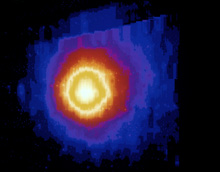
WASHINGTON -- NASA scientists have obtained the highest resolution
terrain mapping to date of the moon's rugged south polar region and
will discuss the imagery Wednesday, Feb. 27, at the 3rd Space
Exploration Conference in Denver.

Researchers at NASA's Jet Propulsion Laboratory in Pasadena, Calif.,
generated the imagery using data collected with the facility's
Goldstone Solar System Radar. The news media briefing is scheduled for
noon MST in Room 506 of the Colorado Convention Center.
snip
-----------------------------------------------------

I received a note from Burton Sharpe, one of the co-authors of "THE
MOON - Resources, Future Development and Settlement" in response to my
thoughts that we can't see all of the Moon's South Pole. [See Below]

In my reply to Burt I mentioned some links I found on the Moon's
libration, which is what being able to see more than 50% of the Moon
talks about.
When is a good time to look at the South Pole and when would it be
good to look at the North Pole?

Nice simulation. - LRK -
LIBRATION
http://en.wikipedia.org/wiki/Libration

More information. - LRK -
-------------------------
http://www-istp.gsfc.nasa.gov/stargaze/Smoon4.htm
4b.   Libration of the Moon
-------------------------

Where you are on this mother Earth makes a difference too as we have a
tilt with respect to the ecliptic as well.
- LRK -

http://www-istp.gsfc.nasa.gov/stargaze/Sseason.htm
Seasons.

I mentioned to Burt that when Lunar Prospector was targeted to go into
a crater at the lunar south pole we didn't see any signature for water
vapor which it was hoped would be generated by the impact into where
it was suspected there might be frozen water.  I was asked why the
software program 'Starry Night' didn't show an Earth rise if you put
yourself on the surface of the Moon at the south pole. My only thought
was that Lunar Prospector went in on July 31 and the partial lunar
eclipse had occurred on the 28 of July and the Moon was descending
towards the ecliptic and might be going below the ecliptic and Earth's
path around the Sun by the 31st.

I just took a look at an Astronomical Calendar 1999 by Guy Ottewell
and on page 36 he says that on July 29 2:34 UT the Moon's center
reaches descending node through the ecliptic.  Doesn't look like by
the 31st it would be the best time for looking UP at the south pole
but rather would be better for looking down at the north pole.

http://science.nasa.gov/newhome/headlines/ast26jul99_1.htm
http://sunearth.gsfc.nasa.gov/eclipse/LEcat/LEdecade1991.html
http://sunearth.gsfc.nasa.gov/eclipse/LEplot/LEplot1951/LE1999Jul28P.GIF

Sooooh, will be interesting to see what comes up on the website on February 27
-------------------------------------
At noon MST on Feb. 27, terrain maps of the moon's south pole and
other images will be available online at:

http://www.nasa.gov/mission_pages/exploration/mmb/022708.html
-------------------------------------.

Boy, I am sure glad you folks keep me on my toes, wouldn't want the
gray matter to turn to mush. :-)

Thanks for looking up with me.

Larry Kellogg

Web Site: http://lkellogg.vttoth.com/LarryRussellKellogg/
BlogSpot: http://kelloggserialreports.blogspot.com/
RSS link: http://kelloggserialreports.blogspot.com/atom.xml
Newsletter: https://news.altair.com/mailman/listinfo/lunar-update
==============================================================
Hi Larry -- This should be interesting!

The Moon's rotational axis and orbital plane are tilted a total of
about 6 degrees from the ecliptic, so this means that each month an
observer on earth can see, alternately, 6 degrees beyond the pole,
then 6 degrees shy of the pole.  The SP region, though, has some very
high and low rough terrain, so the actual relative terrain elevations
are not so easily described.  Maybe this will be a bigtime help?

Thanks for your continuing dedication to All Things Lunar!  One of the
very best resources around!

Burt Sharpe

In a message dated 2/23/2008 8:19:33 P.M. Central Standard Time,
larry.kellogg@gmail.com writes:


 I didn't think we could see all of the Lunar South Pole from Earth.
 Will be interesting to see what they got and how they compare with
 what the Japanese are taking with their satellites that are now
 orbiting the Moon.
 - LRK -
Snip
==============================================================
http://www-istp.gsfc.nasa.gov/stargaze/Smoon4.htm
4b.   Libration of the Moon

Observers on Earth can see a little more than half the surface of the
Moon, thanks to processes known as "librations." The term comes from
"libra," Latin for scales. This too is the name of a constellation in
the zodiac, supposedly resembling scales, and what we call "pound"
also used to be called "libra," and hence the abbreviation "lb".

Snip
==============================================================
http://www.stargazing.net/david/moon/moonlibration.html
MOON LIBRATION

Snip
Libration is the small oscillation of the Moon about its mean
position. Longitude libration occurs from the Moon's synchronous
rotation and elliptical orbit. Latitude libration is the result of the
Moon's equator being slightly tilted (1.5�) from its orbital plane and
its orbital plane being tilted 5� from the ecliptic. Diurnal libration
is the result of the motion of the observer on Earth as the Earth
rotates. When the Moon is rising in the east we see more of the Moon's
eastern edge and when the Moon is setting in the west we see more of
the Moon's western edge. Maximum librations are 7� 54' longitude and
6� 50' latitude. Also, 1� diurnal libration occures because of motion
of the observer as the Earth rotates.
Snip
==============================================================
http://trs-new.jpl.nasa.gov/dspace/bitstream/2014/19004/1/98-0161.pdf
LUNAR DISSIPATION: ROTATIONAL AND ORBITAL CONSEQUENCES
J. G. Williams , T. P. Krisher, D. H. Boggs, J. T. Ratcliff, and J. O. Dickey
Jet Propulsion Laboratory, California Institute of Technology,
Pasadena, CA, 91109

snip
The analysis of lunar laser ranging (LLR) data strongly detects a
signature of dissipation in lunar rotation. The two possible sources of dissipation are
solid-body tides and interaction at a liquid-core/solid-mantle interface. A simultaneous
fit of both dissipation models [1] finds each cause contributing about half of the dissipation
signature. The separation comes from rotation terms which are a few percent of the
leading dissipation term. Dissipation from tides and core also influences the lunar orbit,
causing secular changes in the orbit period and eccentricity. The latter is useful and
is in better agreement when core dissipation is included,

The lunar equator (mantle) is tilted I = 1.5427� to the ecliptic plane
and it exhibits retrograde precession along the ecliptic with an 18.6 yr period. The
equator and orbit planes precess along the ecliptic plane with the same 18.6 yr
(retrograde) period. Without dissipation, the descending node of the equator matches the ascending
node of the orbit, The most important effect of dissipation on the
lunar rotation is a shift of the node of the processing equator plane (and pole of
rotation) from alignment with the orbit node [2] [3] [4]. Dissipation from both solid-body tides [2]
and core/mantle interactions [3] can cause this phase shift, The shift is most
sensitive to monthly tides and monthly velocity differences between fluid core and mantle. The shift
in the processing pole direction projects into the direction to Earth as a monthly signature.

Snip
==============================================================

WHAT THE MIND CAN CONCEIVE, AND BELIEVE, IT WILL ACHIEVE - LRK

==============================================================
Many folks would like to see us back on the Moon and developing its resources.
Showing posts with label lunar eclipse. Show all posts
Showing posts with label lunar eclipse. Show all posts
Tuesday, February 26, 2008


Tuesday, February 19, 2008
Total Eclipse of The Moon - February 20, 2008
-------------------------------------------------------
http://sunearth.gsfc.nasa.gov/eclipse/LEmono/TLE2008Feb21/TLE2008Feb21.html

   Introduction

A total eclipse of the Moon occurs during the night of Wednesday,
February 20/21, 2008. The entire event is visible from South America and
most of North America (on Feb. 20) as well as Western Europe, Africa,
and western Asia (on Feb. 21). During a total lunar eclipse, the Moon's
disk can take on a dramatically colorful appearance from bright orange
to blood red to dark brown and (rarely) very dark gray.

An eclipse of the Moon can only take place at Full Moon, and only if the
Moon passes through some portion of Earth's shadow. The shadow is
actually composed of two cone-shaped parts, one nested inside the other.
The outer shadow or /penumbra/ is a zone where Earth blocks some (but
not all) of the Sun's rays. In contrast, the inner shadow or /umbra/ is
a region where Earth blocks all direct sunlight from reaching the Moon.

If only part of the Moon passes through the umbra, a partial eclipse is
seen. However, if the entire Moon passes through the umbral shadow, then
a total eclipse of the Moon occurs. For more information on how, what,
why, where and when of lunar eclipses, see the special web page lunar
eclipses for beginners <http://www.MrEclipse.com/Special/LEprimer.html>.

Snip
-------------------------------------------------------

More here. - LRK -

-------------------------------------------------------
http://www.hermit.org/Eclipse/2008-02-21/
Total Lunar Eclipse: February 21 2008

The total lunar eclipse
<http://www.hermit.org/Eclipse/why_lunar.html#Total> of February 21 2008
will be visible over the Americas, Europe, Africa, and western Asia.

The penumbral eclipse
<http://www.hermit.org/Eclipse/why_lunar.html#Penumbral> -- the least
exciting, and hardest to see part -- will begin at 00:34:59 UT and end
at 06:17:16 UT. It will be visible from western Asia, Europe and Africa
when it begins around Moonset, the Americas, and the Pacific Ocean it
ends at around Moonrise.

The partial eclipse
<http://www.hermit.org/Eclipse/why_lunar.html#Partial> will begin at
01:42:59 UT and end just under 3œ hours later at 05:09:07 UT, and will
be visible from a slightly smaller area. The total eclipse
<http://www.hermit.org/Eclipse/why_lunar.html#Total> lasts for over œ an
hour; it begins at 03:00:34 UT and ends at 03:51:32 UT, with the moment
of greatest eclipse at 03:26:05 UT. It is visible over western Asia,
most of the Middle East, Europe, Africa, the Americas (barring extreme
southwestern Alaska), and the eastern Pacific Ocean. Hawaii just misses
out on the total eclipse, and will see the Moon rise about half eclipsed.

The total eclipse should be a spectacular sight, even though quite
short-lived; although the Moon will be just within the Earth's umbral
shadow (the umbral magnitude is 1.111), it should be visibly coloured by
the Earth's atmosphere. Don't miss it!

More information on this eclipse may be found at Fred Espenak's site
<http://sunearth.gsfc.nasa.gov/eclipse/LEplot/LEplot2001/LE2008Feb21T.GIF>.

The following map shows the areas where the partial eclipse will be visible:

Snip

-------------------------------------------------------

May the clouds part.
- LRK -

Thanks for looking up with me.

Larry Kellogg

Web Site: http://lkellogg.vttoth.com/LarryRussellKellogg/
BlogSpot: http://kelloggserialreports.blogspot.com/
RSS link: http://kelloggserialreports.blogspot.com/atom.xml
Newsletter: https://news.altair.com/mailman/listinfo/lunar-update
==============================================================
And Google says - LRK -
-------------------------------------------------------

Lunar eclipse will be `a cosmic ballet'
<http://www.miamiherald.com/news/broward/story/423760.html>
MiamiHerald.com - Miami,FL,USA
If the weather cooperates, you'll enjoy one of nature's grandest
spectacles -- a total eclipse of the *moon*, your last opportunity until
2010. *...*
See all stories on this topic
<http://news.google.com/news?hl=en&ncl=http://www.miamiherald.com/news/broward/s
tory/423760.html>


Total eclipse of *moon* Wednesday evening
<http://www.princegeorgecitizen.com/index.php?option=com_content&task=view&id=11
8811&Itemid=557>
Prince George Citizen - Prince George,British Columbia,Canada
A rare event for skygazers, the total eclipse of the *moon*, takes place
Wednesday evening. The eclipse will start around 5:43 pm as the *moon*
enters the *...*
See all stories on this topic
<http://news.google.com/news?hl=en&ncl=http://www.princegeorgecitizen.com/index.
php%3Foption%3Dcom_content%26task%3Dview%26id%3D118811%26Itemid%3D557>

Get ready for the eclipse that saved Columbus
<http://afp.google.com/article/ALeqM5jFJTgLH6SM8ybh3HDxGmBrHVOiZA>
AFP -
PARIS (AFP) � The *Moon* will turn an eerie shade of red for people in
the western hemisphere late Wednesday and early Thursday, recreating the
eclipse that *...*
See all stories on this topic
<http://news.google.com/news?hl=en&ncl=http://afp.google.com/article/ALeqM5jFJTg
LH6SM8ybh3HDxGmBrHVOiZA>

� *Moon* takes on a new hue
<http://www.mlive.com/news/saginawnews/index.ssf?/base/news-25/1203348017129310.
xml&coll=9>
The Saginaw News - MLive.com - Saginaw,MI,USA
The full *moon* will cast an unusual glow as it slips into total lunar
eclipse -- and Michigan is situated for prime observation of the event,
*...*
See all stories on this topic
<http://news.google.com/news?hl=en&ncl=http://www.mlive.com/news/saginawnews/ind
ex.ssf%3F/base/news-25/1203348017129310.xml%26coll%3D9>

Brace yourself for the total eclipse of *moon*
<http://www.insidebayarea.com/ci_8294635>
San Mateo County Times - San Mateo,CA,USA
By Betsy Mason, Staff writer A thin waxing crescent *Moon* is seen just
after Sunset, in Tyler, Texas on Friday, February 8, 2008, 1 day after
the *Moon* passed *...*
See all stories on this topic
<http://news.google.com/news?hl=en&ncl=http://www.insidebayarea.com/ci_8294635>

*Moon* Turns Vivid Red On Wednesday Night
<http://www.efluxmedia.com/news_Moon_Turns_Vivid_Red_On_Wednesday_Night_14138.ht
ml>
eFluxMedia - USA
By Dee Chisamera All we need for Wednesday night is a clear sky and the
*Moon* will put up a spectacular show for us. Sure, much colder than the
one in August *...*
See all stories on this topic
<http://news.google.com/news?hl=en&ncl=http://www.efluxmedia.com/news_Moon_Turns
_Vivid_Red_On_Wednesday_Night_14138.html>

Snip
==============================================================

WHAT THE MIND CAN CONCEIVE, AND BELIEVE, IT WILL ACHIEVE - LRK

==============================================================
Monday, August 27, 2007
Exploding Lunar Eclipse
There is a Lunar Eclipse tonight/morning.
One of those times that the Sun, Earth, and Moon form a straight
line letting Earth's shadow fall on the Moon.

It also happens to be at a time when the Moon may be pelted by a bunch
of baseball size objects.  These objects are coming from the Sun sided
and are normally hard to see when impacting a lit Moon but in the shadow
of the Earth the flash of light given off by the impacts may be captured
with a telescope and video camera.

One would like to get some data on how many objects may be hitting the
Moon especially if you want to set up a base camp and stay around for
awhile.

How do you go about protecting yourself when the sky is falling?
Here on Earth we have an atmosphere that does a nice job of burning them up.
Makes for falling star parties.

On the Moon one may not like to have your party disrupted by the
equivalent of 100 kg of TNT exploding next to you.

Have fun looking ulp.

Larry Kellogg

Web Site: http://lkellogg.vttoth.com/LarryRussellKellogg/
BlogSpot: http://kelloggserialreports.blogspot.com/
RSS link: http://kelloggserialreports.blogspot.com/atom.xml
Newsletter: https://news.altair.com/mailman/listinfo/lunar-update
==============================================================
Earth to put the moon in the shade

What we will see.
http://www.theage.com.au/ffximage/2007/08/26/rgn_eclipse_wideweb__470x327,2.jpg
Source: NASA; www.mreclipse.com; Sky and Space magazine.
Graphic: /Jo Gay

Chee Chee Leung
August 27, 2007

AS A sky show, it has kept Australian star-gazers waiting for seven years.

A spectacular total lunar eclipse will be visible across the country
tomorrow at full moon, when the sun, Earth and moon are in perfect
alignment.

The Earth casts a shadow across the moon and blocks out the sunlight,
causing the moon to become dark, almost disappearing.

Although it is a total eclipse, the moon will not completely black out.
Some sunlight will reach it, bent by the Earth's atmosphere.

Snip
==============================================================
NASA Science News for August 27, 2007

On Tuesday morning, Aug. 28th, a team of astronomers and engineers at
the Marshall Space Flight Center will attempt something never done
before--to observe meteoroids hitting the Moon and exploding during a
lunar eclipse. This will allow them to explore an elusive and mysterious
population of "Helion" meteoroids coming from the direction of the sun.

FULL STORY at

http://science.nasa.gov/headlines/y2007/27aug_explodingeclipse.htm?list965414

Check out our RSS feed at http://science.nasa.gov/rss.xml

Snip
==============================================================
http://science.nasa.gov/headlines/y2007/03aug_dreamyeclipse.htm

Dreamy Lunar Eclipse
08.03.2007

*August 3, 2007:* Close your eyes, breathe deeply, let your mind wander
to a distant seashore: It's late in the day, and the western sun is
sinking into the glittering waves. At your feet, damp sand reflects the
twilight, while overhead, the deep blue sky fades into a cloudy mélange
of sunset copper and gold, so vivid it almost takes your breath away.

A breeze touches the back of your neck, and you turn to see a pale full
Moon rising into the night. Hmmm. The Moon could use a dash more color.
You reach out, grab a handful of sunset, and drape the Moon with
phantasmic light. Much better.

Too bad it's only a dream...

Early Tuesday morning, August 28th, the dream will come true. There's
going to be a colorful lunar eclipse visible from five continents
including most of North America: map.

http://science.nasa.gov/headlines/y2007/images/dreamyeclipse/Finazzi1_med.jpg
Photos of the March 3, 2007, lunar eclipse. Credit: Antonio Finazzi and
Michele Festa of Lago di Garda, Italy. [Larger image.]

The event begins 54 minutes past midnight PDT (0754 UT) on August 28th
when the Moon enters Earth's shadow. At first, there's little change.
The outskirts of Earth's shadow are as pale as the Moon itself; an
onlooker might not even realize anything is happening. But as the Moon
penetrates deeper, a startling metamorphosis occurs. Around 2:52 am PDT
(0952 UT), the color of the Moon changes from moondust-gray to
sunset-red. This is totality, and it lasts for 90 minutes.

Snip
==============================================================
http://sunearth.gsfc.nasa.gov/eclipse/LEmono/TLE2007Aug28/TLE2007Aug28.html
Total Lunar Eclipse: August 28, 2007

http://sunearth.gsfc.nasa.gov/eclipse/LEmono/TLE2007Aug28/image/TLE2007Aug28-PDTs.GIF
Path of the Moon through Earth's umbral and penumbral shadows
during the Total Lunar Eclipse of Aug. 28, 2007.
(Pacific Daylight Time)


Introduction

A total eclipse of the Moon occurs during the early morning of Tuesday,
August 28, 2007. The event is widely visible from the United States and
Canada as well as South America, the Pacific Ocean, western Asia and
Australia. During a total lunar eclipse, the Moon's disk can take on a
dramatically colorful appearance from bright orange to blood red to dark
brown and (rarely) very dark gray.

An eclipse of the Moon can only take place at Full Moon, and only if the
Moon passes through some portion of Earth's shadow. The shadow is
actually composed of two cone-shaped parts, one nested inside the other.
The outer shadow or /penumbra/ is a zone where Earth blocks some (but
not all) of the Sun's rays. In contrast, the inner shadow or /umbra/ is
a region where Earth blocks all direct sunlight from reaching the Moon.

If only part of the Moon passes through the umbra, a partial eclipse is
seen. However, if the entire Moon passes through the umbral shadow, then
a total eclipse of the Moon occurs. For more information on how, what,
why, where and when of lunar eclipses, see the special web page lunar
eclipses for beginners.

--------------------------------------


Lunar Eclipse Diagrams

The following diagrams show the Moon's path through Earth's shadows
(higher resolution versions of the above figure). The times of major
stages of the eclipse are given for a number of time zones in North
America. Please choose the diagram for your own time zone. Each diagram
is a GIF file with a size of about 100k.

* Eclipse Diagram for ADT (Atlantic Daylight Time)

<http://sunearth.gsfc.nasa.gov/eclipse/LEmono/TLE2007Aug28/image/TLE2007Aug28-ADT2.GIF>
* Eclipse Diagram for EDT (Eastern Daylight Time)

<http://sunearth.gsfc.nasa.gov/eclipse/LEmono/TLE2007Aug28/image/TLE2007Aug28-EDT.GIF>
* Eclipse Diagram for CDT (Central Daylight Time)

<http://sunearth.gsfc.nasa.gov/eclipse/LEmono/TLE2007Aug28/image/TLE2007Aug28-CDT.GIF>
* Eclipse Diagram for MDT (Mountain Daylight Time)

<http://sunearth.gsfc.nasa.gov/eclipse/LEmono/TLE2007Aug28/image/TLE2007Aug28-MDT.GIF>
* Eclipse Diagram for PDT (Pacific Daylight Time)

<http://sunearth.gsfc.nasa.gov/eclipse/LEmono/TLE2007Aug28/image/TLE2007Aug28-PDT.GIF>
* Eclipse Diagram for ADT (Alaska Daylight Time)

<http://sunearth.gsfc.nasa.gov/eclipse/LEmono/TLE2007Aug28/image/TLE2007Aug28-ADT.GIF>
* Eclipse Diagram for HST (Hawaiian Standard Time)

<http://sunearth.gsfc.nasa.gov/eclipse/LEmono/TLE2007Aug28/image/TLE2007Aug28-HST.GIF>

* Eclipse Diagram for GMT (Greenwich Mean Time)

<http://sunearth.gsfc.nasa.gov/eclipse/LEmono/TLE2007Aug28/image/TLE2007Aug28-GMT.GIF>

* Eclipse Diagram (without times)

<http://sunearth.gsfc.nasa.gov/eclipse/LEmono/TLE2007Aug28/image/TLE2007Aug28-ZZZ.GIF>


Daylight Saving Time
<http://sunearth.gsfc.nasa.gov/eclipse/SEhelp/DaylightSaving.html> is in
effect for most of the United States and Canada during the eclipse.
However, *Arizona* remains on Mountain Standard Time year-round and does
not use Daylight Saving Time. Eclipse times for Arizona are the same as
those for Pacific Daylight Time (The Navajo Nation in northeastern
Arizona is currently on Mountain Daylight Time).

Some people may be puzzled that the Moon's motion is from west to east
(right to left) in these diagrams, instead of its daily east to west
(left to right) motion in the sky. However, the Moon actually moves WEST
to EAST (right to left in the Northern Hemisphere) with respect to the
Earth's shadow and the stars.

[See more information on phases and times. - LRK -]

Snip
==============================================================
WHAT THE MIND CAN CONCEIVE, AND BELIEVE, IT WILL ACHIEVE - LRK
==============================================================
Subscribe to:
Posts (Atom)