http://www.kentucky.com/142/story/645815.html
By Ryan Alessi - ralessi@herald-leader.com
MOREHEAD — Standing nearly 69 feet tall, the giant structure on the
hill overlooking Morehead State University's campus might look to some
as simply an oversize satellite TV dish.
But to those involved with the university's Space Science Program, the
dish — which is actually a space tracking antenna system that can
control satellites and measure celestial masses — remains a beacon for
a program that's traveled light-years from its days in a garage
apartment.
"We've come a long way," said Benjamin K. Malphrus, director of the
Space Science Center, who started the program after coming to Morehead
in the 1990s as an astronomy professor.
Now, faculty and staff are helping engineer and launch Kentucky's
first satellite.
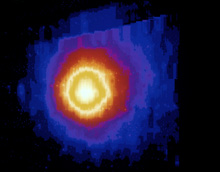
They're using their 3-year-old $3 million antenna to measure energy
from the moon and even, accidentally, a black hole.
snip
The hope, Malphrus said, is to establish a pipeline of eager and
engaged students who then choose Morehead or another Kentucky school
to study aerospace engineering before ultimately opening up shop in
the commonwealth.
snip
----------------------------------------------------------------------
Here is to looking up in this New Year.
Which reminds me that when back at NASA Ames I was sent a spread sheet
file from a high school student in Hungary of the energy he saw from
his Yagi antenna pointed at the Moon. Just something to think about
in case you didn't have $3 million. :-)
http://en.wikipedia.org/wiki/Yagi_antenna
What was that you said, who might be looking up.
http://www.newuniverse.co.uk/astronomicalsocieties_links.html
- LRK -
Thanks for looking up with me.
Larry Kellogg
Web Site: http://lkellogg.vttoth.com/LarryRussellKellogg/
BlogSpot: http://kelloggserialreports.blogspot.com/
RSS link: http://kelloggserialreports.blogspot.com/atom.xml
Newsletter: https://news.altair.com/mailman/listinfo/lunar-update
==============================================================
http://www.morehead-st.edu/
Morehead State University
http://www.morehead-st.edu/aboutmsu/
Meeting the educational needs of East Kentucky while striving to
constantly improve the quality of its public service, economic
development and applied research programs are the primary objectives
of Morehead State University.
Academically, the University offers 78 undergraduate degree programs,
including 8 associate level degrees and 12 pre-professional programs
in four colleges -- Caudill College of Humanities, College of
Business, College of Education, and College of Science and Technology)
and the Institute for Regional Analysis and Public Policy -- and 20
academic departments. There are 51 graduate degree programs plus 42
graduate level non-degree programs designed especially for
professional educators. The education specialist in five specialty
areas also is offered. A master's degree for physician assistants,
social workers and a cooperative doctoral program, all with the
University of Kentucky, are available on the MSU campus.
snip
==============================================================
http://pdf.aiaa.org/preview/CDReadyMSPOPS08_1436/PV2008_3520.pdf
The Development and Testing of a 21 m Earth
Station and Radio Telescope at Morehead State
University for Research and Education
Abstract
The Space Science Center at Morehead State University (Morehead, KY, U.S.A.) has
developed a 21 meter full-motion antenna system that serves as:
1.) a ground station capable of tracking Earth-orbiting satellites in a variety of orbital configurations
2.) a test bed for advanced RF systems, and
3.) a radio telescope for astronomical research.
The 21 m also serves as an active laboratory for students engaged in space science, engineering, telecommunications electronics, and astrophysics. The instrument primarily supports undergraduate student research projects in observational astrophysics, hardware and software design related to radio astronomy observations, telecommunication systems, and space systems operation. The 21 m is engaged in radio observations of microvariability in active galactic nuclei (AGNs), observations of transient events, (i.e. radio afterglow of Gamma Ray Bursts) and surveys (i.e. kinematic surveys of atomic hydrogen in the Milky Way Galaxy). In Earth station mode, the 21 m is capable of tracking a variety of satellites including LEOs, MEOs, GEOs, and lunar orbiting and fly-by spacecraft.
A major goal of this project is to assist in the development of a workforce for the space operations industry. The 21 m was brought on-line in 2006 and currently operates two receivers: an L-band receiver (1.4-1.7 GHz) covering the "water hole" and a Ku-band receiver (11.2-12.7 GHz) for continuum observations and satellite mission support. Other frequency bands (including an S-band 2.2-2.5 GHz receiver for satellite mission support and a 6 cm (C-band) feed for radio astronomy research) are in the development stages. The 21 m will serve as the primary Earth station for the KySat-1 and -2 orbital missions, as an Education and Public Outreach (E/PO) Earth station for NASA's PharmaSat mission, and as an Earth station for future NASA (and potentially ESA) missions.
snip
==============================================================
WHAT THE MIND CAN CONCEIVE, AND BELIEVE, IT WILL ACHIEVE - LRK
==============================================================
By Ryan Alessi - ralessi@herald-leader.com
MOREHEAD — Standing nearly 69 feet tall, the giant structure on the
hill overlooking Morehead State University's campus might look to some
as simply an oversize satellite TV dish.
But to those involved with the university's Space Science Program, the
dish — which is actually a space tracking antenna system that can
control satellites and measure celestial masses — remains a beacon for
a program that's traveled light-years from its days in a garage
apartment.
"We've come a long way," said Benjamin K. Malphrus, director of the
Space Science Center, who started the program after coming to Morehead
in the 1990s as an astronomy professor.
Now, faculty and staff are helping engineer and launch Kentucky's
first satellite.
They're using their 3-year-old $3 million antenna to measure energy
from the moon and even, accidentally, a black hole.
snip
The hope, Malphrus said, is to establish a pipeline of eager and
engaged students who then choose Morehead or another Kentucky school
to study aerospace engineering before ultimately opening up shop in
the commonwealth.
snip
------------------------------
Here is to looking up in this New Year.
Which reminds me that when back at NASA Ames I was sent a spread sheet
file from a high school student in Hungary of the energy he saw from
his Yagi antenna pointed at the Moon. Just something to think about
in case you didn't have $3 million. :-)
http://en.wikipedia.org/wiki/
What was that you said, who might be looking up.
http://www.newuniverse.co.uk/
- LRK -
Thanks for looking up with me.
Larry Kellogg
Web Site: http://lkellogg.vttoth.com/
BlogSpot: http://kelloggserialreports.
RSS link: http://kelloggserialreports.
Newsletter: https://news.altair.com/
==============================
http://www.morehead-st.edu/
Morehead State University
http://www.morehead-st.edu/
Meeting the educational needs of East Kentucky while striving to
constantly improve the quality of its public service, economic
development and applied research programs are the primary objectives
of Morehead State University.
Academically, the University offers 78 undergraduate degree programs,
including 8 associate level degrees and 12 pre-professional programs
in four colleges -- Caudill College of Humanities, College of
Business, College of Education, and College of Science and Technology)
and the Institute for Regional Analysis and Public Policy -- and 20
academic departments. There are 51 graduate degree programs plus 42
graduate level non-degree programs designed especially for
professional educators. The education specialist in five specialty
areas also is offered. A master's degree for physician assistants,
social workers and a cooperative doctoral program, all with the
University of Kentucky, are available on the MSU campus.
snip
==============================
http://pdf.aiaa.org/preview/
The Development and Testing of a 21 m Earth
Station and Radio Telescope at Morehead State
University for Research and Education
Abstract
The Space Science Center at Morehead State University (Morehead, KY, U.S.A.) has
developed a 21 meter full-motion antenna system that serves as:
1.) a ground station capable of tracking Earth-orbiting satellites in a variety of orbital configurations
2.) a test bed for advanced RF systems, and
3.) a radio telescope for astronomical research.
The 21 m also serves as an active laboratory for students engaged in space science, engineering, telecommunications electronics, and astrophysics. The instrument primarily supports undergraduate student research projects in observational astrophysics, hardware and software design related to radio astronomy observations, telecommunication systems, and space systems operation. The 21 m is engaged in radio observations of microvariability in active galactic nuclei (AGNs), observations of transient events, (i.e. radio afterglow of Gamma Ray Bursts) and surveys (i.e. kinematic surveys of atomic hydrogen in the Milky Way Galaxy). In Earth station mode, the 21 m is capable of tracking a variety of satellites including LEOs, MEOs, GEOs, and lunar orbiting and fly-by spacecraft.
A major goal of this project is to assist in the development of a workforce for the space operations industry. The 21 m was brought on-line in 2006 and currently operates two receivers: an L-band receiver (1.4-1.7 GHz) covering the "water hole" and a Ku-band receiver (11.2-12.7 GHz) for continuum observations and satellite mission support. Other frequency bands (including an S-band 2.2-2.5 GHz receiver for satellite mission support and a 6 cm (C-band) feed for radio astronomy research) are in the development stages. The 21 m will serve as the primary Earth station for the KySat-1 and -2 orbital missions, as an Education and Public Outreach (E/PO) Earth station for NASA's PharmaSat mission, and as an Earth station for future NASA (and potentially ESA) missions.
snip
==============================
WHAT THE MIND CAN CONCEIVE, AND BELIEVE, IT WILL ACHIEVE - LRK
==============================