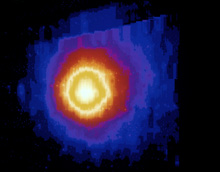
Alright, it isn't a Trcorder yet, but a beginning just the same.
http://en.wikipedia.org/wiki/Tricorder
- LRK -
_____________________________________________________________________
NASA Science News for April 6, 2007

A miniature biological laboratory important to the future of space
exploration has just passed an important test onboard the International
Space Station.

FULL STORY at

http://science.nasa.gov/headlines/y2007/06apr_locad2.htm?list965414

Snip
_____________________________________________________________________
*April 6, 2007:* "What a huge relief," says Norman Wainwright of the
Charles River Laboratories in Charleston, SC. "The whole technical team
was delighted that it worked so well."

He's talking about a miniature biological laboratory just tested for the
first time onboard the International Space Station. Called LOCAD-PTS
(short for Lab-On-a-Chip Application Development-Portable Test System),
the mini-lab detects the presence of bacteria or fungi on the surfaces
of a spacecraft far more rapidly than standard methods of culturing.

"The ability to monitor microorganisms would be especially important on
long space voyages, not only to check the health of astronauts but also
to monitor electronics and structural materials, which can be corroded
or otherwise damaged by certain fungi and bacteria," says Wainwright,
the experiment's principal investigator. LOCAD-PTS is designed so that
"astronauts can do the analysis onboard with no need to return samples
to laboratories on Earth."

The device was launched last December 9th on board the space shuttle
Discovery, and then stowed aboard ISS until its scheduled experiment
time�which happened to be Saturday night, March 31, Marshall Space
Flight Center time. (Remember that time!)

Snip
_____________________________________________________________________

Thanks for looking up with me.

Larry Kellogg

Web Site: http://lkellogg.vttoth.com/LarryRussellKellogg/
BlogSpot: http://kelloggserialreports.blogspot.com/
RSS link: http://kelloggserialreports.blogspot.com/atom.xml
Newsletter: https://news.altair.com/mailman/listinfo/lunar-update

==============================================================
http://exploration.nasa.gov/programs/station/LOCAD-PTS.html
Lab-on-a-Chip Application Development-Portable Test System (LOCAD-PTS)
Brief Summary

Lab-on-a-Chip Application Development-Portable Test System (LOCAD-PTS)
is a handheld device for rapid detection of biological and chemical
substances on board the space station. Astronauts will swab surfaces
within the cabin, add swab material to the LOCAD-PTS, and within 15
minutes obtain results on a display screen. The study's purpose is to
effectively provide an early warning system to enable crew members to
take remedial measures if necessary to protect the health and safety of
those on board the station.

Principal Investigator

Norman R. Wainwright, Ph.D., Charles River Endosafe, Charleston SC

Co-Investigator(s)

Jake Maule, Ph.D., Carnegie Institution of Washington, Washington, DC

Payload Developer


Marshall Space Flight Center, Huntsville, AL
Charles River Endosafe, Charleston, SC

Sponsoring Agency

National Aeronautics and Space Administration (NASA)

Expeditions Assigned

14,15,16

Previous ISS Missions

LOCAD-PTS is a new investigation for space research.

Snip
Research Summary

LOCAD-PTS is a handheld device for rapid detection of biological onboard
the International Space Station (ISS).

LOCAD-PTS analysis is immediate. Effectively providing an early warning
system to enable crew to take remedial measures if necessary to protect
themselves on board ISS.

Current testing focuses on detecting bacteria and fungi. Other sample
cartridges can be developed to detect chemical substances of concern to
crew safety on ISS (hydrazine, ammonia, etc.) and proteins in urine,
saliva and blood for aiding medical diagnoses.

Description

The Lab-on-a-Chip Application Development ᅵ Portable Test System
(LOCAD-PTS) is a handheld device, enabling crew to perform complex
laboratory tests on a thumb-sized cartridge with a press of a button.
Every thumb-sized plastic cartridge has 4 channels and each channel
contains a dried extract of horseshoe crab blood cells and colorless
dye. In the presence of bacteria and fungi, the dried extract reacts
strongly to turn the dye a green color. Therefore, the more green dye,
the more microorganisms there are in the original sample.

Tests by LOCAD-PTS will become increasingly specific with the advent of
new cartridges. Current cartridges target bacteria and fungi. New
cartridges, to be launched on subsequent flights, will target bacteria
only, then groups of bacteria and eventually individual species or
strains that pose a specific risk to crew health. Cartridges can also be
adapted to detect chemical substances of concern to crew safety on ISS
(e.g. hydrazine, ammonia and certain acids) and proteins in urine,
saliva and blood of astronauts to provide added information for medical
diagnosis. A phrase that summarizes this mode of operation is "same
instrument, just change the cartridge".

Snip
==============================================================
http://www.aiaa.org/aerospace/images/articleimages/pdf/AA_Mar07_EN.pdf
Primitive creatures aid healthy space travel.
Snip

The high-tech device relies on four enzymes extracted from the blood
cells of one of Earth�s most ancient living creatures -- the horseshoe crab.
"The horseshoe crab, a species that has survived some 300 million years, has
a very primitive but sensitive immune system," Wainwright explains. A single
bacterium can be enough to trigger enzymes in the crab's immune system, which
clot the blood to seal off a wound.

The enzymes' extraordinary sensitivity and rapid response make them widely
useful in medical research to test the effectiveness of drugs and devices. With
drawing a bit of blood annually from horseshoe crabs, which are then returned to
the sea, does not injure the creatures. So far, there is no acceptable synthetic
substitute.

It is these horseshoe crab enzymes that allow LOCAD-PTS to be so small,
sensitive, and fast.

Snip
==============================================================
Not all Tricorders were the same on Star Trek and other devices to aid
us in exploring space are being considered as well.
- LRK -
_____________________________________________________________________
http://www.nasa.gov/vision/earth/technologies/nuggets.html
NASA Develops a Nugget to Search for Life in Space
07.27.05

Astrobiologists, who search for evidence of life on other planets, may
find a proposed Neutron/Gamma ray Geologic Tomography (NUGGET)
instrument to be one of the most useful tools in their toolbelt

As conceived by scientists at the Goddard Space Flight Center (GSFC) in
Greenbelt, Md., NUGGET would be able to generate three-dimensional
images of fossils embedded in an outcrop of rock or beneath the soil of
Mars or another planet. Tomography uses radiation or sound waves to look
inside objects. NUGGET could help determine if primitive forms of life
took root on Mars when the planet was awash in water eons ago.

Similar to seismic tomography used by the oil industry to locate oil
reserves beneath Earth�s surface, NUGGET would look instead for evidence
of primitive algae and bacteria that fossilized along the edges of
extinct rivers or oceans. As on Earth, these remains could lie just a
few centimeters beneath the surface, compressed between layers of silt.
If a mechanical rover that explores planet surfaces were equipped with
an instrument like NUGGET -- capable of peering beneath the surface --
then it might be able to reveal evidence of life beyond Earth.

Snip
==============================================================

WHAT THE MIND CAN CONCEIVE, AND BELIEVE, IT WILL ACHIEVE - LRK

==============================================================
Friday, April 06, 2007


Monday, April 02, 2007
USGS Astrogeology - Hot Topics
When you go on a trip it helps to have a map to tell you where to go
when you come to a fork in the road.
http://astrogeology.usgs.gov/HotTopics/
If you would like look at what is happening now on the road to space,
check out the link above.
- LRK -
Various agencies publish maps around the World and in the USA the U.S.
Geological Survey office has done that for some time.
_____________________________________________________________________
http://www.usgs.gov/aboutusgs/
Our Mission and Vision
Mission: The USGS serves the Nation by providing reliable scientific
information to describe and understand the Earth; minimize loss of life
and property from natural disasters; manage water, biological, energy,
and mineral resources; and enhance and protect our quality of life.
Vision: USGS has become a world leader in the natural sciences thanks to
our scientific excellence and responsiveness to society's needs.
Snip
_____________________________________________________________________
Maps of mother Earth do not help you when you want to find a place to
land on the Moon.
Who would like to map the Moon?
It often takes someone with a vision to push for change and show the
chain of command that the project will work.
Eugene M. Shoemaker was that kind of person.
- LRK -
_____________________________________________________________________
http://astrogeology.usgs.gov/About/AstroHistory/shoemaker.html
Gene Shoemaker founded the Astrogeology Research Program in 1961 and was
its first Chief Scientist. He established the Flagstaff Science Center
in 1963, and retired from the USGS in 1993. He remained on Emeritus
status with the USGS and maintained an affiliation with * Lowell
Observatory <http://www.lowell.edu/> * until his death in a car accident
in Australia in 1997.
Gene was involved in the Lunar Ranger and Surveyor programs and
continued with the manned Apollo programs. He culminated his lunar
studies in 1994 with new data on the Moon from * Project Clementine
<http://astrogeology.usgs.gov/Missions/Clementine/>*, for which he was
the science-team leader. Gene collaborated closely with his wife,
Carolyn, a planetary astronomer. The discovery of Comet Shoemaker-Levy
(which impacted Jupiter in 1994) with colleague David Levy, gained them
world-wide fame. This was just one of Gene's many great accomplishments.
For more on Gene Shoemaker, see the * Eugene M. Shoemaker
<http://astrogeology.usgs.gov/About/People/GeneShoemaker> * page.
Snip
_____________________________________________________________________
If you have never read about him, take a look at what the USGS has to
say about him.
- LRK -
_____________________________________________________________________
http://astrogeology.usgs.gov/About/People/GeneShoemaker/
Eugene M. Shoemaker
April 28, 1928 - July 18, 1997
Table of Contents
* Biography
<http://astrogeology.usgs.gov/About/People/GeneShoemaker/#Biography>
* Photo Gallery
<http://astrogeology.usgs.gov/About/People/GeneShoemaker/#Photos>
* Additional Info
<http://astrogeology.usgs.gov/About/People/GeneShoemaker/#Additional>
* * Return to /About:People/
<http://astrogeology.usgs.gov/About/People/>*
Snip
_____________________________________________________________________
Thanks for looking up with me.
Larry Kellogg
Web Site: http://lkellogg.vttoth.com/LarryRussellKellogg/
BlogSpot: http://kelloggserialreports.blogspot.com/
RSS link: http://kelloggserialreports.blogspot.com/atom.xml
Newsletter: https://news.altair.com/mailman/listinfo/lunar-update
==============================================================
http://astrogeology.usgs.gov/About/AstroHistory/
The USGS Astrogeology Research Program has a rich history of
participation in space exploration efforts and planetary mapping,
starting in 1963 when the Flagstaff Science Center was established to
provide lunar geologic mapping and assist in training astronauts
destined for the Moon.
Throughout the years, the Program has participated in processing and
analyzing data from various missions to the planetary bodies in our
solar system, assisting in finding potential landing sites for
exploration vehicles, mapping our neighboring planets and their moons,
and conducting research to better understand the origins, evolutions,
and geologic processes operating on these bodies.
Historical Tour
* * Flagstaff Science Center:*
<http://astrogeology.usgs.gov/About/AstroHistory/ffc.html> How and
why the Science Center was established
* * Gene Shoemaker:*
<http://astrogeology.usgs.gov/About/AstroHistory/shoemaker.html>
The Founder of the USGS Astrogeology Research Program
* * Astronaut Training*
<http://astrogeology.usgs.gov/About/AstroHistory/astronauts.html>:
The role of Flagstaff and the USGS in astronaut training,
equipment testing, and mission simulations
* * Harrison H. Schmitt:*
<http://astrogeology.usgs.gov/About/AstroHistory/schmitt.html> a
USGS geologist goes to the Moon
* * Recommended Reading:*
<http://astrogeology.usgs.gov/About/AstroHistory/books.html> Books
and other resources about the history of the USGS Astrogeology
Research Program and the role of scientists in the early days of
the U.S. space program
Snip
==============================================================
http://astrogeology.usgs.gov/Projects/LunarAtlas/
The View From The Astronaut's Eyes
Apollo Mission Lunar Exploration Media Gallery
This gallery features interactive panoramas (or /virtual reality/
movies), photography, and maps from the various Apollo manned missions
to explore the lunar surface.
Snip
Lunar Links!
* *USGS Astro:* The Earth's Moon
<http://astrogeology.usgs.gov/SolarSystem/Earth/Moon/> - links to
lunar web pages right here at the USGS Astrogeology Research Program!
* *NASA:* Apollo Lunar Surface Journal
<http://www.hq.nasa.gov/alsj/frame.html>
* *NASA NSSDC:* Lunar Exploration
<http://nssdc.gsfc.nasa.gov/planetary/lunar/> - Mission info and more
* *NASA:* Welcome to the Planets - Earth
<http://pds.jpl.nasa.gov/planets/choices/earth1.htm> (includes the
Moon) http://www.lpi.usra.edu/research/apollo/
* *LPI:* Apollo Image Atlas <http://www.lpi.usra.edu/research/apollo/>
* *SEDS:* The Nine Planets Tour - Earth's Moon
<http://www.seds.org/nineplanets/nineplanets/luna.html>
* *SEDS:* Lunar Resources <http://www.seds.org/%7Erme/lunar.html>
USGS Astrogeology Research Program Home <http://astrogeology.usgs.gov/>
The imagery and maps were prepared as part of a project by a USGS team
under funding from the USGS Technology Transfer Program and NASA's
Planetary Geology and Geophysics Program. Dr. Christopher D. Condit (U.
Massachusetts) and Mr. Richard Kozak provided scientific and technical
assistance. Contact Kenneth L Tanaka (ktanaka@usgs.gov
ktanaka@usgs.gov>), Dennis McMacken (dmcmacke@usgs.gov
dmcmacke@usgs.gov>), or Glenn Bennett (gbennett@usgs.gov
gbennett@usgs.gov>), for additional information.
Snip
==============================================================
WHAT THE MIND CAN CONCEIVE, AND BELIEVE, IT WILL ACHIEVE - LRK
==============================================================
when you come to a fork in the road.
http://astrogeology.usgs.gov/HotTopics/
If you would like look at what is happening now on the road to space,
check out the link above.
- LRK -
Various agencies publish maps around the World and in the USA the U.S.
Geological Survey office has done that for some time.
_____________________________________________________________________
http://www.usgs.gov/aboutusgs/
Our Mission and Vision
Mission: The USGS serves the Nation by providing reliable scientific
information to describe and understand the Earth; minimize loss of life
and property from natural disasters; manage water, biological, energy,
and mineral resources; and enhance and protect our quality of life.
Vision: USGS has become a world leader in the natural sciences thanks to
our scientific excellence and responsiveness to society's needs.
Snip
_____________________________________________________________________
Maps of mother Earth do not help you when you want to find a place to
land on the Moon.
Who would like to map the Moon?
It often takes someone with a vision to push for change and show the
chain of command that the project will work.
Eugene M. Shoemaker was that kind of person.
- LRK -
_____________________________________________________________________
http://astrogeology.usgs.gov/About/AstroHistory/shoemaker.html
Gene Shoemaker founded the Astrogeology Research Program in 1961 and was
its first Chief Scientist. He established the Flagstaff Science Center
in 1963, and retired from the USGS in 1993. He remained on Emeritus
status with the USGS and maintained an affiliation with * Lowell
Observatory <http://www.lowell.edu/> * until his death in a car accident
in Australia in 1997.
Gene was involved in the Lunar Ranger and Surveyor programs and
continued with the manned Apollo programs. He culminated his lunar
studies in 1994 with new data on the Moon from * Project Clementine
<http://astrogeology.usgs.gov/Missions/Clementine/>*, for which he was
the science-team leader. Gene collaborated closely with his wife,
Carolyn, a planetary astronomer. The discovery of Comet Shoemaker-Levy
(which impacted Jupiter in 1994) with colleague David Levy, gained them
world-wide fame. This was just one of Gene's many great accomplishments.
For more on Gene Shoemaker, see the * Eugene M. Shoemaker
<http://astrogeology.usgs.gov/About/People/GeneShoemaker> * page.
Snip
_____________________________________________________________________
If you have never read about him, take a look at what the USGS has to
say about him.
- LRK -
_____________________________________________________________________
http://astrogeology.usgs.gov/About/People/GeneShoemaker/
Eugene M. Shoemaker
April 28, 1928 - July 18, 1997
Table of Contents
* Biography
<http://astrogeology.usgs.gov/About/People/GeneShoemaker/#Biography>
* Photo Gallery
<http://astrogeology.usgs.gov/About/People/GeneShoemaker/#Photos>
* Additional Info
<http://astrogeology.usgs.gov/About/People/GeneShoemaker/#Additional>
* * Return to /About:People/
<http://astrogeology.usgs.gov/About/People/>*
Snip
_____________________________________________________________________
Thanks for looking up with me.
Larry Kellogg
Web Site: http://lkellogg.vttoth.com/LarryRussellKellogg/
BlogSpot: http://kelloggserialreports.blogspot.com/
RSS link: http://kelloggserialreports.blogspot.com/atom.xml
Newsletter: https://news.altair.com/mailman/listinfo/lunar-update
==============================================================
http://astrogeology.usgs.gov/About/AstroHistory/
The USGS Astrogeology Research Program has a rich history of
participation in space exploration efforts and planetary mapping,
starting in 1963 when the Flagstaff Science Center was established to
provide lunar geologic mapping and assist in training astronauts
destined for the Moon.
Throughout the years, the Program has participated in processing and
analyzing data from various missions to the planetary bodies in our
solar system, assisting in finding potential landing sites for
exploration vehicles, mapping our neighboring planets and their moons,
and conducting research to better understand the origins, evolutions,
and geologic processes operating on these bodies.
Historical Tour
* * Flagstaff Science Center:*
<http://astrogeology.usgs.gov/About/AstroHistory/ffc.html> How and
why the Science Center was established
* * Gene Shoemaker:*
<http://astrogeology.usgs.gov/About/AstroHistory/shoemaker.html>
The Founder of the USGS Astrogeology Research Program
* * Astronaut Training*
<http://astrogeology.usgs.gov/About/AstroHistory/astronauts.html>:
The role of Flagstaff and the USGS in astronaut training,
equipment testing, and mission simulations
* * Harrison H. Schmitt:*
<http://astrogeology.usgs.gov/About/AstroHistory/schmitt.html> a
USGS geologist goes to the Moon
* * Recommended Reading:*
<http://astrogeology.usgs.gov/About/AstroHistory/books.html> Books
and other resources about the history of the USGS Astrogeology
Research Program and the role of scientists in the early days of
the U.S. space program
Snip
==============================================================
http://astrogeology.usgs.gov/Projects/LunarAtlas/
The View From The Astronaut's Eyes
Apollo Mission Lunar Exploration Media Gallery
This gallery features interactive panoramas (or /virtual reality/
movies), photography, and maps from the various Apollo manned missions
to explore the lunar surface.
Snip
Lunar Links!
* *USGS Astro:* The Earth's Moon
<http://astrogeology.usgs.gov/SolarSystem/Earth/Moon/> - links to
lunar web pages right here at the USGS Astrogeology Research Program!
* *NASA:* Apollo Lunar Surface Journal
<http://www.hq.nasa.gov/alsj/frame.html>
* *NASA NSSDC:* Lunar Exploration
<http://nssdc.gsfc.nasa.gov/planetary/lunar/> - Mission info and more
* *NASA:* Welcome to the Planets - Earth
<http://pds.jpl.nasa.gov/planets/choices/earth1.htm> (includes the
Moon) http://www.lpi.usra.edu/research/apollo/
* *LPI:* Apollo Image Atlas <http://www.lpi.usra.edu/research/apollo/>
* *SEDS:* The Nine Planets Tour - Earth's Moon
<http://www.seds.org/nineplanets/nineplanets/luna.html>
* *SEDS:* Lunar Resources <http://www.seds.org/%7Erme/lunar.html>
USGS Astrogeology Research Program Home <http://astrogeology.usgs.gov/>
The imagery and maps were prepared as part of a project by a USGS team
under funding from the USGS Technology Transfer Program and NASA's
Planetary Geology and Geophysics Program. Dr. Christopher D. Condit (U.
Massachusetts) and Mr. Richard Kozak provided scientific and technical
assistance. Contact Kenneth L Tanaka (ktanaka@usgs.gov
Snip
==============================================================
WHAT THE MIND CAN CONCEIVE, AND BELIEVE, IT WILL ACHIEVE - LRK
==============================================================
Sunday, April 01, 2007
Subscribe to:
Posts (Atom)