Many folks would like to see us back on the Moon and developing its resources.

Showing posts with label spacecraft. Show all posts

Thursday, December 20, 2012

Asteroids and comets visited by spacecraft as of December 2012


Toutatis asteroid went by and China's Chang'E 2 photographed it but I didn't hear much fanfare.
There have been other asteroids and comets visited by spacecraft and hopefully the information obtained will be useful should we want to know how to change their orbits to avoid a collision with Earth or modify an orbit to capture one for space mining.  I hope we have some idea of their radiation history and what risks would be involved with sending humans  to one as I hear mumbles about doing so.
 - LRK -

Emily Lakdawalla of the Planetary Society has put together aN asteroids-and-coments montage.
- LRK -

-----------------------
My ever-popular asteroids-and-comets montage, now in color, with bonus Toutatis
Posted By Emily Lakdawalla
2012/12/18 04:26 CST
My collage of all the asteroids and comets visited by spacecraft is probably the single most popular image I have ever posted on this blog. I've now updated it to be in color and to include Toutatis, which Chang'E 2 photographed last week. When I first started working on a color version, it didn't seem to hang together very well as a composition, because the colors were all over the map. But when I hit upon the idea of trying to represent the bodies with correct relative brightness, it seemed to come together nicely. Vesta is not included because it dwarfs the others. (I'd have to increase the height and width of the montage by factors of three.)
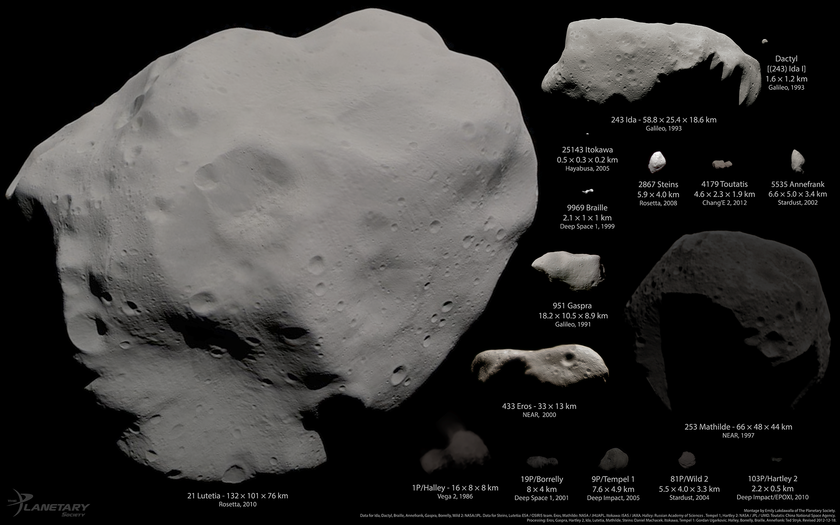
Asteroids and comets visited by spacecraft as of December 2012, in color, excepting Vesta
Montage by Emily Lakdawalla. Data from NASA / JPL / JHUAPL / UMD / JAXA / ESA / OSIRIS team / Russian Academy of Sciences / China National Space Agency. Processed by Emily Lakdawalla, Daniel Machacek, Ted Stryk, Gordan Ugarkovic.
Asteroids and comets visited by spacecraft as of December 2012, in color, excepting Vesta
A montage of 16 of the 17 asteroids and comets that have been photographed up close as of December 2012, when Chang'E 2 flew past Toutatis. This version is in color and shows the bodies at their correct relative (though not absolute) albedo or brightness. Not included is Vesta, which would cover an area about three times the width and height of this montage.

snip
-----------------------


Some information on spacecraft that have visited asteroids and coments.
- LRK -

List of asteroids visited by spacecraft

Category:Comets visited by spacecraft

snip
-----------------------

NASA images Touatis with ground radar.
- LRK -

-----------------------
Asteroid Toutatis Slowly Tumbles by Earth
by Staff Writers
Pasadena CA (JPL) Dec 17, 2012

Scientists working with NASA's 230-foot-wide (70-meter) Deep Space Network antenna at Goldstone, Calif., have generated a series of radar data images of a three-mile-long (4.8-kilometer) asteroid that made its closest approach to Earth on Dec. 12, 2012.

The images that make up the movie clip were generated with data taken on Dec. 12 and 13, 2012. On Dec. 12, the day of its closest approach to Earth, Toutatis was about 18 lunar distances, 4.3 million miles (6.9 million kilometers) from Earth. On Dec. 13, the asteroid was about 4.4 million miles (7 million kilometers), or about 18.2 lunar distances.

The radar data images of asteroid Toutatis indicate that it is an elongated, irregularly shaped object with ridges and perhaps craters. Along with shape detail, scientists are also seeing some interesting bright glints that could be surface boulders.

Toutatis has a very slow, tumbling rotational state. The asteroid rotates about its long axis every 5.4 days and precesses (changes the orientation of its rotational axis) like a wobbling, badly thrown football, every 7.4 days.The orbit of Toutatis is well understood. The next time Toutatis will approach at least this close to Earth is in November of 2069, when the asteroid will safely fly by at about 7.7 lunar distances, or 1.8 million miles (3 million kilometers).
snip
------------------------


China's flyby of Toutatis with Chang'e-2 spacecraft.
- LRK -

-----------------------
China Makes First Asteroid Fly By
by Staff Writers
Beijing (XNA) Dec 17, 2012
China's space probe Chang'e-2 has successfully conducted a maneuver in which it flew by the asteroid Toutatis, about seven million km away from the Earth.

Travelling in deep space, Chang'e-2 made the flyby on Dec. 13 at 16:30:09 Beijing Time (08:30"09 GMT), the State Administration of Science, Technology and Industry for National Defense (SASTIND) announced on Saturday.

The flyby was the first time an unmanned spacecraft launched from Earth has taken such a close viewing of the asteroid, named after a Celtic god.

It also made China the fourth country after the United States, the European Union and Japan to be able to examine an asteroid by spacecraft.

Chang'e-2 came as close as 3.2 km from Toutatis and took pictures of the asteroid at a relative velocity of 10.73 km per second, the SASTIND said in a statement.

Sources with the administration told Xinhua that Chang'e-2 is continuing its deep space travel and will reach a distance of more than 10 million km away from Earth in January next year.

Chang'e-2 was launched on Oct. 1, 2010 from Xichang Satellite Launch Center and later orbited the moon to finish a more extensive probe than its predecessor Chang'e-1.

Chang'e-2 left its lunar orbit for an extended mission to the Earth-Sun L2 Lagrangian point on June 9, 2011, after finishing its lunar objectives, which collected data for a complete lunar map.

The probe departed from L2 this year and began its mission to Toutatis.snip
-----------------------

Post Cina . org
- LRK -

You are here: Home > China > Nation
Chinese space probe flies by asteroid Toutatis
Xinhua, December 15, 2012
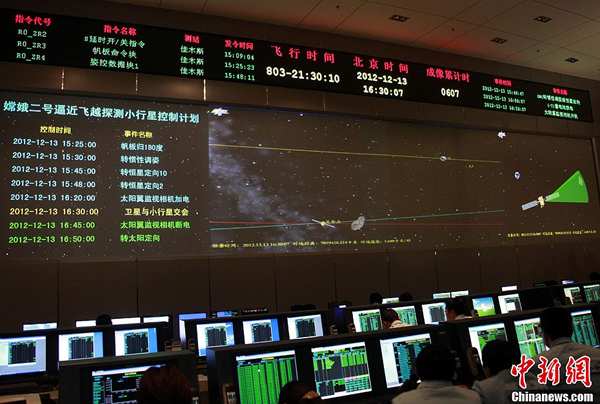
China's space probe Chang'e-2 has successfully conducted a maneuver in which it flew by the asteroid Toutatis, about seven million km away from the Earth.

China's space probe Chang'e-2 has successfully conducted a maneuver in which it flew by the asteroid Toutatis, about seven million km away from the Earth. [Photo: Chinanews.com]

Travelling in deep space, Chang'e-2 made the flyby on Dec. 13 at 16:30:09 Beijing Time (08:30"09 GMT), the State Administration of Science, Technology and Industry for National Defense (SASTIND) announced on Saturday.
The flyby was the first time an unmanned spacecraft launched from Earth has taken such a close viewing of the asteroid, named after a Celtic god.
It also made China the fourth country after the United States, the European Union and Japan to be able to examine an asteroid by spacecraft.
Chang'e-2 came as close as 3.2 km from Toutatis and took pictures of the asteroid at a relative velocity of 10.73 km per second, the SASTIND said in a statement.
snip
-----------------------

You can reach these celestial bodies with conventional rockets.  Just be prepared to spend a few years en route.

Thanks for looking with me.
- LRK -
=============================================================
Dec. 12, 2012: This week, NASA's Goldstone radar is tracking a large asteroid as it passes by Earth, and obtaining unusually clear images of the tumbling space rock.

"There is no danger of a collision with Earth," says Lance Benner of NASA's Near Earth Object Program. "At closest approach on Dec. 12th, asteroid 4179 Toutatis will be 7 million km away or 18 times farther than the Moon."

Asteroid Toutatis is well known to astronomers; it passes by Earth’s orbit every 4 years. Measuring 4.5 km in length, it is one of the largest known potentially hazardous asteroids (PHAs), and its orbit is inclined less than half-a-degree from Earth's. No other kilometer-sized PHA moves around the Sun in an orbit so nearly coplanar with our own.  This makes it an important target for radar studies.

NASA's Goldstone radar in the Mojave Desert will be pinging the space rock every day from Dec. 4th through 22nd.  The echoes highlight the asteroid's topography and improve the precision with which researchers know the asteroid's orbit.

"We already know that Toutatis will not hit Earth for hundreds of years," says Benner.  "These new observations will allow us to predict the asteroid's trajectory even farther into the future."

Benner and colleagues are particularly excited about a new digital imaging system at Goldstone that could reveal never-before-seen details on the asteroid's surface. "Using the new system, we can now image the asteroid's surface with 2 to 5 times finer resolution than previous flybys," he says. "We may we see something new on Toutatis."
snip

=============================================================
Japanese Spacecraft Returns From Asteroid Sampling Mission

BY LISA GROSSMAN
06.14.10
11:55 AM

The Japanese spacecraft Hayabusa returned from its seven-year trek to the asteroid Itokawa on Sunday, and a capsule that hopefully contains pieces of the asteroid was recovered in the Australian outback Monday morning. The mission was the first round trip to a planetary body beyond the moon, and — if the capsule isn’t empty — the fourth space-sample return mission ever.
The capsule detached from the spacecraft at 7:51 pm Japanese time on June 13. The rest of the spacecraft burnt up in a dramatic, meteor-like blaze at 10:51 p.m., but a heat shield protected the capsule as it reentered the atmosphere. The capsule landed in the Australian Woomera Prohibited Area, 300 miles northwest of Adelaide, and was located around 11:56 p.m. It will be flown to Tokyo tomorrow, where scientists will open the capsule.
snip
=============================================================
WHAT THE MIND CAN CONCEIVE, AND BELIEVE, IT WILL ACHIEVE - LRK -

=============================================================

Thursday, August 02, 2007

INTERMISSION - "TIME ENOUGH FOR LOVE - The Lives of Lazarus Long"

Army daughter, two children, and Army husband are here and will leave
the grandchildren as they go back to NY to get ready to deploy to Iraq.
We will have the grandchildren for the year and a half that they are gone.
Have been busy with in-laws and their goodbyes to all.

That said, have been trying to read Robert A. Heinlein's "TIME ENOUGH
FOR LOVE - The Lives of Lazarus Long" and have reached the INTERMISSION
at the halfway point. It says, "Excerpts from the Notebooks of Lazarus
Long."

Since we are interested in reasons to go the the Moon, Mars and Beyond,
let me lift a few of those quips starting at page 240.
- LRK -
------------------------------------------------------------------
snip

By the data to date, there is only one animal in the Galaxy dangerous to
man --- man himself. So he must supply his own indispensable
competition. He has no enemy to help him.

snip

When a place gets crowded enough to require ID's, social collapse is not
far away. It is time to go elsewhere. The best thing about space travel
is that it made it possible to go elsewhere.

snip

The second best thing about space travel is that the distance involved
make war very difficult, usually impractical, and almost always
unnecessary. This is propably a loss for most people, since war is our
race's most popular diversion, one which gives purpose and color to dull
and stupid lives. But it is a great boon to the intelligent man who
fights onlt when he must --- never for sport.

snip

Peace is an extension of war by political means. Plenty of elbowroom is
pleasanter --- and much safer.

snip
------------------------------------------------------------------

Larry Klaes passed this link.
http://lifeboat.com/ex/why.the.moon.human.survival
"Why the Moon? Human survival!" by Robert Shapiro.

So leave before it is too late, stick around and fix the problem, curl
up and go to sleep, may get interesting or overwhelming.
- LRK -

http://www.youtube.com/watch?v=-fVI3BRBC6o&NR=1
There Is No Energy Crisis, There is a Crisis of Ignorance

And if you have more time than I do, something to chew on.
- LRK -

http://www.werbos.com/*
Welcome to the Werbos World!*


Thanks for looking up with me.
- LRK -

Larry Kellogg

Web Site: http://lkellogg.vttoth.com/LarryRussellKellogg/
BlogSpot: http://kelloggserialreports.blogspot.com/
RSS link: http://kelloggserialreports.blogspot.com/atom.xml
Newsletter: https://news.altair.com/mailman/listinfo/lunar-update
==============================================================
http://www.rvt.com/~lucas/heinlein/faq/bio.html
Robert Anson Heinlein: A Short Biography

Snip
==============================================================
http://www.thespacereview.com/article/901/1
"We must ride the lightning": Robert Heinlein and American spaceflight

by Dwayne A. Day
Monday, July 2, 2007

Snip
==============================================================
http://www.geocities.com/msmaire/heinlein.html
/*ROBERT ANSON HEINLEIN 1907-1988*/
L I N K S !

Snip
==============================================================
WHAT THE MIND CAN CONCEIVE, AND BELIEVE, IT WILL ACHIEVE - LRK
==============================================================

Wednesday, July 25, 2007

Verona Rupes: Tallest Known Cliff in the Solar System


Astronomy Picture of the Day
20 Kilometer Drop
Verona Rupes: Tallest Known Cliff in the Solar System

It has been suggested that this Astronomy Picture of the Day would be
great for your viewing.

If you are afraid of heights, then be forewarned, don't look down.
- LRK -
--------------------------------------------------------------------------
http://antwrp.gsfc.nasa.gov/apod/ap070723.html -
Verona Rupes: Tallest Known Cliff in the Solar System
Credit: Voyager 2, NASA
Explanation: Could you survive a jump off the tallest cliff in the Solar
System? Quite possibly. Verona Rupes on Uranus' moon Miranda is
estimated to be 20 kilometers deep -- ten times the depth of the Earth's
Grand Canyon. Given Miranda's low gravity, it would take about 12
minutes for a thrill-seeking adventurer to fall from the top, reaching
the bottom at the speed of a racecar -- about 200 kilometers per hour.
Even so, the fall might be survivable given proper airbag protection.
The above image of Verona Rupes was captured by the passing Voyager 2
robotic spacecraft in 1986. How the giant cliff was created remains
unknown, but is possibly related to a large impact or tectonic surface
motion.
--------------------------------------------------------------------------

Part of the reason I think folks would like to go to the Moon, Mars, and
Beyond is for the thrill of seeing new sights and living on the edge.

Folks climb mountains, scale Half Doom at Yosemite, go down into caves,
and generally go places that test their abilities.
http://travel.webshots.com/album/13284027EEyAVMFdoL
http://www.ocean.udel.edu/kiosk/bsmoker.html
http://www.caves.org/

And then there are some that have taken a barrel over the Niagara Falls.
http://www.niagarafallslive.com/daredevils_of_niagara_falls.htm

Best you check with your fellow astronauts just why they want to go
forth and explore.
- LRK -

Thanks for looking up with me.
- LRK -

Larry Kellogg

Web Site: http://lkellogg.vttoth.com/LarryRussellKellogg/
BlogSpot: http://kelloggserialreports.blogspot.com/
RSS link: http://kelloggserialreports.blogspot.com/atom.xml
Newsletter: https://news.altair.com/mailman/listinfo/lunar-update
==============================================================
Astronomy Picture of the Day
20 Kilometer Drop
Verona Rupes: Tallest Known Cliff in the Solar System
http://antwrp.gsfc.nasa.gov/apod/ap070723.html -

Snip
==============================================================
http://antwrp.gsfc.nasa.gov/apod/lib/aptree.html
Astronomy Picture of the Day
Index - Main Page

Snip
==============================================================
http://antwrp.gsfc.nasa.gov/apod/archivepix.html
Astronomy Picture of the Day Archive

Snip
==============================================================
WHAT THE MIND CAN CONCEIVE, AND BELIEVE, IT WILL ACHIEVE - LRK
==============================================================

Friday, April 06, 2007

LOCAD-PTS (short for Lab-On-a-Chip Application Development-Portable Test System)


Alright, it isn't a Trcorder yet, but a beginning just the same.
http://en.wikipedia.org/wiki/Tricorder
- LRK -
_____________________________________________________________________
NASA Science News for April 6, 2007

A miniature biological laboratory important to the future of space
exploration has just passed an important test onboard the International
Space Station.

FULL STORY at

http://science.nasa.gov/headlines/y2007/06apr_locad2.htm?list965414

Snip
_____________________________________________________________________
*April 6, 2007:* "What a huge relief," says Norman Wainwright of the
Charles River Laboratories in Charleston, SC. "The whole technical team
was delighted that it worked so well."

He's talking about a miniature biological laboratory just tested for the
first time onboard the International Space Station. Called LOCAD-PTS
(short for Lab-On-a-Chip Application Development-Portable Test System),
the mini-lab detects the presence of bacteria or fungi on the surfaces
of a spacecraft far more rapidly than standard methods of culturing.

"The ability to monitor microorganisms would be especially important on
long space voyages, not only to check the health of astronauts but also
to monitor electronics and structural materials, which can be corroded
or otherwise damaged by certain fungi and bacteria," says Wainwright,
the experiment's principal investigator. LOCAD-PTS is designed so that
"astronauts can do the analysis onboard with no need to return samples
to laboratories on Earth."

The device was launched last December 9th on board the space shuttle
Discovery, and then stowed aboard ISS until its scheduled experiment
time�which happened to be Saturday night, March 31, Marshall Space
Flight Center time. (Remember that time!)

Snip
_____________________________________________________________________

Thanks for looking up with me.

Larry Kellogg

Web Site: http://lkellogg.vttoth.com/LarryRussellKellogg/
BlogSpot: http://kelloggserialreports.blogspot.com/
RSS link: http://kelloggserialreports.blogspot.com/atom.xml
Newsletter: https://news.altair.com/mailman/listinfo/lunar-update

==============================================================
http://exploration.nasa.gov/programs/station/LOCAD-PTS.html
Lab-on-a-Chip Application Development-Portable Test System (LOCAD-PTS)
Brief Summary

Lab-on-a-Chip Application Development-Portable Test System (LOCAD-PTS)
is a handheld device for rapid detection of biological and chemical
substances on board the space station. Astronauts will swab surfaces
within the cabin, add swab material to the LOCAD-PTS, and within 15
minutes obtain results on a display screen. The study's purpose is to
effectively provide an early warning system to enable crew members to
take remedial measures if necessary to protect the health and safety of
those on board the station.

Principal Investigator

Norman R. Wainwright, Ph.D., Charles River Endosafe, Charleston SC

Co-Investigator(s)

Jake Maule, Ph.D., Carnegie Institution of Washington, Washington, DC

Payload Developer


Marshall Space Flight Center, Huntsville, AL
Charles River Endosafe, Charleston, SC

Sponsoring Agency

National Aeronautics and Space Administration (NASA)

Expeditions Assigned

14,15,16

Previous ISS Missions

LOCAD-PTS is a new investigation for space research.

Snip
Research Summary

LOCAD-PTS is a handheld device for rapid detection of biological onboard
the International Space Station (ISS).

LOCAD-PTS analysis is immediate. Effectively providing an early warning
system to enable crew to take remedial measures if necessary to protect
themselves on board ISS.

Current testing focuses on detecting bacteria and fungi. Other sample
cartridges can be developed to detect chemical substances of concern to
crew safety on ISS (hydrazine, ammonia, etc.) and proteins in urine,
saliva and blood for aiding medical diagnoses.

Description

The Lab-on-a-Chip Application Development ᅵ Portable Test System
(LOCAD-PTS) is a handheld device, enabling crew to perform complex
laboratory tests on a thumb-sized cartridge with a press of a button.
Every thumb-sized plastic cartridge has 4 channels and each channel
contains a dried extract of horseshoe crab blood cells and colorless
dye. In the presence of bacteria and fungi, the dried extract reacts
strongly to turn the dye a green color. Therefore, the more green dye,
the more microorganisms there are in the original sample.

Tests by LOCAD-PTS will become increasingly specific with the advent of
new cartridges. Current cartridges target bacteria and fungi. New
cartridges, to be launched on subsequent flights, will target bacteria
only, then groups of bacteria and eventually individual species or
strains that pose a specific risk to crew health. Cartridges can also be
adapted to detect chemical substances of concern to crew safety on ISS
(e.g. hydrazine, ammonia and certain acids) and proteins in urine,
saliva and blood of astronauts to provide added information for medical
diagnosis. A phrase that summarizes this mode of operation is "same
instrument, just change the cartridge".

Snip
==============================================================
http://www.aiaa.org/aerospace/images/articleimages/pdf/AA_Mar07_EN.pdf
Primitive creatures aid healthy space travel.
Snip

The high-tech device relies on four enzymes extracted from the blood
cells of one of Earth�s most ancient living creatures -- the horseshoe crab.
"The horseshoe crab, a species that has survived some 300 million years, has
a very primitive but sensitive immune system," Wainwright explains. A single
bacterium can be enough to trigger enzymes in the crab's immune system, which
clot the blood to seal off a wound.

The enzymes' extraordinary sensitivity and rapid response make them widely
useful in medical research to test the effectiveness of drugs and devices. With
drawing a bit of blood annually from horseshoe crabs, which are then returned to
the sea, does not injure the creatures. So far, there is no acceptable synthetic
substitute.

It is these horseshoe crab enzymes that allow LOCAD-PTS to be so small,
sensitive, and fast.

Snip
==============================================================
Not all Tricorders were the same on Star Trek and other devices to aid
us in exploring space are being considered as well.
- LRK -
_____________________________________________________________________
http://www.nasa.gov/vision/earth/technologies/nuggets.html
NASA Develops a Nugget to Search for Life in Space
07.27.05

Astrobiologists, who search for evidence of life on other planets, may
find a proposed Neutron/Gamma ray Geologic Tomography (NUGGET)
instrument to be one of the most useful tools in their toolbelt

As conceived by scientists at the Goddard Space Flight Center (GSFC) in
Greenbelt, Md., NUGGET would be able to generate three-dimensional
images of fossils embedded in an outcrop of rock or beneath the soil of
Mars or another planet. Tomography uses radiation or sound waves to look
inside objects. NUGGET could help determine if primitive forms of life
took root on Mars when the planet was awash in water eons ago.

Similar to seismic tomography used by the oil industry to locate oil
reserves beneath Earth�s surface, NUGGET would look instead for evidence
of primitive algae and bacteria that fossilized along the edges of
extinct rivers or oceans. As on Earth, these remains could lie just a
few centimeters beneath the surface, compressed between layers of silt.
If a mechanical rover that explores planet surfaces were equipped with
an instrument like NUGGET -- capable of peering beneath the surface --
then it might be able to reveal evidence of life beyond Earth.

Snip
==============================================================

WHAT THE MIND CAN CONCEIVE, AND BELIEVE, IT WILL ACHIEVE - LRK

==============================================================

Sunday, February 25, 2007

The Study of the Pioneer Anomaly:

The Study of the Pioneer Anomaly:
New Data and Objectives for New Investigation

Slava G. Turyshev, a
Viktor T. Toth, b
Larry R. Kellogg, c
Eunice. L. Lau, a and
Kyong J. Lee, a

a Jet Propulsion Laboratory, California Institute of Technology,
4800 Oak Grove Drive, Pasadena, CA 91109, USA
b vttoth.com, 3-575 Old St Patrick St., Ottawa ON K1N 9H5, Canada
c NASA Ames Research Center, Moffett Field, CA 94035, USA 1

1 Contractor to NASA Ames Research Center employed by Bendix Field Engineering Corporation early on and Orbital Sciences Corporation at the end of the Pioneer missions; presently retired.

Abstract

The Pioneer 10/11 spacecraft yielded the most precise navigation in deep space to date. However, their radiometric tracking data has consistently indicated the presence of a small, anomalous, Doppler frequency drift. The drift is a blue shift, uniformly changing with a rate of  6 × 10⁻⁹ Hz/s and can be interpreted as a constant sunward acceleration of each particular spacecraft of aP = (8.74 ±1.33) × 10−10 m/s2 (or, alternatively, a time acceleration of at = (2.92 ± 0.44) × 10−18 s/s2). This signal has become known as the Pioneer anomaly; the nature of this anomaly remains unexplained. We discuss the current state of the efforts to retrieve the entire data sets of the Pioneer 10 and 11 radiometric Doppler data. We also report on the availability of recently recovered telemetry files that may be used to reconstruct the engineering history of both spacecraft using original project documentation and newly developed software tools. We discuss possible ways to further investigate the discovered effect using these telemetry files in conjunction with the analysis of the much extended Pioneer Doppler data.

In preparation for this new upcoming investigation, we summarize the current knowledge of the
Pioneer anomaly and review some of the mechanisms proposed for its explanation. We emphasize the main objectives of this new study, namely i) analysis of the early data that could yield the true direction of the anomaly and thus, its origin, ii) analysis of planetary encounters, that should tell more about the onset of the anomaly (e.g. Pioneer 11’s Saturn flyby), iii) analysis of the entire dataset, that should lead to a better determination of the temporal behavior of the anomaly, iv) comparative analysis of individual anomalous accelerations for the two Pioneers with the data taken from similar heliocentric distances, v) the detailed study of on-board systematics, and vi) development of a thermal-electric-dynamical model using on-board telemetry. The outlined strategy may allow for a higher accuracy solution for the anomalous acceleration of the Pioneer spacecraft and, possibly, will lead to an unambiguous determination of the origin of the Pioneer anomaly.

Contents
1 Introduction 2
2 The Pioneer Anomaly and the Search for its Origin 5
2.1 The Pioneer Anomaly . . . . . . . . . . . . . . . . . . . . . . . . . . . . . . . . . . . . . . . . . . 5
2.2 Original Efforts to Explain the Anomaly . . . . . . . . . . . . . . . . . . . . . . . . . . . . . . . . 7
2.2.1 Effects with Sources External to the Spacecraft . . . . . . . . . . . . . . . . . . . . . . . . 7
2.2.2 Study of the On-Board Systematics . . . . . . . . . . . . . . . . . . . . . . . . . . . . . . 7
2.2.3 Computational Systematics . . . . . . . . . . . . . . . . . . . . . . . . . . . . . . . . . . . 8
2.3 Recent Efforts to Explain the Anomaly . . . . . . . . . . . . . . . . . . . . . . . . . . . . . . . . . 8
2.3.1 Search for Independent Confirmation . . . . . . . . . . . . . . . . . . . . . . . . . . . . . . 8
2.3.2 Conventional Physics Mechanisms . . . . . . . . . . . . . . . . . . . . . . . . . . . . . . . 8
2.3.3 Possibility for New Physics? . . . . . . . . . . . . . . . . . . . . . . . . . . . . . . . . . . . 9
3 Recovery of the Extended Pioneer Doppler Data Set 10
3.1 Doppler Data . . . . . . . . . . . . . . . . . . . . . . . . . . . . . . . . . . . . . . . . . . . . . . . 10
3.2 Pioneer Doppler Data Formats . . . . . . . . . . . . . . . . . . . . . . . . . . . . . . . . . . . . . 11
3.2.1 ATDF – Archival Tracking Data File (Format TRK-2-25) . . . . . . . . . . . . . . . . . . 12
3.2.2 ODF – Orbit Data File (Format TRK-2-18) . . . . . . . . . . . . . . . . . . . . . . . . . . 13
3.3 Retrieval of the Pioneer Doppler Data . . . . . . . . . . . . . . . . . . . . . . . . . . . . . . . . . 13
3.4 Current Status of the Data Recovery Process . . . . . . . . . . . . . . . . . . . . . . . . . . . . . 14
4 Pioneer Telemetry and On-Board Systematics 16
4.1 Master Data Records . . . . . . . . . . . . . . . . . . . . . . . . . . . . . . . . . . . . . . . . . . . 16
4.1.1 MDR Media and Data Organization . . . . . . . . . . . . . . . . . . . . . . . . . . . . . . 16
4.1.2 Data Integrity and Completeness . . . . . . . . . . . . . . . . . . . . . . . . . . . . . . . . 18
4.1.3 Interpreting the Data . . . . . . . . . . . . . . . . . . . . . . . . . . . . . . . . . . . . . . 18
4.1.4 Decoding Analog Values . . . . . . . . . . . . . . . . . . . . . . . . . . . . . . . . . . . . . 19
4.1.5 Software Implementation . . . . . . . . . . . . . . . . . . . . . . . . . . . . . . . . . . . . 20
4.2 Available Telemetry Information . . . . . . . . . . . . . . . . . . . . . . . . . . . . . . . . . . . . 21
4.3 What Can Telemetry Tell Us About the Spacecraft? . . . . . . . . . . . . . . . . . . . . . . . . . 24
5 A Strategy to Find the Origin of the Pioneer Anomaly 26
5.1 Analysis of the Earlier Data . . . . . . . . . . . . . . . . . . . . . . . . . . . . . . . . . . . . . . . 27
5.2 Study of the Planetary Encounters . . . . . . . . . . . . . . . . . . . . . . . . . . . . . . . . . . . 30
5.3 Analysis of the Entire Data Span . . . . . . . . . . . . . . . . . . . . . . . . . . . . . . . . . . . . 30
5.4 Analysis of the Individual Trajectories for Both Pioneers . . . . . . . . . . . . . . . . . . . . . . . 30
5.5 Investigation of the On-Board Systematics . . . . . . . . . . . . . . . . . . . . . . . . . . . . . . . 31
5.5.1 Radio Beam Reaction Force . . . . . . . . . . . . . . . . . . . . . . . . . . . . . . . . . . . 31
5.5.2 Anisotropic Heat Reflection . . . . . . . . . . . . . . . . . . . . . . . . . . . . . . . . . . . 32
5.5.3 Differential Change of the RTG’s Radiant Emissivity . . . . . . . . . . . . . . . . . . . . . 34
5.5.4 Constant Electrical Heat Radiation as the Source . . . . . . . . . . . . . . . . . . . . . . . 35
5.5.5 Helium Expulsion from the RTGs . . . . . . . . . . . . . . . . . . . . . . . . . . . . . . . . 35
5.5.6 Propulsive Mass Expulsion . . . . . . . . . . . . . . . . . . . . . . . . . . . . . . . . . . . 36
5.6 Building a Thermal/Electrical/Dynamical Model for the Pioneers . . . . . . . . . . . . . . . . . . 37
6 Conclusion

Snip
http://arxiv.org/PS_cache/gr-qc/pdf/0512/0512121.pdf
Snip

======================================================

A bit selfish I know, but I don't want the Pioneer 10 and 11 missions to be lost to the general consciousness.

If you get to page 17 you can see some of what goes into pulling the health of the spacecraft out of the Master Data Records.

Was a lot of fun working in support of the Pioneer Missions.

Larry R. Kellogg