Many folks would like to see us back on the Moon and developing its resources.

Showing posts with label comets. Show all posts

Tuesday, June 25, 2013

Ten Thousandth Near-Earth Object Discovered

The work goes on to see what is out there that might find its way here and make for a big boom.  What we do with the information remains to be seen. It often comes down to money that has to be shared among a lot of mission requests.  

It might be said that the squeaky wheel gets the grease, but sometimes when no grease is available the wheel may catch fire or just seize up, break, and fall off. Your interpretation of the sound bites may vary.  :-)
- LRK -

---------------------------------------------
Ten Thousandth Near-Earth Object Discovered

June 25, 2013:  More than 10,000 asteroids and comets that can pass near Earth have now been discovered. The 10,000th near-Earth object, asteroid 2013 MZ5, was first detected on the night of June 18, 2013, by the Pan-STARRS-1 telescope, located on the summit of the Haleakala crater on Maui. Managed by the University of Hawaii, the PanSTARRS survey receives NASA funding.

"Finding 10,000 near-Earth objects is a significant milestone," said Lindley Johnson, program executive for NASA's Near-Earth Object Observations (NEOO) Program at NASA Headquarters. "But there are at least 10 times that many more to be found before we can be assured we will have found any and all that could impact and do significant harm to the citizens of Earth."

Near-Earth objects (NEOs) are asteroids and comets that can approach the Earth's orbital distance to within about 28 million miles (45 million kilometers). They range in size from as small as a few feet to as large as 25 miles (41 kilometers) for the largest near-Earth asteroid, 1036 Ganymed. Ninety-eight percent of all known near-Earth objects were first detected by NASA-supported surveys:statistics 

snip
---------------------------------------------

You may view charts and visuals of the numbers here.
- LRK -

---------------------------------------------
NEO Discovery Statistics

Some entries in the following charts and tables are dependent upon a diameter that is roughly inferred from the object’s estimated absolute magnitude (H) and its assumed reflectivity, or albedo. The absolute magnitude (H) of a near-Earth asteroid (NEA) is a measure of the object's brightness one astronomical unit from the sun and Earth and at zero phase angle (i.e., the angle between the sun and Earth, as seen from the NEA, is zero). The absolute magnitude (H) for a particular NEA is computed from the observed apparent magnitudes of the object at various times when the phase angles and the distances from the sun and Earth are known. An effective diameter is the diameter of a hypothetical spherical NEA that would provide the same apparent brightness as the observed NEA, whose actual shape is unknown.

Since most NEAs do not have a known reflectivity, or albedo, this albedo must be estimated before the H values, representing intrinsic brightness, can be converted to an approximate diameter. Pravec et al (2012) determined that, for their sample of 583 main-belt asteroids and NEAs, the mean albedos and their standard deviations are 0.057 (±0.013) for the Tholen/Bus/DeMeo C/G/B/F/P/D types and 0.197 (±0.051) for the S/A/L types. Since the albedos for NEAs are most likely to be either approximately 6% for asteroids of the C-type and associated taxonomic classes or 20% for asteroids of the more populous S-type and associated taxonomic classes, we have used an approximate mean value of 14% albedo and an H value of 17.75 to represent a one kilometer spherical NEA. Since the determined H values are uncertain, and likely biased by a few tenths (see Pravec et al., 2012, Icarus) and the single 14% albedo is only a rough mean representing a bimodal albedo distribution, the estimated numbers of one kilometer and larger sized objects in the tables below are very rough. However, these statistics are useful for monitoring the annual NEA discovery progress.

Using near-infrared data provided by the WISE spacecraft in 2010 and early 2011, Mainzer et al (2011) were able to determine diameters and albedos for 250 NEAs with a minimum uncertainty of 10% and 20% respectively. Hence they were able to determine the albedo distribution of these objects with known diameters and this distribution was then used to compute diameters for previously known NEOs with known H values but unknown diameters or albedos. They provided an estimate of 981 (±19) NEAs as the total population of NEAs one kilometer and larger. At the time of their analysis (Spring 2011), they also estimated that 911 (±17) of these large NEAs had already been discovered. While this latter estimate is both higher and more accurate than the estimated numbers given for Spring 2011 in the following tables, this statistical technique cannot be easily employed for day-to-day estimates of the population of NEAs one kilometer and larger. In the following tables, we will continue to use the simpler method described in the previous paragraph.
snip
---------------------------------------------

"Grand Challenges," let me clear my throat, ach, hmm, for whom?
- LRK -

---------------------------------------------
White House, NASA want help hunting asteroids
June 22, 2013

By Joel AchenbachThe Washington Post

WASHINGTON — The White House and NASA on Tuesday will ask the public for help finding asteroids that potentially could slam into the Earth with catastrophic consequences.

Citing planetary defense, the administration has decided that the search for killer rocks in space should be the latest in a series of "Grand Challenges," in which the government sets an ambitious goal, helps create public-private partnerships and sometimes offers prize money for innovative ideas.

"This is really a call to action to find all asteroid threats to human populations and know what to do about them," NASA Deputy Administrator Lori Garver said Monday. She said the asteroid hunt would help prove that "we're smarter than the dinosaurs."

- See more at: http://randolphguide.com/features/x1885652768/White-House-NASA-want-help-hunting-asteroids#sthash.8Rw4soIV.dpuf

snip
---------------------------------------------

Finding what is out there is important if you want to go catch an asteroid or push one around. How you define a set of missions will have to take into account risk and cost, and just what are the benefits. We seem to do a lot of talking.and I don't know that the asteroids are listening. :-)
- LRK -

---------------------------------------------
House Hearing Shows Opposition to Asteroid Mission, Divisions on Draft Bill

Marcia S. Smith
Posted: 19-Jun-2013
Updated: 20-Jun-2013 12:46 AM
The House subcommittee hearing on a draft 2013 NASA Authorization Act this morning showed continued skepticism about or opposition to the Obama Administration's proposed asteroid initiative.  It also revealed that even some Republicans on the subcommittee object to certain provisions of the draft bill.
Rep. Steve Palazzo (R-MS), chairman of the Space Subcommittee of the House Science, Space and Technology Committee, began the hearing by praising the committee's outreach efforts in drafting the bill saying that it was the result of "input from a wide variety of interests throughout the science and space communities."   Somewhat surprisingly then, not only did subcommittee Democrats and both witnesses -- NASA Advisory Council Chairman Steve Squyres and retired industry executive Tom Young -- express deep reservations about the bill, but the subcommittee's vice chairman, Rep. Mo Brooks (R-AL), said he "may have to oppose it."  
Brooks's complaint is the $1.4 billion for the Space Launch System (SLS) included in the bill is insufficient.  He read from an email sent by former NASA Administrator Mike Griffin and a letter from an unnamed former NASA official both insisting that a minimum of $1.8 billion is needed for that program.  SLS is being built at Marshall Space Flight Center, which Brooks represents.
The total amount of funding provided by the bill is $16.845 billion for FY2014 and for FY2015.  A provision in the bill says that if Congress repeals or replaces the sequester and additional funds become available, they are to be spent 50 percent for the International Space Station (ISS), 25 percent for commercial crew, and 25 percent for SLS.
Not everyone on the committee is a fan of SLS, however.   Rep. Dana Rohrabacher (R-CA), vice chairman of the full committee and a strong supporter of commercial space, called it the "SLS Titanic," saying it is not sustainable and will drain money from everything else.  He asked Squyres, who is best known as the principal investigator for the Mars rovers Spirit and Opportunity, if SLS is a prerequisite for sending people to Mars.  Squyres said that some sort of heavy lift rocket is needed, but his main concern is that NASA is being asked to do too much with too little:  "We can afford to utilize the space station.... We can afford to develop SLS and to do it on a safe and reasonable schedule. But I don't see that we can do both."  Squyres also expressed concern about the low launch rate expected for SLS -- perhaps one launch every two years -- an issue he has emphasized in the past. 
Later, Rep. Bill Posey (R-FL) asked Squyres and Young when we could send people to Mars if we started right now.    Squyres asked "with the current budget?" and then turned to Young, who quickly responded "never."  Squyres added "I agree."
snip
---------------------------------------------

And the hands are raised and you hear the shouts, "Fund me, fund me!"

Thanks for looking up with me.
- LRK -
 
Why Should Space Exploration Get More Money Than Ocean Exploration?
By Marc Boucher on June 23, 2013 10:20 PM

"In fiscal year 2013 NASA's annual exploration budget was roughly $3.8 billion. That same year, total funding for everything NOAA does--fishery management, weather and climate forecasting, ocean research and management, among many other programs--was about $5 billion, and NOAA's Office of Exploration and Research received just $23.7 million. Something is wrong with this picture. Space travel is certainly expensive. But as Cameron proved with his dive that cost approximately $8 million, deep-sea exploration is pricey as well. And that's not the only similarity between space and ocean travel: Both are dark, cold, and completely inhospitable to human life. ... This imbalance in pop culture is illustrative of what plays out in real life. We rejoiced along with the NASA mission-control room when the Mars rover landed on the red planet late last year. One particularly exuberant scientist, known as "Mohawk Guy" for his audacious hairdo, became a minor celebrity and even fielded his share of spontaneous marriage proposals. But when Cameron bottomed out in the Challenger Deep more than 36,000 feet below the surface of the sea, it was met with resounding indifference from all but the dorkiest of ocean nerds such as myself."
snip
============================================================== 
How Can We Defend Earth From Asteroids?
"When I go outside and it's clear? Yeah, I look up. It's a habit. It's something I wish more people did. You may seem something that will profoundly affect you."— Phil Plait
Gazing up at the night sky is simultaneously humbling and utterly thrilling. This hour, we'll hear from TED speakers who share an infectious sense of wonder and curiosity about our place in the universe and what lies beyond our skies.
snip  
==============================================================

WHAT THE MIND CAN CONCEIVE, AND BELIEVE, IT WILL ACHIEVE - LRK -

==============================================================

Thursday, December 20, 2012

Asteroids and comets visited by spacecraft as of December 2012


Toutatis asteroid went by and China's Chang'E 2 photographed it but I didn't hear much fanfare.
There have been other asteroids and comets visited by spacecraft and hopefully the information obtained will be useful should we want to know how to change their orbits to avoid a collision with Earth or modify an orbit to capture one for space mining.  I hope we have some idea of their radiation history and what risks would be involved with sending humans  to one as I hear mumbles about doing so.
 - LRK -

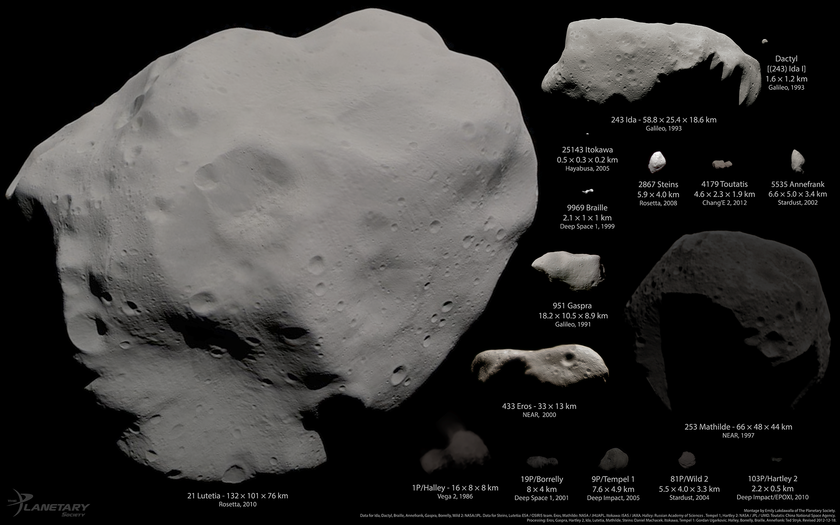
Emily Lakdawalla of the Planetary Society has put together aN asteroids-and-coments montage.
- LRK -

-----------------------
My ever-popular asteroids-and-comets montage, now in color, with bonus Toutatis
Posted By Emily Lakdawalla
2012/12/18 04:26 CST
My collage of all the asteroids and comets visited by spacecraft is probably the single most popular image I have ever posted on this blog. I've now updated it to be in color and to include Toutatis, which Chang'E 2 photographed last week. When I first started working on a color version, it didn't seem to hang together very well as a composition, because the colors were all over the map. But when I hit upon the idea of trying to represent the bodies with correct relative brightness, it seemed to come together nicely. Vesta is not included because it dwarfs the others. (I'd have to increase the height and width of the montage by factors of three.)
Asteroids and comets visited by spacecraft as of December 2012, in color, excepting Vesta
Montage by Emily Lakdawalla. Data from NASA / JPL / JHUAPL / UMD / JAXA / ESA / OSIRIS team / Russian Academy of Sciences / China National Space Agency. Processed by Emily Lakdawalla, Daniel Machacek, Ted Stryk, Gordan Ugarkovic.
Asteroids and comets visited by spacecraft as of December 2012, in color, excepting Vesta
A montage of 16 of the 17 asteroids and comets that have been photographed up close as of December 2012, when Chang'E 2 flew past Toutatis. This version is in color and shows the bodies at their correct relative (though not absolute) albedo or brightness. Not included is Vesta, which would cover an area about three times the width and height of this montage.

snip
-----------------------


Some information on spacecraft that have visited asteroids and coments.
- LRK -

List of asteroids visited by spacecraft

Category:Comets visited by spacecraft

snip
-----------------------

NASA images Touatis with ground radar.
- LRK -

-----------------------
Asteroid Toutatis Slowly Tumbles by Earth
by Staff Writers
Pasadena CA (JPL) Dec 17, 2012

Scientists working with NASA's 230-foot-wide (70-meter) Deep Space Network antenna at Goldstone, Calif., have generated a series of radar data images of a three-mile-long (4.8-kilometer) asteroid that made its closest approach to Earth on Dec. 12, 2012.

The images that make up the movie clip were generated with data taken on Dec. 12 and 13, 2012. On Dec. 12, the day of its closest approach to Earth, Toutatis was about 18 lunar distances, 4.3 million miles (6.9 million kilometers) from Earth. On Dec. 13, the asteroid was about 4.4 million miles (7 million kilometers), or about 18.2 lunar distances.

The radar data images of asteroid Toutatis indicate that it is an elongated, irregularly shaped object with ridges and perhaps craters. Along with shape detail, scientists are also seeing some interesting bright glints that could be surface boulders.

Toutatis has a very slow, tumbling rotational state. The asteroid rotates about its long axis every 5.4 days and precesses (changes the orientation of its rotational axis) like a wobbling, badly thrown football, every 7.4 days.The orbit of Toutatis is well understood. The next time Toutatis will approach at least this close to Earth is in November of 2069, when the asteroid will safely fly by at about 7.7 lunar distances, or 1.8 million miles (3 million kilometers).
snip
------------------------


China's flyby of Toutatis with Chang'e-2 spacecraft.
- LRK -

-----------------------
China Makes First Asteroid Fly By
by Staff Writers
Beijing (XNA) Dec 17, 2012
China's space probe Chang'e-2 has successfully conducted a maneuver in which it flew by the asteroid Toutatis, about seven million km away from the Earth.

Travelling in deep space, Chang'e-2 made the flyby on Dec. 13 at 16:30:09 Beijing Time (08:30"09 GMT), the State Administration of Science, Technology and Industry for National Defense (SASTIND) announced on Saturday.

The flyby was the first time an unmanned spacecraft launched from Earth has taken such a close viewing of the asteroid, named after a Celtic god.

It also made China the fourth country after the United States, the European Union and Japan to be able to examine an asteroid by spacecraft.

Chang'e-2 came as close as 3.2 km from Toutatis and took pictures of the asteroid at a relative velocity of 10.73 km per second, the SASTIND said in a statement.

Sources with the administration told Xinhua that Chang'e-2 is continuing its deep space travel and will reach a distance of more than 10 million km away from Earth in January next year.

Chang'e-2 was launched on Oct. 1, 2010 from Xichang Satellite Launch Center and later orbited the moon to finish a more extensive probe than its predecessor Chang'e-1.

Chang'e-2 left its lunar orbit for an extended mission to the Earth-Sun L2 Lagrangian point on June 9, 2011, after finishing its lunar objectives, which collected data for a complete lunar map.

The probe departed from L2 this year and began its mission to Toutatis.snip
-----------------------

Post Cina . org
- LRK -

You are here: Home > China > Nation
Chinese space probe flies by asteroid Toutatis
Xinhua, December 15, 2012

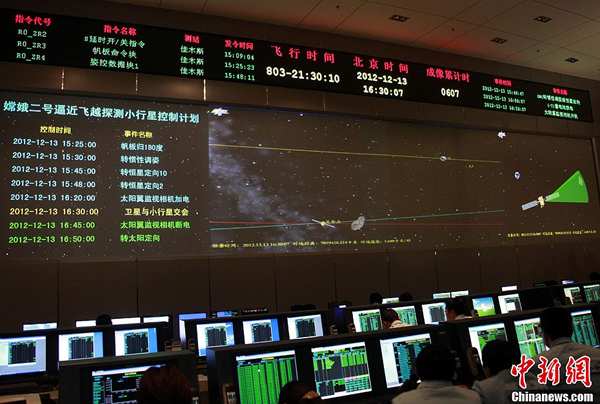
China's space probe Chang'e-2 has successfully conducted a maneuver in which it flew by the asteroid Toutatis, about seven million km away from the Earth.

China's space probe Chang'e-2 has successfully conducted a maneuver in which it flew by the asteroid Toutatis, about seven million km away from the Earth. [Photo: Chinanews.com]

Travelling in deep space, Chang'e-2 made the flyby on Dec. 13 at 16:30:09 Beijing Time (08:30"09 GMT), the State Administration of Science, Technology and Industry for National Defense (SASTIND) announced on Saturday.
The flyby was the first time an unmanned spacecraft launched from Earth has taken such a close viewing of the asteroid, named after a Celtic god.
It also made China the fourth country after the United States, the European Union and Japan to be able to examine an asteroid by spacecraft.
Chang'e-2 came as close as 3.2 km from Toutatis and took pictures of the asteroid at a relative velocity of 10.73 km per second, the SASTIND said in a statement.
snip
-----------------------

You can reach these celestial bodies with conventional rockets.  Just be prepared to spend a few years en route.

Thanks for looking with me.
- LRK -
=============================================================
Dec. 12, 2012: This week, NASA's Goldstone radar is tracking a large asteroid as it passes by Earth, and obtaining unusually clear images of the tumbling space rock.

"There is no danger of a collision with Earth," says Lance Benner of NASA's Near Earth Object Program. "At closest approach on Dec. 12th, asteroid 4179 Toutatis will be 7 million km away or 18 times farther than the Moon."

Asteroid Toutatis is well known to astronomers; it passes by Earth’s orbit every 4 years. Measuring 4.5 km in length, it is one of the largest known potentially hazardous asteroids (PHAs), and its orbit is inclined less than half-a-degree from Earth's. No other kilometer-sized PHA moves around the Sun in an orbit so nearly coplanar with our own.  This makes it an important target for radar studies.

NASA's Goldstone radar in the Mojave Desert will be pinging the space rock every day from Dec. 4th through 22nd.  The echoes highlight the asteroid's topography and improve the precision with which researchers know the asteroid's orbit.

"We already know that Toutatis will not hit Earth for hundreds of years," says Benner.  "These new observations will allow us to predict the asteroid's trajectory even farther into the future."

Benner and colleagues are particularly excited about a new digital imaging system at Goldstone that could reveal never-before-seen details on the asteroid's surface. "Using the new system, we can now image the asteroid's surface with 2 to 5 times finer resolution than previous flybys," he says. "We may we see something new on Toutatis."
snip

=============================================================
Japanese Spacecraft Returns From Asteroid Sampling Mission

BY LISA GROSSMAN
06.14.10
11:55 AM

The Japanese spacecraft Hayabusa returned from its seven-year trek to the asteroid Itokawa on Sunday, and a capsule that hopefully contains pieces of the asteroid was recovered in the Australian outback Monday morning. The mission was the first round trip to a planetary body beyond the moon, and — if the capsule isn’t empty — the fourth space-sample return mission ever.
The capsule detached from the spacecraft at 7:51 pm Japanese time on June 13. The rest of the spacecraft burnt up in a dramatic, meteor-like blaze at 10:51 p.m., but a heat shield protected the capsule as it reentered the atmosphere. The capsule landed in the Australian Woomera Prohibited Area, 300 miles northwest of Adelaide, and was located around 11:56 p.m. It will be flown to Tokyo tomorrow, where scientists will open the capsule.
snip
=============================================================
WHAT THE MIND CAN CONCEIVE, AND BELIEVE, IT WILL ACHIEVE - LRK -

=============================================================

Friday, July 31, 2009

The Perseids are Coming

While planets may be hit by asteroids or comets, we can also pass through the debris from them.
Time to get out the easy chair and look up at the night sky.
See the link for more information on best viewing.
- LRK -

------------------------------------------------------------------
The Perseids are Coming
http://science.nasa.gov/headlines/y2009/31jul_perseids2009.htm?list965414

July 31, 2009: Earth is entering a stream of dusty debris from Comet Swift-Tuttle, the source of the annual Perseid meteor shower. Although the shower won't peak until August 11th and 12th, the show is already getting underway.

Brian Emfinger of Ozark, Arkansas, photographed this early Perseid just after midnight on Sunday, July 26th:

http://science.nasa.gov/headlines/y2009/images/perseids2009/Brian-Emfinger2.jpg

"I used an off-the-shelf digital camera to capture this fireball and its smoky trail," says Emfinger. "It was a bright one!"

Don't get too excited, cautions Bill Cooke of NASA's Meteoroid Environment Office. "We're just in the outskirts of the debris stream now. If you go out at night and stare at the sky, you'll probably only see a few Perseids per hour."

This will change, however, as August unfolds.

"Earth passes through the densest part of the debris stream sometime on August 12th. Then, you could see dozens of meteors per hour.
snip
------------------------------------------------------------------

John sent a link that might indicate that Venus can be hit by comets as Jupiter may have experienced of late.
- LRK -

------------------------------------------------------------------
http://www.livescience.com/space/090730-venus-bright-spot.html
Bright Spot on Venus Stumps Scientists
By Andrea Thompson, Senior Writer
posted: 30 July 2009 05:14 pm ET

A sudden bright spot that appeared in the clouds of Venus just days after a comet left a bruise on Jupiter has scientists stumped as to its cause.

Venus' bright spot, first noticed by amateur astronomer Frank Melillo of Holtsville, NY on July 19, is not the first such brightening noticed on our cloudy neighbor, said planetary scientist Sanjay Limaye of the University of Wisconsin-Madison.

"We have seen such events before," he told SPACE.com.
snip

http://www.space.com/scienceastronomy/090730-venus-bright-spot.html
------------------------------------------------------------------

And while you are looking up from the comfort of your easy chair you might contemplate the constellation of Orion and the bright, bright star Betelgeuse.
What if it exploded while you were looking at it?
Would you catch it on your digital camera?
- LRK -

Link thanks to SpaceWarper.
------------------------------------------------------------------
http://www.eso.org/public/outreach/press-rel/pr-2009/pr-27-09.html
ESO 27/09 - Science Release

29 July 2009
For immediate release
Sharpest views of Betelgeuse reveal how supergiant stars lose mass

Unveiling the true face of a behemoth

Using different state-of-the-art techniques on ESO's Very Large Telescope, two independent teams of astronomers have obtained the sharpest ever views of the supergiant star Betelgeuse. They show that the star has a vast plume of gas almost as large as our Solar System and a gigantic bubble boiling on its surface. These discoveries provide important clues to help explain how these mammoths shed material at such a tremendous rate.

Betelgeuse — the second brightest star in the constellation of Orion (the Hunter) — is a red supergiant, one of the biggest stars known, and almost 1000 times larger than our Sun [1]. It is also one of the most luminous stars known, emitting more light than 100 000 Suns. Such
extreme properties foretell the demise of a short-lived stellar king. With an age of only a few million years, Betelgeuse is already nearing the end of its life and is soon doomed to explode as a supernova. When it does, the supernova should be seen easily from Earth, even in broad
daylight.

snip
------------------------------------------------------------------

And if there are any life forms on planets in that area, will we receive a data dump of their life history in one last expression of their existence?
Will SETI pick up the death cry?
http://www.seti.org/Page.aspx?pid=1345

And if you were at Moon Base Alpha, would your radio telescope record the happening?
http://www.space1999.net/moonbase99/
http://www.space1999.net/

And if you would just like to go see the Moon using the new Google Earth information that NASA and JAXA have added information to, well check this out.
- LRK -

------------------------------------------------------------------
http://www.nasa.gov/centers/ames/news/features/2009/Google_Moon.html
NASA and Google Launch Virtual Exploration of the Moon
07.20.09

Forty years ago on July 20, 1969, the world watched as the crew of Apollo 11 took the first steps on the surface of the moon.

To celebrate this historic occasion, NASA and Google announced the launch of the Moon in Google Earth, an interactive, 3D atlas of the moon, viewable with Google Earth 5.0.

The announcement was made during a press conference at the Newseum in Washington, featuring remarks by Apollo 11 astronaut Buzz Aldrin; Alan Eustace, a Google senior vice president; Andrew Chaikin, author and space historian; and Anousheh Ansari, the first female space tourist.

With the Moon in Google Earth, users can explore a virtual moonscape, follow guided tours from astronauts Buzz Aldrin and Jack Schmidt, view high-resolution "street view" style panoramic images and see previously unreleased footage captured from the lunar surface.

Whether rediscovering iconic moments from the history of lunar exploration, or learning about them for the first time, the Moon in Google Earth enables users to better understand the moon and mankind's relationship to it using an immersive, 3D experience.

snip
http://earth.google.com/moon/
------------------------------------------------------------------

Thanks for looking up with me.


Larry Kellogg

Web Site: http://lkellogg.vttoth.com/LarryRussellKellogg/
BlogSpot: http://kelloggserialreports.blogspot.com/
RSS link: http://kelloggserialreports.blogspot.com/atom.xml
Newsletter: https://news.altair.com/mailman/listinfo/lunar-update
Twitter: http://twitter.com/lrkellogg
==============================================================
http://en.wikipedia.org/wiki/Perseids
Perseids
-From Wikipedia, the free encyclopedia

The Perseids (pronounced /ˈpɜrsiː.ɨdz/ us dict: pûr′·sē·ĭdz) are a prolific meteor shower associated with the comet Swift-Tuttle. The Perseids are so called because the point they appear to come from, called the radiant, lies in the constellation Perseus. Meteor showers occur when Earth moves through a meteor stream. The stream in this case is called the Perseid cloud and it stretches along the orbit of the Comet Swift-Tuttle. The cloud consists of particles ejected by the
comet as it passed by the Sun. Most of the dust in the cloud today is approximately a thousand years old. However, there is also a relatively young filament of dust in the stream that boiled off the comet in 1862. The rate of meteors originating from this filament is much higher than for the older part of the stream.

snip
==============================================================
http://www.universetoday.com/2009/07/20/land-on-the-moon-in-google-earth/
Land on the Moon in Google Earth

To celebrate the 40th anniversary of the Apollo 11 Moon landing, Google has launched a new feature: the Moon in Google Earth. You can now use Google Earth to explore, fly around and search the Moon. Google was able to get several astronauts to participate in this new
feature, and you can get tours of landing sites, narrated by Apollo astronauts, view 3D models of landed spacecraft, zoom into 360-degree photos to see astronauts' footprints and watch rare TV footage of the Apollo missions. The hi-resolution views of the Moon were developed in collaboration with NASA Ames Research and JAXA. It's loads of fun and provides an historic perspective as well as a look to the future of lunar exploration. If you already have Google Earth 5.0 on your computer, just click on the tab on the top toolbar that has a picture of Saturn, and click on Moon. If you click on the Apollo 11 flag, you can zoom in on that location and take a tour of the first landing site on the Moon! What a great way celebrate the 40th anniversary. Enjoy!

Link to the Moon in Google Earth.
http://earth.google.com/moon/index.html

snip
==============================================================
http://www.msnbc.msn.com/id/32234721/ns/technology_and_science-space/
Space shuttle lands safely in Florida completed 16-day construction job at international space station

By Marcia Dunn

CAPE CANAVERAL, Florida - Space shuttle Endeavour and its seven astronauts returned to Earth on Friday, completing a long but successful construction job that boosted the size and power of the international space station.

Endeavour glided through a slightly hazy sky and touched down on Kennedy Space Center's landing strip. Its smooth and punctual late morning arrival set off a stream of praise.

"Congratulations on a superb mission from beginning to end. Very well done," Mission Control radioed.

snip
http://www.nasa.gov/home/hqnews/2009/jul/HQ_09_179_Shuttle_landing_success.html
============================================================

WHAT THE MIND CAN CONCEIVE, AND BELIEVE, IT WILL ACHIEVE - LRK

============================================================