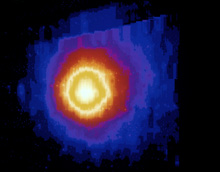
To the Moon, Mars, and Beyond, well at least TO THE MOON.
KAGUYA is in orbit around the Moon.

I have missed the news with doing homework with the grandchildren.
Did it make the six o'clock news?
Were they jumping up and down in Time's Square?
Is this going to be a repeat of the Apollo Missions, Ho Hum, yeah, if
you say so?

Come on, get excited!
Soon to release two smaller satellites.
- LRK -

----------------------------------------------------------------------
http://www.selene.jaxa.jp/index_e.htm

*KAGUYA (SELENE)*

*The Japan Aerospace Exploration Agency(JAXA)* launched *"KAGUYA
(SELENE)" *by the H-IIA Launch Vehicle at 10:31:01 a.m. on September 17,
2007 (JST) from Tanegashima Space Center. The major objectives of the
"KAGUYA" mission are to obtain scientific data of the lunar origin and
evolution and to develop the technology for the future lunar
exploration. *"KAGUYA"* consists of a main orbiting satellite at about
100km altitude and two small satellites (Relay Satellite and VRAD
Satellite) in polar orbit. The orbiters will carry instruments for
scientific investigation of the Moon, on the Moon, and from the Moon.

Snip
----------------------------------------------------------------------

... and to develop the technology for the future lunar exploration.

Thanks for looking up with me.
- LRK -

Larry Kellogg

Web Site: http://lkellogg.vttoth.com/LarryRussellKellogg/
BlogSpot: http://kelloggserialreports.blogspot.com/
RSS link: http://kelloggserialreports.blogspot.com/atom.xml
Newsletter: https://news.altair.com/mailman/listinfo/lunar-update
==============================================================

----------------------------------------------------------------------
                   ***  JAXA MAIL SERVICE  ***
               Japan Aerospace Exploration Agency
----------------------------------------------------------------------
                          KAGUYA (SELENE)
       Result of the Lunar Orbit Injection Maneuver (LOI1)
            -  Lunar orbit injection was confirmed  -

                                               October 5, 2007 (JST)
                           Japan Aerospace Exploration Agency (JAXA)

The Japan Aerospace Exploration Agency (JAXA) performed the lunar
orbit injection maneuver (LOI1) for the "KAGUYA" (SELENE) at 6:20 a.m.
on October 4, 2007 (Japan Standard Time, JST.) The KAGUYA is a lunar
explorer launched by the H-IIA Launch Vehicle No. 13 (H-IIA F13) on
September 14, 2007 (JST) from the Tanegashima Space Center. As a
result of the orbit calculation after the maneuver, we have confirmed
that the KAGUYA was injected into the following lunar orbit.
The satellite is confirmed to be in good health.

                                    Injected orbit
             Apogee altitude             11,741 km
             Perigee altitude               101 km
             Period            16 hours 42 minutes

We are now pleased to be able to report to you that we have safely
delivered messages and signs that were collected from 412,627 people
around the world through the Wish upon the Moon Campaign and engraved
on the sheets to be aboard the KAGUYA to the Moon. We would like to
express our profound appreciation to all perticipants and hope your
continued support to the KAGUYA mission.
You can also check this information on the following Special Site:
[http://www.jaxa.jp/countdown/f13/index_e.html]


This page URL:
http://www.jaxa.jp/press/2007/10/20071005_kaguya_e.html
---------------------------------------------------------------------
Publisher : Public Affairs Department
          Japan Aerospace Exploration Agency (JAXA)
          Marunouchi Kitaguchi Building,
          1-6-5, Marunouchi, Chiyoda-ku, Tokyo 100-8260
          Japan
          TEL:+81-3-6266-6400

JAXA WEB SITE :
http://www.jaxa.jp/index_e.html

About This Mail Service :
To change registered e-mail address, or to cancel this service,
please access to
http://www.jaxa.jp/pr/mail/index_e.html

Snip
==============================================================
http://news.xinhuanet.com/english/2007-10/05/content_6831664.htm
Japan's probe satellite put into orbit around moon.

www.chinaview.cn 2007-10-05 11:08:28
TOKYO, Oct. 5 (Xinhua) -- Japan's first lunar probe satellite was
successfully put into orbit around the moon, the Japan Aerospace
Exploration Agency (JAXA) said Friday.

The agency announced that the Selenological and Engineering Explorer was
injected into a lunar orbit with an Apogee altitude of 11,741 km and an
Perigee altitude of 101 km. Its period is 16 hours and 42 minutes.

The satellite, dubbed "Kaguya" after Japanese ancient fable, was lift
off on Sept. 14 with a H-2A rocket from the Tanegashima Space Center in
Japan's southern Kagoshima prefecture. The agency performed the lunar
orbit injection maneuver on Oct. 4.

Snip
==============================================================
http://www.skyandtelescope.com/news/10259202.html
Kaguya Now the Moon's Captive
So far, so good.

Early today Japanese space officials confirmed that the Kaguya
spacecraft, launched three weeks ago, has slipped into lunar orbit as
planned. Yesterday an onboard rocket fired at 6:20 a.m. (Japan Standard
Time), allowing the craft to settle into a looping 16.7-hour polar orbit
that ranges in altitude from 63 miles (101 km) to 7,296 miles (11,741 km)

A brief press release posted by the Japan Aerospace Exploration Agency
notes that "the satellite is confirmed to be in good health."

Kaguya, named for a mythical lunar princess, represents Japan's first
dedicated lunar mission since 1990. Over the next few days it'll release
two smaller satellites: one will be tracked carefully to map the Moon's
gravity, and the other will serve as a radio relay.

Snip
==============================================================

THE DAY IN SPACE
__________________
In today's space news from SpaceRef:

-- Mikulski Delivers on Commitment to Pay NASA Back, Includes $1 Billion in
Budget
http://www.spaceref.com/news/viewpr.nl.html?pid=23719
-- Senate Passes Mikulski-Hutchison Amendment to Add $1 Billion in NASA Funding
http://www.spaceref.com/news/viewpr.nl.html?pid=23712
"U.S. Senator Kay Bailey Hutchison (R-TX), Ranking Member of the Senate Commerce
Subcommittee on Space, Aeronautics and Related Sciences, and Sen. Barbara Mikulski
(D-MD), the Chairman of the Commerce, Justice and Science Appropriation (CJS) Subcommittee,
today passed an amendment to the Fiscal Year 2008 CJS appropriations bill to provide
$1 billion in additional funding for NASA. The funding will reimburse the agency for costs
incurred for returning the Space Shuttle to flight status following the Columbia disaster and
implementing recommendations of the Columbia Accident Investigation Board."

-- NASA Scientist Available for Interviews About New Jupiter Findings
http://www.spaceref.com/news/viewpr.nl.html?pid=23718
"What NASA's Pluto-bound New Horizons spacecraft found when it flew by Jupiter
on Feb. 28, 2007, stunned scientists who now are releasing more information in nine journal
articles in Science."

-- Result of Selene's Lunar Orbit Injection Maneuver
http://www.spaceref.com/news/viewsr.nl.html?pid=25620
"The Japan Aerospace Exploration Agency (JAXA) performed the lunar orbit
injection maneuver (LOI1) for the "KAGUYA" (SELENE) at 6:20 a.m. on October 4, 2007 (Japan Standard
Time, JST.) "

Snip
==============================================================
Jeroen Lapre' is working on short film that takes place on the Moon. - LRK -
--------------------------------------------------------------
Dear Maelstrom II cast, crew, consultants, and friends,

now that a 3rd of the edit is locked, we have finally posted the first
match-a-mation task for this project!

http://www.distant-galaxy.com/maelstrom2/Sequences/CountDownSeq/M2CD_R1B_S03T1_1OctK7.html

If you know of any Maya match-a-mators that would be willing to
volunteer, please let me know.

Cheers
-jeroen

http://www.distant-galaxy.com/maelstrom2/MaelstromII.html

Snip
==============================================================

WHAT THE MIND CAN CONCEIVE, AND BELIEVE, IT WILL ACHIEVE - LRK

==============================================================
Many folks would like to see us back on the Moon and developing its resources.
Showing posts with label SELENE. Show all posts
Showing posts with label SELENE. Show all posts
Friday, October 05, 2007


Wednesday, August 15, 2007
New Launch Day of the KAGUYA (SELENE) by H-IIA Launch Vehicle No. 13
Thanks to Larry Klaes for passing the below post from "JAXA Press
Release Mail Service".
- LRK -

-----------------------------------------------------------------------
Date: Wed, 15 Aug 2007 10:55:53 +0900
----------------------------------------------------------------------
                   ***  JAXA MAIL SERVICE  ***
               Japan Aerospace Exploration Agency
----------------------------------------------------------------------
              New Launch Day of the KAGUYA (SELENE)
                 by H-IIA Launch Vehicle No. 13

                                               August 15, 2007 (JST)
                                   Mitsubishi Heavy Industries, Ltd.
                           Japan Aerospace Exploration Agency (JAXA)

Mitsubishi Heavy Industries, Ltd. and the Japan Aerospace Exploration
Agency would like to announce that the launch of the Lunar Orbit
Explorer "KAGUYA" (SELENE) by H-IIA Launch Vehicle No. 13 (H-IIA F13)
was rescheduled as follows.

Scheduled date of launch :
September 13 (Thursday), 2007 (Japan Standard Time, JST)

Launch time :
10:35:47 a.m. (JST)

Launch windows :
September 14 (Fri) through September 21 (Fri) 2007 (JST)
(Launch time will be set for each day.)

The original launch date was postponed due to the replacement work of
parts in the two onboard baby satellites of the "KAGUYA" as announced
on July 20, 2007. The replacement was successfully completed thus the
new launch date was set.

This page URL:
http://www.jaxa.jp/press/2007/08/20070815_kaguya_e.html
---------------------------------------------------------------------
Publisher : Public Affairs Department
          Japan Aerospace Exploration Agency (JAXA)
          Marunouchi Kitaguchi Building,
          1-6-5, Marunouchi, Chiyoda-ku, Tokyo 100-8260
          Japan
          TEL:+81-3-6266-6400

JAXA WEB SITE :
http://www.jaxa.jp/index_e.html

About This Mail Service :
To change registered e-mail address, or to cancel this service,
please access to
http://www.jaxa.jp/pr/mail/index_e.html
-----------------------------------------------------------------------

September is just around the corner.
Here is to looking up.
- LRK -


Larry Kellogg

Web Site: http://lkellogg.vttoth.com/LarryRussellKellogg/
BlogSpot: http://kelloggserialreports.blogspot.com/
RSS link: http://kelloggserialreports.blogspot.com/atom.xml
Newsletter: https://news.altair.com/mailman/listinfo/lunar-update
==============================================================
http://www.jaxa.jp/press/2007/08/20070815_kaguya_e.html


  New Launch Day of the KAGUYA (SELENE)
  by H-IIA Launch Vehicle No. 13

Scheduled date of launch: September 13 (Thursday), 2007 (Japan
Standard Time, JST)
Launch time: 10:35:47 a.m. (JST)
Launch windows: September 14 (Fri) through September 21 (Fri)
2007 (JST)
(Launch time will be set for each day.)

Snip
Mission website:

Mitsubishi Heavy Industries, Ltd. (MHI) H-IIA Launch Services
<http://www.h2a.jp/index.html>
SELenological and ENgineering Explorer "KAGUYA" (SELENE)
<http://www.jaxa.jp/projects/sat/selene/index_e.html>
H-IIA Launch Vehicle <http://www.jaxa.jp/projects/rockets/h2a/index_e.html>
Launch of KAGUYA/H-IIAF13 Special Site
<http://www.jaxa.jp/countdown/f13/index_e.html>

Index for 2007/8 <http://www.jaxa.jp/press/2007/08/index_e.html>

Snip
==============================================================
WHAT THE MIND CAN CONCEIVE, AND BELIEVE, IT WILL ACHIEVE - LRK
==============================================================
Labels:
H-IIA,
Japan space,
KAGUYA,
moon missions,
SELENE
Sunday, July 22, 2007
Columbia Astronomer Offers New Theory Into 400-year-old Lunar Mystery
*TLP - Columbia Astronomer Offers New Theory Into 400-year-old Lunar
Mystery - To Flash or Not To Flash - That is the question.

*Folks have looked at the Moon and over the years some have said they
saw flashes of light up there.
Some have said it must be from the aliens living on the Moon.
Some have said it is just the reflection of the Sun on shinny rocks.
Some have said the Moon has volcanic activity and we are seeing signs of
this.
Some have said that it is just gas from the core of the Moon and wonder
what kind of gas.

Some have organized to watch with their telescopes.
----------------------------------------------------------
http://www.amlunsoc.org/tlp.htm
*THE LUNAR TRANSIENT PHENOMENA PROGRAM*
by David Darling (website: HTTP://www.ltpresearch.org)
----------------------------------------------------------

I had to go wash my eyes, I thought I might be seeing things.
- LRK -

----------------------------------------------------------
*Columbia Astronomer Offers New Theory Into 400-year-old Lunar Mystery*
http://www.columbia.edu/cu/news/07/06/lunar.html

Columbia astronomy professor Arlin Crotts thinks he has
solved a 400-year-old mystery: the origin of strange optical flashes
often reported as appearing on the moon�s surface.

Transient Lunar Phenomena (TLPs), in which the lunar surface reportedly
changes in brightness, blurriness or color, have been photographed and
observed by thousands of astronomers over the centuries. Yet explanations
of why they occur and even their reality as true lunar phenomena have been
hotly debated. The TLPs typically cover a space of a few kilometers and last
for several minutes.

Crotts has uncovered a strong statistical relationship between TLPs and
so-called outgassing events on the lunar surface. Outgassing occurs when
gases trapped beneath a moon or planet are released and, if only
briefly, become part of the object's atmosphere. A key component of this
gas is radon.

"People over the years have attributed TLPs to all sorts of effects:
turbulence in Earth's atmosphere, visual physiological effects,
atmospheric smearing of light like a prism, and even psychological
effects like hysteria or planted suggestion" says Crotts, "but TLPs
correlate strongly with radon gas leaking from the moon. No earth-bound
effect can fake that."

Snip
---------------------------------------------------------

So what has been causing those flashes, if flashes they be?

Is it some gas from the inside of the Moon?

What kind of gas?

Just some radio active decay product or will there also be something
that might be worth drilling for?


Everyone is going to the Moon, well not everyone, but if the missions
that we have heard about take place the Moon will never be the same.
The Apollo Astronauts landed on the Moon, and left behind some trash.
Every lander left exhaust gases that bounced around on the surface of
the Moon until the gases froze out or escaped into space.
When we go back and start landing again, the Moon's environment will
feel our presence.
What was a pretty good vacuum, for awhile will not be the same.

Now how do you get a base line of what is there or not there, before we
put a lot of our stuff there?
The next orbiters will get a look at what is below and then it will be
different.

The Japanese are going to the Moon shortly with a good set of
instruments and it would be nice to look at the Moon while their
spacecraft is in orbit so that if we should see some flashes of light we
might also ask them what they saw up close and personal.
http://www.isas.ac.jp/e/enterp/missions/selene/index.shtml

The August 16 launch has been delayed which may help some of you get
ready to look up.
- LRK -
---------------------------------------------------------
http://www.jaxa.jp/projects/sat/selene/index_e.html
July 20, 2007 Updated

 Launch Postponement of the KAGUYA (SELENE)

Mitsubishi Heavy Industries, Ltd. and the Japan Aerospace Exploration
Agency would like to announce that we decided to postpone the launch of
the Lunar Orbit Explorer "KAGUYA" (SELENE) by the H-IIA Launch Vehicle
No. 13 (H-IIA F13.)
The launch was originally scheduled on August 16, 2007 (Japan Standard
Time, JST.)
The new launch date will be announced as soon as it is determined.

- Launch Postponement of the KAGUYA (SELENE)
(Press Release)
---------------------------------------------------------

Did you go look at the News Release from Columbia University in New York?
http://www.columbia.edu/cu/news/07/06/lunar.html

The reason I ask is that I received an e-mail from Professor Arlin
Crotts asking for ideas on how they might get better coverage around the
World during the SELENE mission coming up. Take a look at his letter I
copied below (with permission) and if you know of someone with deep
pockets that could help, let him know.

Let me see, wasn't GOOGLE going to start a research center on the Moon?
http://www.google.com/jobs/lunar_job.html
*Google Copernicus Hosting Environment and Experiment in Search
Engineering* (G.C.H.E.E.S.E.)

Maybe they would like to update their Google Moon Map with some TLP sites.
http://moon.google.com/


Thanks for looking up with me.
- LRK -

Larry Kellogg

Web Site: http://lkellogg.vttoth.com/LarryRussellKellogg/
BlogSpot: http://kelloggserialreports.blogspot.com/
RSS link: http://kelloggserialreports.blogspot.com/atom.xml
Newsletter: https://news.altair.com/mailman/listinfo/lunar-update
==============================================================

Dear Larry,

I am coming to you via Paul Spudis and Steve Durst.  Our group
is conducting an observational experiment regarding the lunar
atmosphere.  Even though we have applied for funding from NASA,
the NSF and other organizations, this experiment will be much more
interesting if we can perform it over the duration of the JAXA
SELENE mission, so are in urgent need of additional help. (We will
not hear from NASA, NSF, etc. until mid-2008.)  SELENE will carry
the only experiment for many years to study the lunar atmosphere, the
ARD (Alpha Ray Detector), which will detect when and where radon
leaks from the lunar surface.

I have a paper that should be coming out in Icarus showing that
optical transients on the lunar surface (TLPs, with which I imagine
you are familiar) are very strongly correlated with radon leaking
from the lunar surface, as measured on Lunar Prospector and Apollo
15.  In response to this we are putting together a series of robotic
imaging monitors, so as to detect TLPs (and confirm their existence),
but mainly to record as many of these as possible while SELENE is in
orbit.  Our website http://www.astro.columbia.edu/~arlin/TLP/
describes all of this.

We have one monitor in Chile and commitments for other stations
in Utah and Australia, and maybe Maui.  To maximize coverage we
would also like to find a site in Europe or western Asia.  Also, we
have enough support for the one monitor in Chile, and perhaps most
of a second.  Four or five are needed to give nearly 100% coverage.
A single monitor costs about $20000 in hardware and $5000 in
operations.  If there is anyone out there who would like to talk to
us about sponsoring a monitor or providing a site in Europe/west
Asia, this could be crucial.  We would also encourage anyone who
might like to construct their own monitor consistent with ours and
collaborate on the experiment.  We are not ready to work with visual
observers monitoring the Moon and will not be anytime soon, but will
eventually be able to post or send out alerts in realtime when we
detect a TLP.  If anyone is interested in any of the current options
they should contact us via email to arlin@astro.columbia.edu.

We don't really know what the gas leaking out of the Moon
consists of (except for trace radon).  It probably contains a lot of
radiogenic argon-40.  The main site of outgassing is the Aristarchus
Plateau, which was the location of the most massive and some of the
more recent volcanic effusion on the Moon.  It is compelling to
speculate that some of this gas may be of magmatic origin, such as CO
(or CO2), or H2O.  The observational limits on these from these sites
are not very constraining.  If the gas includes these, it would be
very interesting for several reasons. including resource exploitation.

Anyway, I am looking for ideas of where to find help.  Mainly we
need funding support, and maybe we need collaborators in certain
locations in the world.  I wish we could accomplish this by more
conventional means, but these methods are very slow, slower that the
time it takes to get to the Moon!

    Thank you,

          - Prof. Arlin Crotts

Snip
==============================================================
http://www.universetoday.com/2007/06/28/flashes-on-the-moon-caused-by-gas/
Flashes on the Moon Caused by Gas
June 28th, 2007

There's a strange phenomenon on the Moon that has puzzled astronomers for
hundreds of years. They're called
transient lunar phenomena (TLPs), and they look like a brief flashes, changes in
colour, or blurring on the surface of the Moon.

Astronomers have argued about what's really going on for years. Some possible
explanations include turbulence in the Earth's atmosphere, physiological effects
in the human eye, smearing of light, and even psychological causes. But
according to new research by Columbia University astronomy professor Arlin
Crotts, radon gas leaking out from the Moon is probably the best explanation.
Snip
==============================================================
http://en.wikipedia.org/wiki/Transient_lunar_phenomenon
Transient lunar phenomenon

A transient lunar phenomenon (TLP) refers to short-lived lights, colors, or
changes in appearance of the lunar surface. Claims of short-lived phenomena go back at least 1000 years, with some having been observed
independently by multiple witnesses or reputable scientists. Nevertheless, the
majority of transient lunar phenomena reports are irreproducible and do not
possess adequate control experiments that could be used to distinguish among
alternative hypotheses. Few reports concerning these phenomena are ever
published in peer reviewed scientific journals, and rightfully or wrongfully,
the lunar scientific community rarely discusses these observations. Most lunar
scientists will acknowledge that transient events such as outgassing and impact
cratering do occur over geologic time: the controversy lies in the frequency of
such events.

Snip
==============================================================
WHAT THE MIND CAN CONCEIVE, AND BELIEVE, IT WILL ACHIEVE - LRK
==============================================================
Subscribe to:
Posts (Atom)