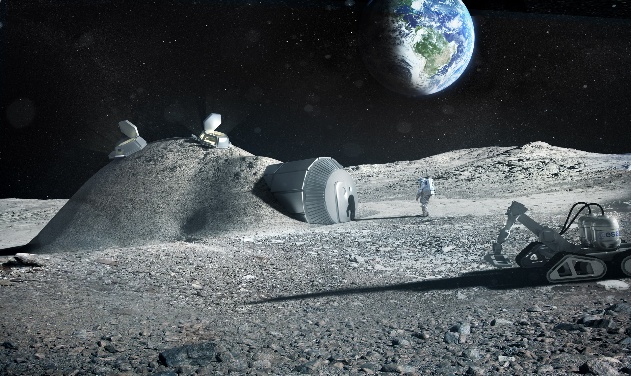
Many folks would like to see us back on the Moon and developing its resources.

Showing posts with label 3D Printing. Show all posts

Saturday, March 23, 2013

Find a Lunar Cave - Think about designing for that cave - 3D printing - Neri Oxman


Using caves on the Moon for habitats plays a part in science fiction and possibly for real if we ever go back to stay.  Finding them and checking out their usefulness will be necessary and Jaro alerted me to the below PDF article.

When you decide to move it will take a bit of fixing up and I have been viewing some videos of Neri Oxman of MIT's Media Lab using 3D printers. Could I use any of her ideas?  Look around and see what mother nature has done and be inspired and creative.
- LRK -

----------------------------------------------------------------
44th Lunar and Planetary Science Conference (2013) - 3080.pdf
SKYLIGHT: MISSION TO INVESTIGATE AND MODEL A LUNAR PIT. H. L. Jones1, K. M. Peterson2, W. L. Whittaker1,2, and U. Y. Wong1 1Robotics Institute, Carnegie Mellon University (5000 Forbes Ave, Pittsburgh, PA 15213, {hlj|red|uyw}@cs.cmu.edu), 2Astrobotic Technology, Inc. (2515 Liberty Ave, Pittsburgh, PA 15222, kev-in.peterson@astrobotictech.com).

Introduction: Caves on planetary bodies beyond Earth have always been of great interest for science and exploration, but for many years there was no known way to enter. Unprecedented high-resolution imagery from the Lunar Reconnaissance Orbiter has revealed pits that are believed to be skylights – features formed by partial cave ceiling collapse that provide access into caves [1],[2]. Skylights have also been discovered on Mars [3], and similar features may exist elsewhere in the solar system [1]. Discovery of these features changes everything. The Skylight mission takes the next step to closely investigate one of these pits.
Mission Objectives: The Skylight mission seeks to answer science and exploration questions about the-se newly discovered lunar skylights. The objectives of the mission are to:
1. provide multi-perspective close-up images of a lunar pit,
2. build a detailed, high quality 3D model of the pit, and
3. survey the terrain surrounding the pit.

Mission Decription: The Skylight mission targets the Marius Hills Hole (MHH) in the Marius Hills re-gion of Oceanus Procellarum at 14.2°N, 303.3°E [4]. This pit is selected because of its location on the lunar near side, facilitating mission operations without re-quirement for installation of expensive communication infrastructure, as well as the indications of lava tubes in surrounding terrain.

snip
----------------------------------------------------------------

Neri Oxman
- LRK -

----------------------------------------------------------------

Neri Oxman, Founder of Mediated Matter Lab -- Part 1


Published on Feb 20, 2013
Neri Oxman, Founder of Mediated Matter Lab -- Part 1...

Material Ecology - http://web.media.mit.edu/~neri/site/i...
MIT - http://www.media.mit.edu/people/neri
Wikipedia - http://en.wikipedia.org/wiki/Neri_Oxman
snip
----------------------------------------------------------------

What might you be able to create with nature in mind.
- LRK -

----------------------------------------------------------------

Neri Oxman: On Designing Form

from  PLUS 3 years ago 
Architect Neri Oxman is the founder of MATERIALECOLOGY, an interdisciplinary design initiative expanding the boundaries of computational form-generation and material engineering. Named one of Fast Company's "100 Most Creative People in Business," Oxman investigates the material and performance of nature in an effort to define form itself.

snip
Uploaded on Mar 12, 2010
Architect Neri Oxman is the founder of MATERIALECOLOGY, an interdisciplinary design initiative expanding the boundaries of computational form-generation and material engineering. Named one of Fast Company's "100 Most Creative People in Business," Oxman investigates the material and performance of nature in an effort to define form itself.

----------------------------------------------------------------

What could you do with the 3D printer?
- LRK -

----------------------------------------------------------------

Revolution in Art & Design using 3D Printing | Objet for Neri Oxman


Published on May 4, 2012
As seen on the Objet blog: http://blog.objet.com/

A special thanks to MIT Media Lab's Neri Oxman, Peter Schmitt (3D printed clock) & Amit Zoran (3D printed flute) for kindly allowing footage of their 3D printed models to be used in the making of this film. (Some of these parts were created using a variety of 3D printing technologies including Objet.) 

In this insightful interview, Neri Oxman,architect, designer and professor of Media Arts and Sciences and Director of the Mediated Matter group at the MIT Media Lab, explains the differences between 'additive' and 'subtractive' manufacturing. Inspired by things that 'grow' in nature, Oxman uses the world's most advanced 3D printing technology - the Objet Connex500 multi-material 3D printer to produce some incredible models which will be on display at the Pompidou Center until August 6th 2012 at the 'Multiversites Creatives' exhibit. Neri also explains 3D printing within the wider paradigm shift in technology and manufacturing - comparing it to the Gutenberg 2D print revolution of the 1440's.

For more information about Objet: http://www.objet.com/
snip
----------------------------------------------------------------

Feel free to express yourself.
Could you design a pair of space suit gloves that would not wear out an astronaut's fingernails?
- LRK -

----------------------------------------------------------------

Neri Oxman, Founder of Mediated Matter Lab -- Part 2


Published on Feb 20, 2013
Neri Oxman, Founder of Mediated Matter Lab -- Part 2... The Next List: CNN's hub for stories about innovation.

Material Ecology - http://web.media.mit.edu/~neri/site/i...
MIT - http://www.media.mit.edu/people/neri
Wikipedia - http://en.wikipedia.org/wiki/Neri_Oxman

The Next List: http://whatsnext.blogs.cnn.com/catego...
snip
----------------------------------------------------------------

Feel free to think outside the box, inside the box, on the box, and really not so boxy in the first place.  :-)

Thanks for looking up with me.  
- LRK -

3D Printing Explained in 37 Seconds!


Published on Jul 31, 2012
The 3D printing process explained visually. Begin by sketching your product concept or idea on paper. Elaborate your idea using 3D CAD software or any 3D content program. Then 3D print the idea using an Objet multi-material 3D Printer which produces all moving parts and different color/material properties in a single production step. A few short hours later you hold a finished, ready-assembled product or prototype. Feel it, test it to validate that your concept really works. This process helps save substantial time and expense by confirming a design before you begin mass production manufacturing.

Visit the Objet Blog http://ow.ly/bQeam
Objet Website http://ow.ly/bQemr
snip
============================================================== 
Advanced 3D Printing Materials


Uploaded on Aug 28, 2011
Objet spoke about a number of new advanced 3D printing materials at EuroMold 2010 including a new ABS-like material with the strength and toughness of engineering plastics, and a new clear transparent material for simulating PMMA in glass-like applications. Both materials were released in early 2011.
snip  
==============================================================

WHAT THE MIND CAN CONCEIVE, AND BELIEVE, IT WILL ACHIEVE - LRK -

==============================================================

Wednesday, February 06, 2013

3D Printing or make a film with the modeling software - decisions

Recently the subject of 3D printers has been in the news.
---
Building a lunar base with 3D printing
February 1, 2013
---
Honey I Shrunk The Dam
Posted 1/28/2013
---

Reading more about 3D printing and having some e-mail conversations lead me to look into how you make the the 3D models that might be printed.  One 3D printing company, Shapeways, had a tutorial on how to make STL  files usingSketchUp 7.1 or later. 

I dusted mine off and found that it exported 3D files in the COLLADA .dae format unless you had a STL plugin.  The Shapeways' tutorial suggested that you could convert the .dae format to .stl format and check the 3D model for errors using (MeshLab and Accutrans3D).  I checked out their websites and downloaded MeshLab.  Accutrans3D is only free for a 30 day trial and then costs a few dollars.  I don't know what I am doing so will wait on that.  What else is out there?

Shapeways supports a number of applications  and there was another tutorial for the Blender application.  Look at that.

Now my head is in a 3D buzz after looking at various websites and I am trying to think of how a 3D modeling program could be used to show off what it might be like to build a lunar base.  Do you use 3D printers on the Moon (and what kind) or do you make a film to show what is going on?  

Having read the tutorial on Bender I thought I would check out its history. Why not get your feet wet and down load theapplication, it is free, and of course it would be nice to see what you can do with the software.

Now the fun part for you.  Put on your thinking caps and look at the following short film productions. They are all around 14 minutes, took time, and people and money and are beautiful (some in sort of a strange way,)  

- LRK -
----------------------------- 
TEARS OF STEEL

Tears of Steel - Blender Foundation's fourth short Open Movie

Published on Sep 26, 2012
"Tears of Steel" was realized with crowd-funding by users of the open source 3D creation tool Blender. Target was to improve and test a complete open and free pipeline for visual effects in film - and to make a compelling sci-fi film in Amsterdam, the Netherlands.

The film itself, and all raw material used for making it, have been released under the Creatieve Commons 3.0 Attribution license. Visit the tearsofsteel.org website to find out more about this, or to purchase the 4-DVD box with a lot of extras.

(CC) Blender Foundation - http://www.tearsofsteel.org

Duration: 12 minutes. Available also in HD and DCP 2.35:1, Dolby 5.1.

Age: Suitable for 12 years and older.
Language: English spoken
Production: Blender Institute

Producer: Ton Roosendaal
Director & Writer: Ian Hubert
Director of Photography: Joris Kerbosch
Composer: Joram Letwory

Starring: Derek de Lint, Sergio Hasselbaink, Rogier Schippers, Vanja Rukavina, Denise Rebergen, Jody Bhe, Chris Haley

Crew: Andreas Goralczyk, David Revoy, Francesco Siddi, Jeremy Davidson, Kjartan Tysdal, Nicolo Zubbini, Rob Tuytel, Roman Volodin, Sebastian Koenig, Brecht van Lommel, Campbell Barton, Sergey Sharybin.

Project funding: Blender Foundation, 
Netherlands Film Fund, Cinegrid Amsterdam

Premium Sponsor: Google
Main Sponsors: NVIDIA, Hewlett-Packard Workstations, Camalot AV Services, BlenderGuru.

https://www.facebook.com/mango.open.movie (Facebbok page)
https://plus.google.com/112059823531133148949/ (Google+ page)
----------------------------- 

- LRK -

----------------------------- 

Sintel - Third Open Movie by Blender Foundation

Uploaded on Sep 30, 2010
"Sintel" is an independently produced short film, initiated by the Blender Foundation as a means to further improve and validate the free/open source 3D creation suite Blender. With initial funding provided by 1000s of donations via the internet community, it has again proven to be a viable development model for both open 3D technology as for independent animation film.
This 15 minute film has been realized in the studio of the Amsterdam Blender Institute, by an international team of artists and developers. In addition to that, several crucial technical and creative targets have been realized online, by developers and artists and teams all over the world.

www.sintel.org

snip
----------------------------- 

This is the one I thought a bit strange but not much different than some of my dreams, oh my.
Elephants Dream (code-named Orange) is a short computer-generated short film that was produced almost completely using the free software 3D suite Blender
- LRK -

----------------------------- 

Elephants Dream - Fantasy Animation HD 2006/Orange Open Movie Pr

Uploaded on Oct 4, 2010
Elephants Dream is the world's first open movie, made entirely with open source graphics software such as Blender, and with all production files freely available to use however you please, under a Creative Commons license.

The short film was created by the Orange Open Movie Project studio in Amsterdam during 2005/2006, bringing together a diverse team of artists and developers from all over the world. More about the project...

Source:
http://www.elephantsdream.org
snip
----------------------------- 

This wasn't done with Bender.  It too is short and Sci-Fi.
- LRK -

-----------------------------

C is the story of Lieutenant Commander Malleck and her radical act of mutiny during an interplanetary cold war.
Watch the intro to the film: vimeo.com/56660860
Check out our website: c-themovie.com
1/30/13
When Derek Van Gorder and Otto Stockmeier decided to make a science fiction short about a mutiny on an interplanetary warship, they didn’t have the funds for CGI. They did, on the other hand, have access to the digital cameras that are part and parcel of any contemporary filmmaker’s toolkit. So they eschewed the digitally rendered graphics that are ubiquitous today, and instead set out to combine classic in-camera special effects with the advanced low-light filming capabilities of the latest cameras. The result: a unique science fiction vision for their film C 299,792 km/s, released yesterday.
snip
----------------------------- 
So many choices to help us look up.
- LRK -
==============================================================
How to make a model for 3D printing

Learn how to create a watertight 3D prototype model for 3D printing, and use your skills to enter to win a MakerBot Thing-O-Matic worth $2,500

snip
==============================================================

WHAT THE MIND CAN CONCEIVE, AND BELIEVE, IT WILL ACHIEVE - LRK -

==============================================================

Saturday, February 02, 2013

3D Printing Buzz

http://www.textually.org/3DPrinting/cat_fun.html

I watched this episode of "The Big Bang Theory" that had a 3D printer.
They seem to be in the news so will see what other info might be relevant with thoughts for doing in space.
- LRK -

----------------------------- 
3D Printing Buzz
February 1m 2013
Latest episode of The Big Bang Theory includes 3D printing
Screen Shot 2013-02-01 at 1.27.33 PM.png
The The Big Bang Theory TV series has picked up on 3D printing.
Don't miss the last episode of The Big Bang Theory (Season 6, Episode 14), where Howard prints a whistle (that works) and action figures of himself, Raj and Bernadette. Bernadette wants him to return the $5'000 printer (what? $5'000 for a couple of dolls?)
emily | 12:54 PM | permalink 
snip
----------------------------- 

NASA and 3D metal printing. 
- LRK -

----------------------------- 
NASA 3D prints rocket parts — with steel, not plastic
By John Hewitt on November 15, 2012 at 10:47 AM

NASA J2-x rocket part, made with an SLM cusing 3D printer
NASA’s Marshall Space Flight Center in Huntsville, Alabama, has 3D printed nickel alloy rocket engine parts using a fabrication technique called selective laser melting, or SLM. The part will be used on the J-2x engine for the largest rocket ever built, known simply as the Space Launch System. 3D printing (see: What is 3D printing?) has become popular for fabricating parts from plastic, but using the technique with metals requires equipment that is a bit more extreme. Will 3D printing of hard materials become part of a general, growing trend, or will these exotic fabrication technologies be viable only for elite, niche markets?

snip
----------------------------- 

3D Printing Industry
- LRK -

----------------------------- 

Supersized Industrial 3D Printing in Metal

By Rachel Park on Wed. December 5, 2012

Concept Laser, a manufacturer of industrial grade, metal 3D printers introduced its latest, large-scale laser melting system at this year’s Euromold event. As I mentioned in my review of the show this is an impressive machine with a range of novel features including a twin build chamber for continuous printing. Here we will take a closer look at the new X line 1000R.
First, a little bit of background — Concept Laser developed the Xline 1000R in collaboration with Fraunhofer ILT and Daimler AG with a focus on the needs of the automotive industry. As automotive manufacturing applications using advanced 3D printing technology has continued to evolve it has become an increasingly relied upon tool within the automotive sector due to its attractive economics and ability to reduce development times. The ability to print with metal materials makes it even more appealing. However, one of the tech’s greatest limitations, to date, has always been scale, specifically up. The primary focus of automakers is on aluminium alloys, which provide the basis for lightweight automobile construction and so the X line 1000R was developed for the tool-less manufacturing of large functional components and technical prototypes with functional material properties.
So it is not too surprising to learn that while the X line 1000R system was unveiled to the world for the first time at Euromold 2012 — a working system has been operating at Daimler AG for some time, with the aim of replacing costly sand-casting and die-casting applications in the early phases of their automotive development. In addition, according to Concept Laser there are more on order from other organisations — four of them.
snip
----------------------------- 

One more from ExtremeTech - good history information and interesting videos. 
Doing this on the Moon will present problems but that is what engineers are for.  :-)
- LRK -

----------------------------- 
3D printing with metal: The final frontier of additive manufacturing
By John Hewitt on December 27, 2012 at 9:21 am

Trumpf laser welding machine
The holidays are a great time to sit back, relax, and watch the world happen around you. Few areas of technology have seen as much development in one year as that of 3D printing. Undoubtedly, the most dramatic and challenging has been printing with metal. For your enjoyment, we have assembled a few incredible videos that showcase the power and flexibility of 3D printing with metal — to not be amazed is to be numb to the technology of our day.

snip
----------------------------- 

3D printing at Wikipedia
- LRK -

-----------------------------
3D printing
Additive manufacturing or 3D printing[1] is a process of making a three-dimensional solid object of virtually any shape from a digital model. 3D printing is achieved using an additive process, where successive layers of material are laid down in different shapes.[2] 3D printing is considered distinct from traditional machining techniques which mostly rely on the removal of material by methods such as cutting or drilling (subtractive processes).
3D printing is usually performed by a materials printer using digital technology. Since the start of the twenty-first century there has been a large growth in the sales of these machines, and their price has dropped substantially.[3]
The technology is used in jewellery, footwear, industrial design, architecture, engineering and construction (AEC), automotive, aerospace, dental and medical industries, education, geographic information systems, civil engineering, and many other fields.
snip
----------------------------- 

Make Parts Fast - something that would come in handy if you were on the Moon and needed one of a kind every so often.
Fire up the CAD program and use the materials found outside your lunar lava tube.  

Looks like we could use some light weight powerful lasers. Just think what new jobs might be developed.  Just think of the possible spin-offs. OR think of what we are doing now and what kind of spin-offs could be generated for use in space.
- LRK -
 

Luke Carter, a Ph.D. student in the University of Birmingham's School of Metallurgy and Materials, discusses and demonstrates his research work in the 3D printing of nickel superalloys and other exotic metals using the Selective Laser Melting (SLM) technique

snip
==============================================================
Resupplying lunar outpost

3-D printer makes parts from moon rock


Wednesday, Nov. 28, 2012
By Tina Hilding, College of Engineering and Architecture

PULLMAN, Wash. - Imagine landing on the moon or Mars, putting rocks through a 3-D printer and making something useful – like a needed wrench or replacement part.

"It sounds like science fiction, but now it’s really possible,’’ says Amit Bandyopadhyay, professor in the School of Mechanical and Materials Engineering at Washington State University.

Bandyopadhyay and a group of colleagues recently published a paper in Rapid Prototyping Journal demonstrating how to print parts using materials from the moon.
 
snip
==============================================================

WHAT THE MIND CAN CONCEIVE, AND BELIEVE, IT WILL ACHIEVE - LRK -

==============================================================

Friday, February 01, 2013

Foster + Partners designs 3D printed lunar base

http://www.fosterandpartners.com/News/492/Default.aspx

I would like to see these designs actually tested on the Moon.  
What company will put together the capital to make it happen?
Read your contract carefully - "Welcome to Moonbase" - Ben Bova.

How soon can we make 'science fiction' become 'science fact'?
- LRK -

----------------------------- 
Foster & Partners designs 3D printed lunar base
31 January 2013 by Andrea Klettner
The structure will be made from lunar soil
Foster & Partners has revealed its designs for a 3D-printed moon base made from lunar soil.
In 2009 the European Space Agency enlisted the help of the practice, which has devised a weight-bearing ‘cantenary’ dome design with a cellular structured wall to shield against small meteoroids and space radiation.
Inside a pressurised inflatable space would be used to shelter astronauts.
-----
Foster Partners' 3D printed lunar base
Foster & Partners’ Lunar base made with 3D printing

-----
The base’s design was guided by the properties of 3D-printed lunar soil, with a 1.5 tonne building block produced as a demonstration.
“3D printing offers a potential means of facilitating lunar settlement with reduced logistics from Earth,” said Scott Hovland of ESA’s human spaceflight team.
“The new possibilities this work opens up can then be considered by international space agencies as part of the current development of a common exploration strategy.”
snip
----------------------------- 

Foster + Partners
- LRK -

----------------------------- 

31/01/2013

Foster + Partners works with European Space Agency to 3D print structures on the moon

Foster + Partners is part of a consortium set up by the ESA to explore the possibilities of 3D printing to construct lunar habitations. Addressing the challenges of transporting materials to the moon, the study is investigating the use of lunar soil, known as regolith, as building matter.

The practice has designed a lunar base to house four people, which can offer protection from meteorites, gamma radiation and high temperature fluctuations. The base is first unfolded from a tubular module that can be transported by space rocket. An inflatable dome then extends from one end of this cylinder to provide a support structure for construction. Layers of regolith are then built up over the dome by a robot-operated 3D printer to create a protective shell.

To ensure strength while keeping the amount of binding “ink” to a minimum, the shell is made up of a hollow closed cellular structure similar to foam. The geometry of the structure was designed by Foster + Partners in collaboration with consortium partners – it is groundbreaking in demonstrating the potential of 3D printing to create structures that are close to natural biological systems.

Simulated lunar soil has been used to create a 1.5 tonne mockup and 3D printing tests have been undertaken at a smaller scale in a vacuum chamber to echo lunar conditions. The planned site for the base is at the moon’s southern pole, where there is near perpetual sunlight on the horizon.

The consortium includes Italian space engineering firm Alta SpA, working with Pisa-based engineering university Scuola Superiore Sant’Anna. Monolite UK supplied the D-Shape™ printer and developed a European source for lunar regolith stimulant, which has been used for printing all samples and demonstrators.

Xavier De Kestelier, Partner, Foster + Partners Specialist Modelling Group:
“As a practice, we are used to designing for extreme climates on earth and exploiting the environmental benefits of using local, sustainable materials – our lunar habitation follows a similar logic. It has been a fascinating and unique design process, which has been driven by the possibilities inherent in the material. We look forward to working with ESA and our consortium partners on future research projects.”
snip
----------------------------- 

BBC article.
- LRK -

----------------------------- 
1 February 2013
3D printed moon building designs revealed

Architects Fosters and Partners have revealed designs for a building on the Moon that could be constructed from material already on its surface.

An inflatable structure would be transported from Earth, then covered with a shell built by 3D printers.
The printers, operated by robots, would use soil from the Moon, known as regolith, to build the layered cover.
The proposed site for the building is the southern pole of the Moon.
It is designed to house four people and could be extended, the firm said.
In 2010 a team of researchers from Washington State University found that artificial regolith containing silicon, aluminium, calcium, iron and magnesium oxide could be used by 3D printers to create solid objects.
The latest plans are the result of a collaboration between a number of organisations including the European Space Agency.
The consortium tested the practicalities of using a printer on the Moon by setting up a D-shape 3D printer, which are used to print very large house-sized structures, in a vacuum chamber with simulated lunar material.
snip
----------------------------- 

As seen at DEXIGNER.
- LRK -

----------------------------- 
Foster + Partners Works with ESA to 3D Print Structures on the Moon
January 31, 2013

Foster + Partners is part of a consortium set up by the ESA to explore the possibilities of 3D printing to construct lunar habitations. Addressing the challenges of transporting materials to the moon, the study is investigating the use of lunar soil, known as regolith, as building matter.

Read more: Foster + Partners Works with ESA to 3D Print Structures on the Moon - Dexigner http://www.dexigner.com/news/26202#ixzz2Jg578Pjh

snip
----------------------------- 

And at SpaceRef
- LRK -

-----------------------------
Building a Lunar Base with 3D Printing
By Keith Cowling Posted January 31, 2013 1:13 PM

Setting up a lunar base could be made much simpler by using a 3D printer to build it from local materials.

Industrial partners including renowned architects Foster + Partners have joined with ESA to test the feasibility of 3D printing using lunar soil. "Terrestrial 3D printing technology has produced entire structures," said Laurent Pambaguian, heading the project for ESA.

"Our industrial team investigated if it could similarly be employed to build a lunar habitat." Foster + Partners devised a weight-bearing 'catenary' dome design with a cellular structured wall to shield against micrometeoroids and space radiation, incorporating a pressurised inflatable to shelter astronauts. A hollow closed-cell structure - reminiscent of bird bones - provides a good combination of strength and weight.

snip
----------------------------- 

Now we need to find reasons to make the trip worthwhile.  Something more than just, "Been there, done that."
- LRK -
BUILDING A LUNAR BASE WITH 3D PRINTING

Setting up a lunar base could be made much simpler by using a 3D printer to build it from local materials. Industrial partners including renowned architects Foster + Partners have joined with ESA to test the feasibility of 3D printing using lunar soil.
“Terrestrial 3D printing technology has produced entire structures,” said Laurent Pambaguian, heading the project for ESA.
“Our industrial team investigated if it could similarly be employed to build a lunar habitat.”
Foster + Partners devised a weight-bearing ‘catenary’ dome design with a cellular structured wall to shield against micrometeoroids and space radiation, incorporating a pressurised inflatable to shelter astronauts.
A hollow closed-cell structure – reminiscent of bird bones – provides a good combination of strength and weight.
snip
==============================================================
Resupplying lunar outpost

3-D printer makes parts from moon rock


Wednesday, Nov. 28, 2012
By Tina Hilding, College of Engineering and Architecture

PULLMAN, Wash. - Imagine landing on the moon or Mars, putting rocks through a 3-D printer and making something useful – like a needed wrench or replacement part.

"It sounds like science fiction, but now it’s really possible,’’ says Amit Bandyopadhyay, professor in the School of Mechanical and Materials Engineering at Washington State University.


Bandyopadhyay and a group of colleagues recently published a paper in Rapid Prototyping Journal demonstrating how to print parts using materials from the moon.
snip
==============================================================

WHAT THE MIND CAN CONCEIVE, AND BELIEVE, IT WILL ACHIEVE - LRK -

==============================================================