Many folks would like to see us back on the Moon and developing its resources.

Showing posts with label Lunar Base. Show all posts

Sunday, February 10, 2013

Blender is a community effort - I need that - What would a lunar base look like?

Let me begin with, I need help.  Too short of a span of attention.  

Ever since buying an Amiga computer back in 1983 I had thought I would become a wiss at computer graphics and just maybe take us to the Moon visually if not actually.  As it turned out too many distracting, interesting events and my graphics software soon would not work on newer computers.  Not to worry, buy newer graphics programs,  that I would again fail to spend enough time with to become proficient.  http://lkellogg.vttoth.com/LarryRussellKellogg/moon.html

Now just a few years have gone by since starting to support NASA in 1983.(30yr) :-)

The Pioneer missions 6, 7, 8, 9, 10 11 12 done, completed, finished.  A few programs written, many enjoyable diversions.  We sent Lunar Prospector to the Moon and I hijacked some data for a website, but no graphics, no movies, no Lunar Bases.

Now we have the Internet and many programmers that are interested in developing visual presentations in cooperation and developing graphic software that can be used by anyone who can stick with it long enough to progress through the learning curve.  Aaagh, there is that problem of attention span.

Once again I have been presented with a graphics program that shows promise. 
Sintel is not a video about the Moon nor is the game one about a lunar base, still it shows what can be done with the Blender software with dedication and a lot participation. [Watch the credits at the end of the movie - LRK -]
-----------------
Uploaded on Sep 30, 2010
"Sintel" is an independently produced short film, initiated by the Blender Foundation as a means to further improve and validate the free/open source 3D creation suite Blender. With initial funding provided by 1000s of donations via the internet community, it has again proven to be a viable development model for both open 3D technology as for independent animation film.
This 15 minute film has been realized in the studio of the Amsterdam Blender Institute, by an international team of artists and developers. In addition to that, several crucial technical and creative targets have been realized online, by developers and artists and teams all over the world.
----------------

It looks like the Blender software might be used to portray what it would be like to have a small lunar base.  All those articles and pictures about going back to the Moon that could be used to tell a story of what it would be like at a lunar base. How nice it would be to actually see what it might be like on the Moon using software that anyone could help with.
Which again presents a problem for this persons short attention span.  Where would I even start? Well, down load the software. Done. Now what? Find the software is being used to teach graphics in Central Dauphin School District and be shamed into reading the Blender Basics - Classroom Tutorial Book and view the YouTube videos that help you with the book..
Uploaded on Apr 3, 2011
These videos are designed to go with the Blender Basics Classroom Tutorial Book Available for free download at:
http://www.cdschools.org/Page/455
----------------
----------------

Now to test my attention span. Read the above and work the examples. Then refer as necessary to the Users Manual.

And then there is "An introduction to BLENDER" a book for beginners. (Which I certainly am.) (305 pages, 23.7 MB)

Then there is the task of actually collecting reference materials and examples.  Do I spend some time updating myhttp://lrkellogg.wordpress.com/ WordPress blog site I started back in 2011? Attention span!!!

Where should we set up the lunar base? I think at the lunar south pole region but there are a number interesting places. We are getting more and more high resolution images. How about Copernicus crater?

Looks like I am going to need some help keeping me focused and on track.
Then again, maybe not a job for one person.
Please feel free to distract me.  :-)
- LRK -
============================================================== 
The colonization of the Moon is the proposed establishment of permanent human communities or robot industries[1] on theMoon.
Recent indication that water might be present in noteworthy quantities at the Lunar poles has increased interest in the Moon. Polar colonies could also avoid the problem of long Lunar nights - about 354 hours,[2] a little more than two weeks - and take advantage of the sun continuously, at least during the local summer (there is no data for the winter yet).[3]
Permanent human habitation on a planetary body other than the Earth is one of science fiction's most prevalent themes. As technology has advanced, and concerns about the future of humanity on Earth have increased, the argument that space colonization is an achievable and worthwhile goal has gained momentum.[4][5] Because of its proximity to Earth, the Moonhas been seen as the most obvious natural expansion after Earth.

snip
==============================================================

WHAT THE MIND CAN CONCEIVE, AND BELIEVE, IT WILL ACHIEVE - LRK -

==============================================================

Friday, February 01, 2013

Foster + Partners designs 3D printed lunar base

http://www.fosterandpartners.com/News/492/Default.aspx

I would like to see these designs actually tested on the Moon.  
What company will put together the capital to make it happen?
Read your contract carefully - "Welcome to Moonbase" - Ben Bova.

How soon can we make 'science fiction' become 'science fact'?
- LRK -

----------------------------- 
Foster & Partners designs 3D printed lunar base
31 January 2013 by Andrea Klettner
The structure will be made from lunar soil
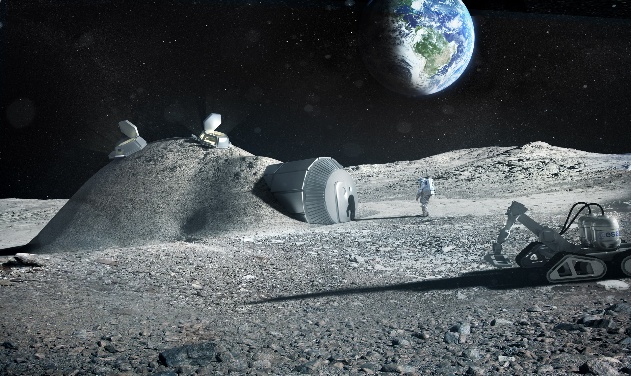
Foster & Partners has revealed its designs for a 3D-printed moon base made from lunar soil.
In 2009 the European Space Agency enlisted the help of the practice, which has devised a weight-bearing ‘cantenary’ dome design with a cellular structured wall to shield against small meteoroids and space radiation.
Inside a pressurised inflatable space would be used to shelter astronauts.
-----
Foster Partners' 3D printed lunar base
Foster & Partners’ Lunar base made with 3D printing

-----
The base’s design was guided by the properties of 3D-printed lunar soil, with a 1.5 tonne building block produced as a demonstration.
“3D printing offers a potential means of facilitating lunar settlement with reduced logistics from Earth,” said Scott Hovland of ESA’s human spaceflight team.
“The new possibilities this work opens up can then be considered by international space agencies as part of the current development of a common exploration strategy.”
snip
----------------------------- 

Foster + Partners
- LRK -

----------------------------- 

31/01/2013

Foster + Partners works with European Space Agency to 3D print structures on the moon

Foster + Partners is part of a consortium set up by the ESA to explore the possibilities of 3D printing to construct lunar habitations. Addressing the challenges of transporting materials to the moon, the study is investigating the use of lunar soil, known as regolith, as building matter.

The practice has designed a lunar base to house four people, which can offer protection from meteorites, gamma radiation and high temperature fluctuations. The base is first unfolded from a tubular module that can be transported by space rocket. An inflatable dome then extends from one end of this cylinder to provide a support structure for construction. Layers of regolith are then built up over the dome by a robot-operated 3D printer to create a protective shell.

To ensure strength while keeping the amount of binding “ink” to a minimum, the shell is made up of a hollow closed cellular structure similar to foam. The geometry of the structure was designed by Foster + Partners in collaboration with consortium partners – it is groundbreaking in demonstrating the potential of 3D printing to create structures that are close to natural biological systems.

Simulated lunar soil has been used to create a 1.5 tonne mockup and 3D printing tests have been undertaken at a smaller scale in a vacuum chamber to echo lunar conditions. The planned site for the base is at the moon’s southern pole, where there is near perpetual sunlight on the horizon.

The consortium includes Italian space engineering firm Alta SpA, working with Pisa-based engineering university Scuola Superiore Sant’Anna. Monolite UK supplied the D-Shape™ printer and developed a European source for lunar regolith stimulant, which has been used for printing all samples and demonstrators.

Xavier De Kestelier, Partner, Foster + Partners Specialist Modelling Group:
“As a practice, we are used to designing for extreme climates on earth and exploiting the environmental benefits of using local, sustainable materials – our lunar habitation follows a similar logic. It has been a fascinating and unique design process, which has been driven by the possibilities inherent in the material. We look forward to working with ESA and our consortium partners on future research projects.”
snip
----------------------------- 

BBC article.
- LRK -

----------------------------- 
1 February 2013
3D printed moon building designs revealed

Architects Fosters and Partners have revealed designs for a building on the Moon that could be constructed from material already on its surface.

An inflatable structure would be transported from Earth, then covered with a shell built by 3D printers.
The printers, operated by robots, would use soil from the Moon, known as regolith, to build the layered cover.
The proposed site for the building is the southern pole of the Moon.
It is designed to house four people and could be extended, the firm said.
In 2010 a team of researchers from Washington State University found that artificial regolith containing silicon, aluminium, calcium, iron and magnesium oxide could be used by 3D printers to create solid objects.
The latest plans are the result of a collaboration between a number of organisations including the European Space Agency.
The consortium tested the practicalities of using a printer on the Moon by setting up a D-shape 3D printer, which are used to print very large house-sized structures, in a vacuum chamber with simulated lunar material.
snip
----------------------------- 

As seen at DEXIGNER.
- LRK -

----------------------------- 
Foster + Partners Works with ESA to 3D Print Structures on the Moon
January 31, 2013

Foster + Partners is part of a consortium set up by the ESA to explore the possibilities of 3D printing to construct lunar habitations. Addressing the challenges of transporting materials to the moon, the study is investigating the use of lunar soil, known as regolith, as building matter.

Read more: Foster + Partners Works with ESA to 3D Print Structures on the Moon - Dexigner http://www.dexigner.com/news/26202#ixzz2Jg578Pjh

snip
----------------------------- 

And at SpaceRef
- LRK -

-----------------------------
Building a Lunar Base with 3D Printing
By Keith Cowling Posted January 31, 2013 1:13 PM

Setting up a lunar base could be made much simpler by using a 3D printer to build it from local materials.

Industrial partners including renowned architects Foster + Partners have joined with ESA to test the feasibility of 3D printing using lunar soil. "Terrestrial 3D printing technology has produced entire structures," said Laurent Pambaguian, heading the project for ESA.

"Our industrial team investigated if it could similarly be employed to build a lunar habitat." Foster + Partners devised a weight-bearing 'catenary' dome design with a cellular structured wall to shield against micrometeoroids and space radiation, incorporating a pressurised inflatable to shelter astronauts. A hollow closed-cell structure - reminiscent of bird bones - provides a good combination of strength and weight.

snip
----------------------------- 

Now we need to find reasons to make the trip worthwhile.  Something more than just, "Been there, done that."
- LRK -
BUILDING A LUNAR BASE WITH 3D PRINTING

Setting up a lunar base could be made much simpler by using a 3D printer to build it from local materials. Industrial partners including renowned architects Foster + Partners have joined with ESA to test the feasibility of 3D printing using lunar soil.
“Terrestrial 3D printing technology has produced entire structures,” said Laurent Pambaguian, heading the project for ESA.
“Our industrial team investigated if it could similarly be employed to build a lunar habitat.”
Foster + Partners devised a weight-bearing ‘catenary’ dome design with a cellular structured wall to shield against micrometeoroids and space radiation, incorporating a pressurised inflatable to shelter astronauts.
A hollow closed-cell structure – reminiscent of bird bones – provides a good combination of strength and weight.
snip
==============================================================
Resupplying lunar outpost

3-D printer makes parts from moon rock


Wednesday, Nov. 28, 2012
By Tina Hilding, College of Engineering and Architecture

PULLMAN, Wash. - Imagine landing on the moon or Mars, putting rocks through a 3-D printer and making something useful – like a needed wrench or replacement part.

"It sounds like science fiction, but now it’s really possible,’’ says Amit Bandyopadhyay, professor in the School of Mechanical and Materials Engineering at Washington State University.


Bandyopadhyay and a group of colleagues recently published a paper in Rapid Prototyping Journal demonstrating how to print parts using materials from the moon.
snip
==============================================================

WHAT THE MIND CAN CONCEIVE, AND BELIEVE, IT WILL ACHIEVE - LRK -

==============================================================

Monday, May 11, 2009

A Lunar Base - "Augustine Report" - Should you worry?

Just received this week's issue of The Space Review, by Jeff Foust.
http://www.thespacereview.com/index.html

I think you should read.
Doesn't give me a warm fuzzy feeling.
More like, "Here we go again, don't talk about putting humans on the Moon."
- LRK -
--------------------------------------------------------------------

Bob Park gets his wish: "It's time for another Augustine Report"
---
Last week the White House announced plans for a new review of NASA's human spaceflight program led by Norm Augustine, who chaired another space policy review nearly 20 years ago. Michael Huang expresses concern that the choice of Augustine as panel chair may lead to conclusions that could put the overall program in jeopardy.
http://www.thespacereview.com/article/1370/1

--------------------------------------------------------------------

During my time at NASA Ames Research Center there were several changes in NASA Administrators and several reorganizations.
For a long time, no talking about going to the Moon with humans, then it became acceptable, and probable.
I feel for those still working at the various NASA Centers and Field Facilities, wondering what is coming next.
http://www.nasa.gov/about/highlights/OrganizationIndex.html

Thanks for looking up with me.

Larry Kellogg

Web Site: http://lkellogg.vttoth.com/LarryRussellKellogg/
BlogSpot: http://kelloggserialreports.blogspot.com/
RSS link: http://kelloggserialreports.blogspot.com/atom.xml
Newsletter: https://news.altair.com/mailman/listinfo/lunar-update
==============================================================
--- Will the new report look like the old one? Should you worry about going to the Moon?
- LRK -
---------------------------------------------------------------------------------------------
http://www.hq.nasa.gov/office/pao/History/augustin.html
Principal Recommendations of the Augustine Commission, 1990
[Editorial Headnote: From the Report of the Advisory Committee on the Future of the U.S. Space Program (Washington, D.C.: U.S. Government Printing Office, December 1990), pp. 47-48. Page numbers of original document in brackets.]


[47] Principal Recommendations

This report offers specific recommendations pertaining to civil space goals and program content as well as suggestions relating to internal NASA management. These are summarized below in four primary groupings. In order to implement fully these recommendations and suggestions, the support of both the Executive Branch and Legislative Branch will be needed, and of NASA itself.


Principal Recommendations Concerning Space Goals

It is recommended that the United States' future civil space program consist of a balanced set of five principal elements:

* a science program, which enjoys highest priority within the civil
space program, and is maintained at or above the current fraction
of the NASA budget (Recommendations 1 and 2);
* a Mission to Planet Earth (MTPE) focusing on environmental
measurements (Recommendation 3);
* a Mission from Planet Earth (MFPE), with the long-term goal of
human exploration of Mars, preceded by a modified Space Station
which emphasizes life-sciences, an exploration base on the moon,
and robotic precursors to Mars (Recommendations 4, 5, 6, and 7);
* a significantly expanded technology development activity, closely
coupled to space mission objectives, with particular attention
devoted to engines + a robust space transportation system
(Recommendation 9).


Principal Recommendations Concerning Programs

With regard to program content, it is recommended that:

* the strategic plan for science currently under consideration be
implemented (Recommendation 2);
* a revitalized technology plan be prepared with strong input from
the mission offices, and that it be funded (Recommendation 8);
* Space Shuttle missions be phased over to a new unmanned
(heavy-lift) launch vehicle except for mission where human
involvement is essential or other critical national needs dictate
(Recommendation 9);
* Space Station Freedom be revamped to emphasize life-sciences and
human space operations, and include microgravity research as
appropriate. It should be reconfigured to reduce cost and
complexity; and the current 90-day time limit on redesign should
be extended if a thorough reassessment is not possible in that
period (Recommendation 6);
* a personnel module be provided, as planned, for emergency return
from Space Station Freedom, and that initial provisions be made
for two-way missions in the event of unavailability of the Space
Shuttle (Recommendation 11).


Principal Recommendations Concerning Affordability

It is recommended that the NASA program be structured in scope so as not to exceed a funding profile containing approximately 10 percent real growth per year throughout the remainder of the decade and then remaining at that level, including but not limited to the following actions:

* redesign and reschedule the Space Station Freedom to reduce cost
and complexity (Recommendation 6);
* defer or eliminate the planned purchase of another orbiter
(Recommendation 10);
* place the Mission from Planet Earth on a "go-as-you-pay" basis,
i.e., tailoring the schedule to match the availability of funds
(Recommendation 5).


Principal Recommendations Concerning Management

With regard to management of the civil space program, it is recommended that:

* an Executive Committee of the Space Council be established which
includes the Administrator of NASA (Recommendation 12);
* major reforms be made in the civil service regulations as they
apply to specialty skills; or, if that is not possible, exemptions
be granted to NASA for at least 10 percent of its employees to
operate under a tailored personnel system; or, as a final [48]
alternative, that NASA begin selectively converting at least some
of its centers into university-affiliated Federally Funded
Research and Development Centers (Recommendations 14 and 15);
* NASA management review the mission of each center to consolidate
and refocus centers of excellence in currently relevant fields
with minimum overlap among centers (Recommendation 13).

It is considered by the Committee that the internal organization of any institution should be the province of, and at the discretion of, those bearing ultimate responsibility for the performance of that institution. . . .

* That the current headquarters structure be revamped,
disestablishing the positions of certain existing Associate
Administrators . . .
* an exceptionally well-qualified independent cost analysis group be
attached to headquarters with ultimate responsibility for all
top-level cost estimating including cost estimates provided
outside of NASA;
* a systems concept and analysis group reporting to the
Administrator of NASA be established as a Federally Funded
Research and Development Center;
* multi-center projects be avoided wherever possible, but when this
is not practical, a strong and independent project office
reporting to headquarters be established near the center having
the principle share of the work for that project; and that this
project office have a systems engineering staff and full budget
authority (ideally industrial funding--i.e., funding allocations
related specifically to end-goals).

In summary, we recommend:

* 1) Establishing the science program as the highest priority
element of the civil space program, to be maintained at or above
the current fraction of the budget.
* 2) Obtaining exclusions for a portion of NASA's employees from
existing civil service rules or, failing that, beginning a gradual
conversion of selected centers to Federally Funded Research and
Development Centers affiliated with universities, using as a model
the Jet Propulsion Laboratory.
* 3) Redesigning the Space Station Freedom to lessen complexity and
reduce cost, taking whatever time may be required to do this
thoroughly and innovatively.
* 4) Pursuing a Mission from Planet Earth as a complement to the
Mission to Planet Earth, with the former having Mars as its very
long-term goal--but relieved of schedule pressures and progressing
according to the availability of funding.
* 5) Reducing our dependence on the Space Shuttle by phasing over to
a new unmanned heavy lift launch vehicle for all but missions
requiring human presence.

The Committee would be pleased to meet again in perhaps six months should the NASA Administrator so desire, in order to assist on the implementation process. In the meantime, NASA may wish to seek the assistance of its regular outside advisory group, the NASA Advisory Council, to provide independent and ongoing advice for implementing these findings.

Each of the recommendations herein is supported unanimously by the members of the Advisory Committee on the Future of the U.S. Space Program.

------------------------------------------------------------------------
/For further information, please contact histinfo@hq.nasa.gov /

snip
==============================================================
http://www.freemars.org/history/augustine/index.html


Advisory Committee on the Future of the U.S. Space Program

Washington, D.C.

December 17, 1990

TO: The Administrator of NASA

Enclosed, in accordance with the schedule established 120 days ago, is the final report of the Committee on the Future of the U.S. Space Program. The Committee members look forward to reporting our findings with you to the Vice President.

The Committee's twelve members represent a broad diversity of backgrounds, comprising in the aggregate several hundred years experience in space activities but also including one member with no specific prior experience in space matters. The Committee includes individuals with backgrounds in industry, academia, the military, and a former NASA administrator; its perspectives include that of scientists, former astronauts, managers, engineers, private citizens, and former members of Congress. The Committee is unanimous in its findings.

The members are grateful to the more than 300 individuals who appeared before the Committee or its working groups as well as to the several hundred persons who wrote provocative, thoughtful letters -- often filling many pages. The Committee also had the opportunity to read or be briefed on over a dozen earlier studies of specific aspects of the civil space program.

The Committee's hearings were held in public session and were carried over satellite television for those interested. The Committee chose to perform its own inquiry and hence had no research staff but was ably supported by a small but excellent administrative staff. The cooperation and openness of the NASA employees with whom we met was superb, including those involved with our visits to all the NASA centers and headquarters.

We conclude that the civil space program is neither as troubled as some would suggest nor nearly as strong as will be needed, given the magnitude of the challenges the program must undertake in the future.

(signed)
Norman R. Augustine
Laurel L. Wilkening
Pete Aldridge
Don Fuqua
Joseph P. Allen
Robert T. Herres
D. James Baker
David T. Kearns
Edward P. Boland
Louis J. Lanzerotti
Daniel J. Fink
Tom Paine


Executive Summary

The United States' civil space program was rather hurriedly formulated some three decades ago on the heels of the successful launch of the Soviet Sputnik. A dozen humans have been placed on the Moon and safely returned to Earth, seven of the other eight planets have been viewed at close range, including the soft landing of two robot spacecraft on Mars, and a variety of significant astronomical and other scientific observations have been accomplished. Closer to Earth, a network of communications satellites has been established, weather and ocean conditions are now monitored and reported as they occur, and the Earth's surface is observed from space to study natural resources and detect sources of pollution.


Problems and Perspectives.

In spite of these virtually unparalleled achievements, the civil space program and its principal agent, the National Aeronautics and Space Administration, are today the subject of considerable criticism. The source of this criticism ranges from concern over technical capability to the complexity of major space projects; from the ability to estimate and control costs to the growth of bureaucracy; and from a perceived lack of an overall space plan to an alleged institutional resistance to new ideas and change. The failure of the Challenger, the recent hydrogen leaks on several Space Shuttle orbiters, the spherical aberration problem encountered with the Hubble Space Telescope, and various launch processing errors such as a work platform left in an engine compartment and discovered during launch preparations, have all heightened this dissatisfaction.

Some of the concern is, in the view of the Committee, deserved and occasionally even self-inflicted. For example, the practice of separately reporting the cost of space missions according to accounting categories (which for bookkeeping purposes allocates launch services to a distinct account) results in confusion as to what is the actual cost of a mission. Yet, in spite of recognized current problems, care must also be taken not to impose potentially disruptive remedies on today's NASA to correct problems that existed in an earlier NASA. The much publicized spherical aberration problem of the Hubble Space Telescope encountered this past year is in fact a consequence of an assembly error left undiscovered in tests conducted a decade ago -- in 1980. The decision to launch the Challenger in cold weather, when the seals between rocket motor segments would be most suspect, took place five years ago and has spurred NASA to many management changes. Since the Challenger accident, NASA has increased the emphasis on safety, and has borne the burden of delaying launches when reasonable questions arose over the readiness to launch safely. On the other hand, processing incidents during launch preparation continue to occur in NASA operations, and to be the cause of justifiable concern.

Because of the intense interest in -- and scrutiny of -- America's commendably open and visible civil space program, it is sometimes easy to overlook the fact that technical problems such as hydrogen leaks, faulty seals and erroneous assembly procedures are not unique to today's space activities, or even to NASA. Although problems of any sort are most emphatically not to be condoned, when comparing today's space program with the successes of the past, it must also be recalled that America's first attempt to launch an Earth satellite using the Vanguard rocket ended in failure. By the end of 1959, 37 satellite launches had been attempted: less than one-third attained orbit. Ten of the first eleven launches of unmanned probes to the Moon to obtain precursor data in support of the Apollo mission failed. Three astronauts were lost in a fire aboard the Apollo capsule during ground testing. A cryogenic storage tank exploded during the mission of Apollo 13 en route to the Moon, seriously damaging the spacecraft. During the few months surrounding the Challenger accident, a Delta, an Atlas-Centaur, two Titan 34-D's, a French Ariane-2 and a Soviet Proton were all lost. Space missions, whether manned or unmanned, are fundamentally difficult and demanding undertakings that depend upon some of the world's most advanced technology. The Saturn V rocket required the integration of some six million components manufactured by thousands of separate contractors. Voyager 2 arrived at Neptune a mere one second behind its final updated schedule after a 12-year, 4.4 billion mile flight, approaching within 3,000 miles of the planet's surface. The information to be gathered by the Earth Observing System could approach 10 trillion bits of information -- about one Library of Congress -- per day. The matter of human frailty is perhaps of even greater import: in the case of the Apollo program, some 400,000 people at some 20,000 locations were involved in its design, test and operation.

snip
-------------
How shall we pay the bills for all of this? First, as already noted, we assume growth in civil space funding for the next decade. We also recommend a redesign of the Space Station, in part, to reduce cost. We would propose diverting funds from the planned additional Space Shuttle orbiter (but not from support hardware needed to assure the Space Shuttle's continued operational viability) to enable construction of the new unmanned heavy lift launch vehicle. We believe that a new unmanned launch vehicle itself can produce substantial savings -- but not in the near term and in the longer term only if we change our processing philosophy and manpower. We recommend configuring the long term manned exploration program, which focuses on Mars but has critical stepping stones along the way in the form of the Space Station and a lunar base, to a schedule that adapts to the availability of funding. And we propose a number of management enhancements that should produce efficiencies and modest attendant cost savings. The most important *ofthis category of improvement, however, is not fully within NASA's wherewithal to implement -- namely, the provision of predictable and stable funding. This will require the support of other parts of the Administration and the Congress. The essential role of this support cannot be overemphasized *ifthe U.S. is to have a successful civil space program.
snip
-------------

Do you live in Minnesota?
- LRK -
[http://www.freemars.org/]
==============================================================
http://www.spacepolitics.com/2009/05/06/that-long-awaited-constellation-review/
Space Politics.Beltway…

That long-awaited Constellation review
May 6, 2009 at 4:37 am ·

It appears that a review of NASA’s Constellation program that had been anticipated by many for weeks, if not months, will finally be moving forward. The Orlando Sentinel reported yesterday afternoon that the White house will officially order that review later this week, perhaps when the detailed NASA budget request for FY2010 is released on Thursday. The review could start later this month and be done in 60 to 90 days. According to Florida Today, the likely chair of the review panel will be Norm Augustine, former chairman and CEO of Lockheed Martin (and neither Lori Garver nor Pete Worden, contrary to previous reports). The White House declined to comment on the upcoming review, telling Florida Today only that “the administration believes it is extremely important to ensure that the nation is on a vigorous and sustainable path to achieving its boldest aspirations in space.”

Such a review would not seem to bode well for the Ares 1 in particular, but at least one supporter remained confident about its prospects despite the impending review. “The Ares 1 and 5 vehicles have been through several studies and reviews and I am confident that any additional study will show that the Ares program is our best option to take our astronauts safely to the space station and beyond,” Congressman Parker Griffith (D-AL) told the Huntsville Times.

[A lot of comments if you care to read. - LRK -]

==============================================================

WHAT THE MIND CAN CONCEIVE, AND BELIEVE, IT WILL ACHIEVE - LRK

==============================================================

Thursday, April 30, 2009

Moon Base - Moon Outpost - or will it be just a tent under the stars?

Administrations change, rumors fly, money is tight, budget for next year not yet published, who knows which way the wind blows?
- LRK -

The International Space Station was going to be big, it was going to be small, it almost didn't happen at all.
Now we have been told we are going back to the Moon and those on the ground are beating each other with their favorite proposal.
Or they are saying my proposal, not yours, I didn't even want to go there, go here.
- LRK -

I hope someone will go to the Moon, dig into some regolith, and open up a Real Estate Office.
[Or go up and see if they can claim the lunar plot they already bought.]
[ http://www.lunarlandowner.com/lunar_city_project.htm ]
- LRK -
---------------------------------------------------------------------------
http://www.newscientist.com/article/dn17052-nasa-may-abandon-plans-for-moon-base.html
NASA may abandon plans for moon base
* 18:33 29 April 2009 by David Shiga
NASA will probably not build an outpost on the moon as originally planned, the agency's acting administrator, Chris Scolese, told lawmakers on Wednesday. His comments also hinted that the agency is open to putting more emphasis on human missions to destinations like Mars or a near-Earth asteroid.

NASA has been working towards returning astronauts to the moon by 2020 and building a permanent base there. But some space analysts and advocacy groups like the Planetary Society have urged the agency to cancel plans for a permanent moon base, carry out shorter moon missions instead, and focus on getting astronauts to Mars.
snip
---------------------------------------------------------------------------
- Chris Scolese Written Statement
http://www.nasa.gov/pdf/338546main_NASA_Testimony.pdf

- Chris Scolese Oral Statement
http://www.nasa.gov/pdf/338547main_Oral_Statement.pdf

There was a time when no one could beat the 4 minute mile, but then the record was broken and now others have too.
No one had done a quad spin in ice skating but now it is expected.

I hope we show that a private commercial firm can go to the Moon.
Maybe if the government only has enough money for a pup tent, the ground will at least be prepared.
Send in the tourist, make a Disney movie, hold the Olympics on the Moon, turn a profit.

If any of you have already purchased your lunar lot with a view, demand access rights.
When does the next shuttle flight leave for the Moon?

Thanks for looking up with me.

Larry Kellogg

Web Site: http://lkellogg.vttoth.com/LarryRussellKellogg/
BlogSpot: http://kelloggserialreports.blogspot.com/
RSS link: http://kelloggserialreports.blogspot.com/atom.xml
Newsletter: https://news.altair.com/mailman/listinfo/lunar-update
==============================================================
http://lunarnetworks.blogspot.com/2009/04/moon-base-not-abandoned.html
LUNAR NETWORKS - blog by Joel Raupe
LUNAR PIONEER, LLP

Reports following testimony Wednesday, April 29, from NASA acting administrator Chris Scolese saying "NASA may abandon plans for moon base " are incorrect.

Congress and the President might one day, even soon, decide to abandon the long-term national goal of setting up a manned station on the Moon, but such a change in policy did not happen, nor was it remotely hinted at, today.

Nothing in Soclese's testimony before a U.S. House committee was inconsistent with present law or NASA policy.

snip
==============================================================
--- A lot of comments on NASA WATCH about the New Scientist article. - LRK -

http://www.nasawatch.com/archives/2009/04/a_shift_in_poli.html
A Shift in Policy? Moon Base Axed?
NASA may abandon plans for moon base, New Scientist

"NASA will probably not build an outpost on the moon
as originally planned, the agency's acting administrator, Chris Scolese, told lawmakers on Wednesday. His comments also hinted that the agency is open to putting more emphasis on human missions to destinations like Mars or a near-Earth asteroid."

"Under Scolese's predecessor, Mike Griffin, the agency held firm to its moon base plans. But the comments by Scolese, who will lead NASA until President Barack Obama nominates the next administrator, suggest a shift in the agency's direction. He spoke to the Subcommittee on Commerce, Justice, Science, and Related Agencies of the House Committee on Appropriations."

Editor's note: According to the New Scientist both Chris Scolese and Doug Cooke were vague on certain answers. If a shift is coming we'll have more details on May 6 when the 2010 budget is due.

Editor's Update: While I don't have Scolese's testimony at this time Rob Coppinger was Twittering the testimony. Here are the tweets with respect to a question on what impact the FY2010 budget would have on moon planning:
"- We are still looking at what we mean by Moon, is that an outpost that is very expensive or is it an Apollo

- Return to the Moon could just be extended sorties

- Scolese says return to Moon could be less than an outpost"

And here is the opening statement by Chairmain Alan B. Mollohan
- Opening Statement of Chairman Alan B. Mollohan
http://images.spaceref.com/news/2009/CJS-FY10-04-29-09.pdf

Editor's Update: Here's the testimony by Chris Scolese:
- Chris Scolese Written Statement
http://www.nasa.gov/pdf/338546main_NASA_Testimony.pdf

- Chris Scolese Oral Statement
http://www.nasa.gov/pdf/338547main_Oral_Statement.pdf

snip
==============================================================
--- Not only the USA having money problems and questions has how to proceed. - LRK -

http://www.spaceflightnow.com/news/n0904/25russia/
Russian lunar and Mars missions face delays
BY CRAIG COVAULT
SPACEFLIGHT NOW
Posted: April 25, 2009

The planned revival by Russia of its once mighty lunar and planetary robotic exploration program is beginning to falter due to Russian budget and spacecraft problems.

The difficulties are threatening to delay Russia's first mission to the Moon in 33 years. A Russian roundtrip mission to the Martian moon Phobos is also in trouble.

The former Soviet Union, which launched dozens of successful deep-space probes in the 1960s-1980s, has not flown a fully successful planetary mission of any kind since the 1984 Vega 2 Halley's Comet/Venus mission. And it has launched no successful missions to the Moon or Mars in 33 years.

In an effort to revive the Russian lunar program, the unique Russian "Lunar Glob" orbiter is to fire instrumented Russian penetrators into the Apollo 11 and Apollo 12 landing sites explored by U.S. astronauts nearly 40 years ago.

The Russian mission, equipped with several surface penetrators and perhaps a small soft lander, is set for launch in 2012.

But that plan is going to be reviewed extensively in May and June by the Russian government and its contractor Lavochkin.

snip
==============================================================
--- Maybe the civilian community will go. - LRK -

http://www.space.com/businesstechnology/090428-tw-glxp-astrobotic.html
*Private Moon Rover Aims for Apollo 11 Landing Site *
*By Jeremy Hsu *
Staff Writer
posted: 29 April 2009
09:26 am ET

/Nearly 40 years after Americans first set foot on the moon on July 20, 1969 with NASA's historic Apollo 11 flight, a host of private rocketeers are hoping to follow to win a $30 million prize. Here, SPACE.com looks at Astrobotic, one of 17 teams competing in the Google Lunar X Prize:/

If there's one name that's on the lips of many Google Lunar X Prize competitors, it's Astrobotic. The team boasts a name that readily conveys its ambitious aspirations for reaching the moon and beyond.

"Astrobotic Technology is going to do a series of missions for scouting, prospecting, mining, and all sorts of things that robots can do to get ready for the human return to the moon ," said David Gump, President of Astrobotic.

Winning the Google Lunar X Prize requires teams to land a robot on the moon, move at least 1,640 feet (500 meters) and beam high definition views back to Earth.

The team plans for a pinpoint landing just over a mile from the Apollo 11 site, where Neil Armstrong became the first man to walk on the moon. Astrobotic's "Red Rover" would then beam back high-definition images of the dusty footprints left by Armstrong and fellow Apollo astronaut Buzz Aldrin, all while taking care not to disturb the historical site.

That rover takes its name from team expert Red Whittaker, a famed Carnegie Mellon University roboticist who led his team to victory in the 2007 DARPA Grand Challenge.

*Founding a frontier *

Astrobotic also gained serious financial muscle by partnering with Raytheon Company — a leading aerospace and defense corporation — to help establish itself as a long-term player in the race back to the moon and beyond. Carnegie Mellon University and Arizona State's Lunar and Planetary Institute have similarly signed on.

"Unlike during the Apollo era, it's clear to many people that the future of the lunar frontier will be a mixed colony of humans and robots simultaneously," Gump explained. "Our goal is to be a company to which you can outsource things. You want to scout a landing site ahead of time, you hire us. You want to get a soil sample before sending your mining machines, you hire us. You need some electrical power supply, we'd have a service."

Potential clients could include nations that would hire one or more Astrobotic rovers to gather rocks and soil, as part of a prestige sample return mission. The team has already lined up at least one private client in Celestis, which announced plans to hire both Astrobotic and fellow competitor Odyssey Moon to fly cremated human remains to the moon.

snip
==============================================================

WHAT THE MIND CAN CONCEIVE, AND BELIEVE, IT WILL ACHIEVE - LRK

==============================================================

Wednesday, April 08, 2009

Lunar Base Construction Robots - Will they be intelligent?

Folks have been thinking about this for some time.
How close to the science fiction stories do you think they will get?
- LRK -

---------------------------------------------------------
http://www.spacedaily.com/spacenet/text/lunar-b.html
Japan Space Net
Talk About Lunar Base Getting Serious

Once simply the fodder for science-fiction stories, building a base on the moon is now being looked at in earnest by Japan.

Tokyo -- December 19,1996 -- Recently some 170 of the world's top space scientists, engineers and mission specialists attending the Second International Lunar Workshop in Kyoto, debating not only an extensive scientific re-exploration of the lunar landscape, but the setting up of a permanent manned presence within thirty years.

Speaker after speaker talked of the scientific and technical benefits to be accrued from exploring the moon. Some pointed to the huge tasks ahead developing critical technology needed even to get there again. But while the problem of raising finance was conveniently skipped during the five day confab, one topic dominated discussions; how to build a lunar base.

snip
---------------------------------------------------------

Nine years later, still a topic of interest.
- LRK -
___________________________________________
http://www.pcworld.com/article/121442/japan_dreams_of_robot_moon_base_in_2025.html
Japan Dreams of Robot Moon Base in 2025
Advanced humanoid robots could take over mining, telescope-building chores for humans.
Paul Kallender, IDG News Service
Jun 20, 2005 1:00 am

TOKYO -- Japan wants to help build a lunar base and populate it with advanced versions of today's humanoid robots by around 2025, according to the head of the nation's space agency.

The idea is more than a pipe-dream; it is part of a 20-year plan, called JAXA Vision 2025, that was drawn up by Keiji Tachikawa, a former president of Japan's largest mobile operator NTT DoCoMo, who is now president of the Japan Aerospace Exploration Agency(JAXA).

As part of the plan, Japan would use advanced robotic technologies to help build the moon base, while redeveloped versions of today's humanoid robots, such as Honda Motor's Asimo and Sony's Qrio, could work in the moon's inhospitable environment in place of astronauts, he said in a recent interview.

Japan's lunar robots would do work such as building telescopes and prospecting and mining for minerals, Tachikawa said.
"I see a big role for Japan's robotics technologies on the moon," he said. "Japanese robots will be one of our big contributions. If there is work where robots can replace humans, they will."

U.S. Also Interested
Tachikawa's plan follows a January 2004 decision by U.S. President George W. Bush that the U.S., with the assistance of partners including Japan, should build a lunar base by about 2020 and use it as a staging point for the human exploration of Mars.
The plan has struck a chord in Japan, which has long harbored dreams of building such a base

snip
---------------------------------------------------------

and now four years later again, robots to go to the Moon.
What kind of robots would colonize the Moon?
- LRK -
---------------------------------------------------------
http://www.timesonline.co.uk/tol/news/tech_and_web/gadgets_and_gaming/article6032128.ece
From The Times
April 4, 2009
One step for a robot, a giant leap for tin-mankind
Leo Lewis in Tokyo
The cutting-edge models can lumber around a room without falling over. A few can play the trumpet or serve tea. The truly sophisticated ones can just about manage the washing-up.
But by 2020, Japan predicts, humanoid robots will be ready to colonise the Moon. Other metallic brethren of these mechanical pioneers, said scientists in Tokyo, will be engaged in the bigger, more prosaic mission of cleaning Earth’s orbit of junk.
---------------------------------------------------------

If we think that a robot might be intelligent, what would that mean?
When you hear the word "Robot" what image does that bring up:
- LRK -
---------------------------------------------------------
http://ti.arc.nasa.gov/groups/intelligent-robotics/
Intelligent Robotics

The NASA Ames Intelligent Robotics Group (IRG) is dedicated to enabling humans and robots to explore and learn about extreme environments, remote locations, and uncharted worlds. IRG conducts applied research in a wide range of areas with an emphasis on robotics systems science and field testing. IRG's expertise includes applied computer vision (navigation, 3D surface modeling, automated science support), human-robot interaction, mobile manipulation, interactive 3D visualization, and robot software architecture.

IRG maintains and operates a variety of robot hardware, including fifteen "Personal Exploration Rovers" (low-cost, educational mobile robots), the K9 planetary rover (based on a JPL FIDO chassis), four K10 planetary rovers, and dexterous manipulators (Amtec Schunk arms and Barrett grippers). IRG's research facilities include the Marscape (3,000 sq. meter outdoor rover test facility and Mars surface analog) and the Moonscape (250 sq. meter indoor rover test facility with high-precision optical tracking).

We firmly believe that collaboration is an essential part of modern research, which improves quality and speeds technology transfer. Thus, we are presently working on joint projects with partners from academia, government, and industry.

snip
---------------------------------------------------------

or do you just want to get some job done and a colony of robots much like an ant colony would be enough?
- LRK -

---------------------------------------------------------
http://www.journal.univagora.ro/download/pdf/261.pdf
Int. J. of Computers, Communications & Control, ISSN 1841-9836, E-ISSN 1841-9844
Vol. III (2008), Suppl. issue: Proceedings of ICCCC 2008, pp. 92-107
Colony of robots: New Challenge
Workshop invited key lecture
Gastón Lefranc

Abstract: The evolution on Robotics has in a cross way of application. For one side is
the applications to manufacturing, other one is application to medicine, another one in space
exploration and it is starting home applications. It is very popular to have contest of robots
for students, motivating very well to student, supported by universities, achieving good image
for the institutions.
One way for mobile robots is Nomad, a nice application for having new knowledge in the
space, but the inversion it is very expense and complex. If it has problem or fail, all the work
will stop. Instead of that, if you use a community of robots, working like a society of insect, it
is possible to have simpler mobile robots to have specific tasks, less expensive, more reliable
to reach the same aims.
In this presentation is focusing in colony of robots. This implies to merge several disciplines
based on models of communities, to have control of a society of robots working together in a
collaborative and cooperative way in non structured environments.
Keywords: Multi-robots, Colony of robots, Multiagents Systems

snip
---------------------------------------------------------

If you think your robot should be intelligent, would you mean that it should have the ability to acquire and use knowledge?

And by knowledge, you mean that it should be able to organize information?
Would you want it to be able to communicate, that is transfer its knowledge?
Should it have intuition, that is built in knowledge.

How would it acquire knowledge?
Have feelings, that is experience sensory input.
Should it have perception, the ability to transform sensations into knowledge?

What about being able to reason, applying logic to thinking.
Oh, should it be able to think, analyze what it imagined.
Aaah, have imagination, that is be able to visualize, model and devise simulations.

And lets be scarry, should it be aware, that is have knowledge of the world (Moon) situation.
Should it show emotion, that is have value judgment, evaluation of good and bad.
Lastly, throw in some consciousness, the ability to include self in the world model.

---------------------------------------------------------
http://www.james-albus.org/interest.htm
snip
A PowerPoint presentation of the potential impact of intelligent machines on science, economics, military strength, and human well being can be found here:
http://www.james-albus.org/Engineering%20of%20Mind3.ppt [116 KB, 22 slides - LRK -]
snip
---------------------------------------------------------
http://www.amazon.com/Engineering-Mind-Introduction-Science-Intelligent/dp/0471438545
Engineering of Mind: An Introduction to the Science of Intelligent Systems (Hardcover)
Presenting a reference model architecture for the design of intelligent systems
Engineering of Mind presents the foundations for a computational theory of intelligence. It discusses the main streams of investigation that will eventually converge in a scientific theory of mind and proposes an avenue of research that might best lead to the development of truly intelligent systems.
snip
---------------------------------------------------------

Will be interesting to see just what kind of robots go to the Moon.
- LRK -

Some added links below from 1990 until 2009.
What kind of robot would you like to have helping you colonize the Moon?

Thanks for looking up with me.

Larry Kellogg

Web Site: http://lkellogg.vttoth.com/LarryRussellKellogg/
BlogSpot: http://kelloggserialreports.blogspot.com/
RSS link: http://kelloggserialreports.blogspot.com/atom.xml
Newsletter: https://news.altair.com/mailman/listinfo/lunar-update
==============================================================
*http://tinyurl.com/ckess3
*

*Lunar base construction robots*
Brooks, R.A.; Maes, P.; Mataric, M.J.; More, G.
Intelligent Robots and Systems apos;90. apos;Towards a New Frontier of Applicationsapos;, Proceedings. IROS apos;90. IEEE International Workshop on
Volume , Issue , 3-6 Jul 1990 Page(s):389 - 392 vol.1
Digital Object Identifier 10.1109/IROS.1990.262415
*Summary:*President Bush called for the construction of a permanently manned lunar base. All serious plans for such a base require the use of lunar soil as shielding material against the Sun's radiation. Plans rely on the use of a large bulldozer-like vehicle to be driven by an astronaut, either locally or under teleoperation control. Brooks and Flynn (89) proposed an alternate approach to a single large and complex robot based on many small totally autonomous robots which trade off time to achieve the task with lowered complexity and cost of the system. In this paper the authors describe an experimental system they are building with 20 small bulldozers, which work without explicit coordination or communication, but nevertheless cooperate to achieve tasks that will be useful in building a manned lunar base. In particular the authors believe such tasks as digging out trenches in which the habitation units will be placed, stockpiling a supply of loose lunar soil to cover the habitation units, and actually covering them when delivered, can all be carried out by such small bulldozers

» View citation and abstract

==============================================================

http://www.cosis.net/abstracts/EGU05/10554/EGU05-J-10554.pdf
Robotic evolution for the Human Lunar Base

Geophysical Research Abstracts, Vol. 7, 10554, 2005
SRef-ID: 1607-7962/gra/EGU05-A-10554
© European Geosciences Union 2005

K. Matsumoto, S. Wakabayashi, T. Hoshino, K. Matsumoto
ISTA/JAXA (matumoto@chofu.jaxa.jp / 81-422-40-3146)

The human lunar base and human lunar exploration is going to be the next world wide
space exploration target, after 30 years absence. In these 30 years, many technologies
have been drastically advanced, especially in the robotics, computers, artificial
intelligence, communications, and so on.

In consideration of the too severe lunar environment, such as the night temperature,
space radiation, and so on, before the human base, the full utilization of those robotic
technologies will be implemented and developed to support and build the safe, reliable,
and affordable human lunar base.

In this presentation, we will discuss and propose the stepwise evolution scenario to
the safe human lunar base, from the view points of robotic technologies. These steps
will start with the international robotic village by the virtual collaboration, as the first
step, and will reach the international human lunar base with many assistant and support
robot systems as the lunar base infrastructure. Those robot systems will be large
scale construction robot for the lunar base assembly, geological sample assembly robot
for in-site resource utilization, maintenance and repair robot of the lunar base itself,
assembly and maintenance of the scientific equipments with delicate fingers or end
effectors, and so on. These lunar base robots will be the next generation space robots
after the ISS space robots and rover robots on the Mars.

snip
==============================================================
http://www.ri.cmu.edu/publication_view.html?pub_id=5672
Crew/Robot Coordinated Planetary EVA Operations at a Lunar Base Analog Site

M. Diftler, R. Ambrose, W. Bluethmann, F. Delgado, E. Herrera, J. Kosmo, B. Janoiko, B. Wilcox, J. Townsend, J. Matthews, Terrence W. Fong, M. Bualat, S. Y. Lee, John Dorsey, and W. Doggett

38th Lunar and Planetary Science Conference, March, 2007.

Download
* Adobe portable document format (pdf) (626KB)
http://www.ri.cmu.edu/pub_files/pub4/diftler_m_2007_1/diftler_m_2007_1.pdf

Copyright notice: This material is presented to ensure timely dissemination of scholarly and technical work. Copyright and all rights therein are retained by authors or by other copyright holders. All persons copying this information are expected to adhere to the terms and constraints invoked by each author's copyright. These works may not be reposted without the explicit permission of the copyright holder.

Abstract
Under the direction of NASA's Exploration Technology Development Program, robots and space suited subjects from several NASA centers recently completed a very successful demonstration of coordinated activities indicative of base camp operations on the lunar surface. For these activities, NASA chose a site near Meteor Crater, Arizona close to where Apollo Astronauts previously trained. The main scenario demonstrated crew returning from a planetary EVA (extra-vehicular activity) to a temporary base camp and entering a pressurized rover compartment while robots performed tasks in preparation for the next EVA. Scenario tasks included: rover operations under direct human control and autonomous modes, crew ingress and egress activities, autonomous robotic payload removal and stowage operations under both local control and remote control from Houston, and autonomous robotic navigation and inspection. In addition to the main scenario, participants had an opportunity to explore additional robotic operations: hill climbing, maneuvering heaving loads, gathering geological samples, drilling, and tether operations. In this analog environment, the suited subjects and robots experienced high levels of dust, rough terrain, and harsh lighting.

Notes
Text Reference
M. Diftler, R. Ambrose, W. Bluethmann, F. Delgado, E. Herrera, J. Kosmo, B. Janoiko, B. Wilcox, J. Townsend, J. Matthews, Terrence W. Fong, M. Bualat, S. Y. Lee, John Dorsey, and W. Doggett, "Crew/Robot Coordinated Planetary EVA Operations at a Lunar Base Analog Site," 38th Lunar and Planetary Science Conference, March, 2007.
snip

- LRK -
Participants: Two suited subjects, four robots and a pressurized rover compartment participated in the demonstration. The Johnson Space Center provided the two space suits and the suit subjects, the two person SCOUT (Science Crew Operations and Utility Testbed) rover, and the dexterous humanoid Centaur robot. The K-10 robot from the Ames Research Center performed inspection activities and the Jet Propulsion Laboratory ATHLETE (All-Terrain Hex-Limbed Extra-Terrestrial Explorer) robot maneuvered and supported a pressurized rover compartment provided by the Langley Research Center.

snip
==============================================================
http://www.sciencedaily.com/releases/2008/06/080614180350.htm
ScienceDaily (June 16, 2008) — Conditions on the moon will be harsher, but prototype NASA robotic vehicles braved sand storms and unprecedented temperature swings this month on sand dunes near Moses Lake, Wash., to prepare for future lunar expeditions. Teams from seven NASA centers and several universities conducted the tests from June 2-13.

"The goal was to gain hands-on experience with specific technical challenges anticipated when humans return to the moon by 2020, begin to explore the lunar surface, and set up outposts," said Test Director Bill Bluethmann of NASA's Johnson Space Center in Houston.

NASA's Human Robotic Systems Project, part of the agency's Exploration Technology Development Program, focused on human and robotic mobility systems for the moon, but also looked at communication and command and control systems that will connect the explorers with Earth and each other. The Moses Lake dunes provided a wide variety of soil consistencies and terrain that allowed the team to put prototype scout robots, rovers, cargo carriers, cranes and spacesuits through tests in a harsh and changing environment.

snip
==============================================================
http://www.sciencedaily.com/releases/2009/02/090225132353.htm
Small Robots Can Prepare Lunar Surface For NASA Outpost

ScienceDaily (Mar. 2, 2009) — Small robots the size of riding mowers could prepare a safe landing site for NASA’s Moon outpost, according to a NASA-sponsored study prepared by Astrobotic Technology Inc. with technical assistance from Carnegie Mellon University’s Robotics Institute.

Astrobotic Technology and Carnegie Mellon researchers analyzed mission requirements and developed the design for an innovative new type of small lunar robot under contract from NASA’s Lunar Surface Systems group.

The results will be presented February 27 in Washington, D.C., at a NASA Lunar Surface Systems conference co-sponsored by the U.S. Chamber of Commerce and its Space Enterprise Council.

“NASA faces a challenge in planning the layout for its outpost, which is expected to begin operations in 2020,” said William “Red” Whittaker, chairman and chief technical officer of Astrobotic and a Carnegie Mellon professor of robotics. “For efficient cargo transfer, the landing site needs to be close to the outpost’s crew quarters and laboratories. Each rocket landing and takeoff, however, will accelerate lunar grit outwards from the pad. With no atmosphere to slow it down, the dry soil would sandblast the outpost.”

snip
==============================================================

WHAT THE MIND CAN CONCEIVE, AND BELIEVE, IT WILL ACHIEVE - LRK

==============================================================